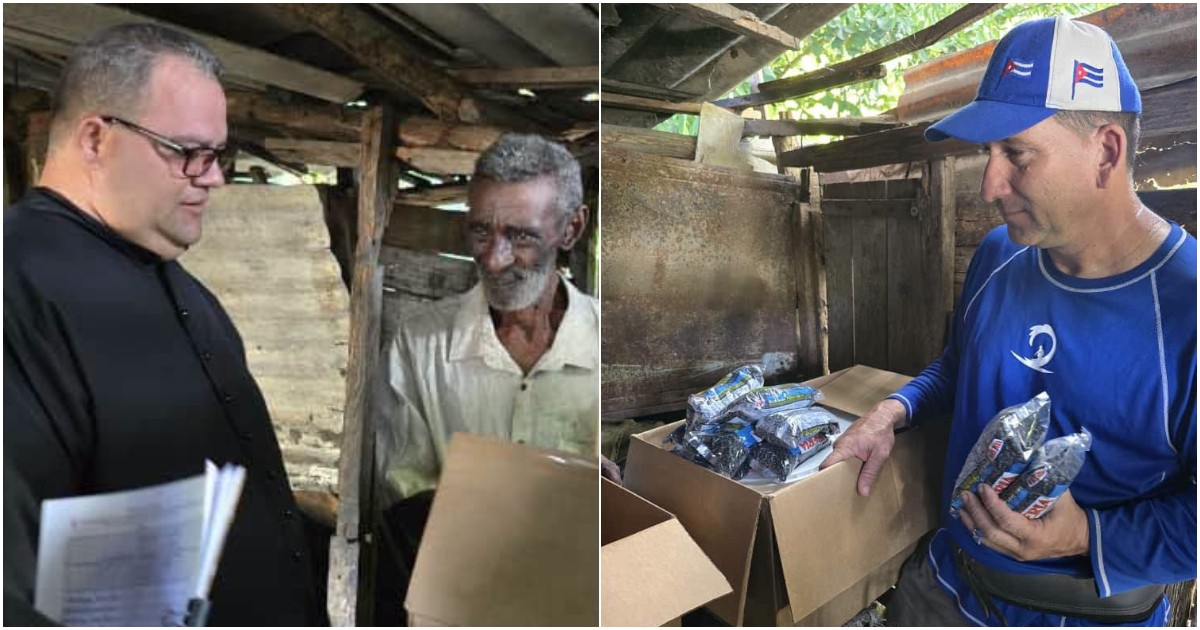
Recent posts and photographs shared by Caritas Santa Clara on social media directly contradict the narrative pushed by Cuban government-linked profiles. These official accounts had previously claimed that humanitarian shipments from the United States contained allegedly contaminated bean packages.
According to Caritas Santa Clara's official statement, families in the Sevilla community, located in Quemado de Güines, received "hygiene and food packages in perfect condition" last Saturday.
The distribution took place in Sevilla, a settlement about two kilometers south of Quemado de Güines in Villa Clara province. Families had been pre-selected by volunteers from La Purísima Concepción parish, and images released by the Santa Clara Diocese depicted beneficiaries receiving the boxes—complete with U.S. flags on the labels—inside their homes.
Community Involvement in Aid Distribution
A noteworthy aspect of this distribution effort was highlighted: "This distribution was unique as it involved young people from Quemado de Güines who do not attend church but chose to participate in this charitable work, alongside Caritas members."
In total, 42 aid packages were distributed throughout the municipality, as stated by Marlene Betancourt, a Caritas volunteer involved in the effort.
Countering Discredit Campaigns
Betancourt's account, also shared by the Diocese, paints a picture that starkly contrasts attempts to undermine the aid: "The delivery of 42 aid modules from the American people was a painful reminder of the surrounding poverty. Witnessing the suffering of those with nothing material was heart-wrenching."
She also captured moments illustrating the beneficiaries' dire needs: "I saw the joy in a grandmother's eyes over a simple lamp, reminding me of the value of small things."
This distribution effort in Quemado de Güines coincided with a smear campaign against U.S. diplomat Mike Hammer, documented this Sunday as he visited Villa Clara. Official propaganda profiles circulated images online, alleging "beans with worms" linked to the U.S. shipment, yet provided no proof that the photographed items were part of the aid.
Logistics of the Humanitarian Shipment
The shipment to Villa Clara—its first for the province—arrived at Santa Clara's Abel Santamaría Airport in mid-September, comprising 700 food modules and 700 hygiene kits. The reception was overseen by the Santa Clara Diocese, with participation from Monsignor Arturo González Amador and Vanesa Hernández Toledo of Caritas Santa Clara. Supplies were stored at La Purísima Concepción Church in Quemado de Güines, with distribution beginning Saturday, coordinated by Caritas Santa Clara and parish priest Andy Acosta.
Beneficiaries were prioritized based on vulnerability: isolated elderly individuals, pregnant or nursing women, people with disabilities, and families with young children. Items distributed included rice, beans, sugar, oil, sardines, and tuna, along with hygiene products and rechargeable lamps.
This aid is part of a $100 million humanitarian assistance program announced by Secretary of State Marco Rubio, with $60 million channeled through the Catholic Church (including Catholic Relief Services and Caritas Cuba) and $40 million through independent NGOs, aiming to deliver resources directly to citizens without regime control.
"Yet amid such adversity, I found hope: the generous spirit of neighbors who, despite their own hardships, rejoiced in the temporary relief others would receive," Betancourt concluded, her testimony ending with a plea for "the sensitivity and strength needed for the days ahead."
Understanding the Impact of U.S. Aid in Cuba
What was the condition of the aid received by families in Villa Clara?
The aid delivered to families in Villa Clara was in perfect condition, as confirmed by Caritas Santa Clara.
Who participated in the distribution of the aid?
The distribution involved young people from Quemado de Güines who do not normally attend church, alongside members of Caritas.
What types of items were included in the aid packages?
The aid packages included food such as rice, beans, sugar, oil, sardines, and tuna, as well as hygiene products and rechargeable lamps.
What is the purpose of the U.S. humanitarian assistance program?
The program aims to provide direct aid to Cuban citizens without the regime's interference, enhancing access to much-needed resources.