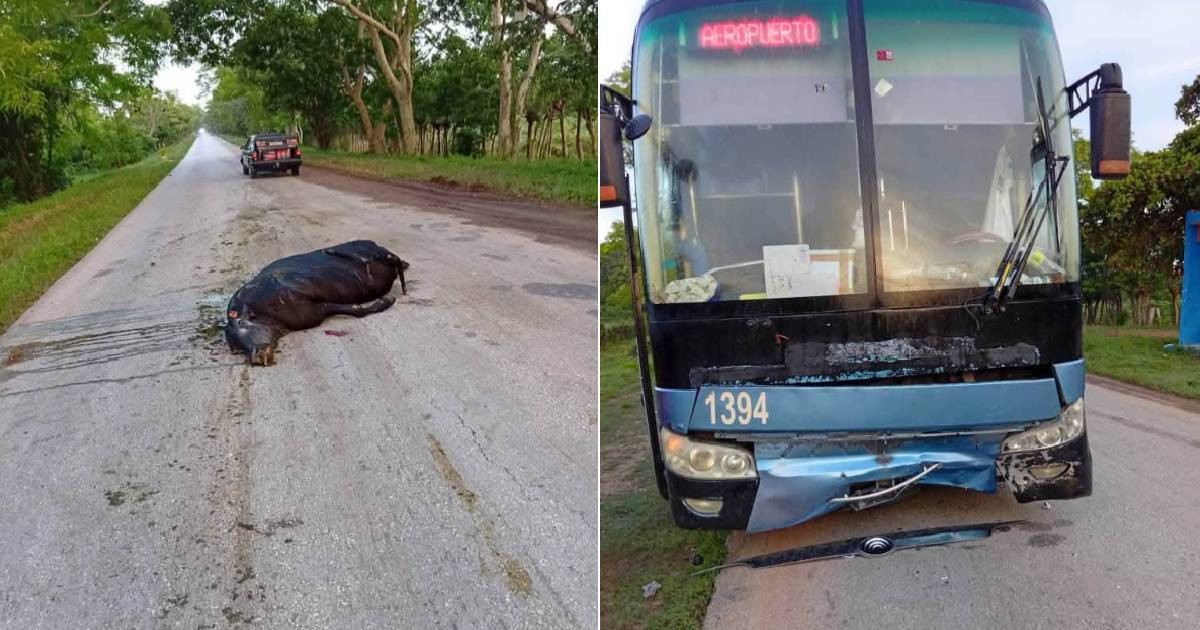
In the early hours of Thursday, a bus operated by the Empresa de Ómnibus Nacionales sustained significant front-end damage after colliding with a cow on a stretch of the Central Highway near Ciego de Ávila.
The incident was shared on Sunday in the Facebook group "Las Guaguas Cubanas y el Transporte en Cuba," where the post garnered over 200 reactions and numerous comments.
Photos reveal that unit 1394, identified by several users as being from the Holguín base, suffered a dented front bumper, detached parts, and visible damage to the front bodywork.
According to an account from a user in the comments, the cow was initially struck by a car whose driver failed to stop, ultimately propelling the animal into the bus. This account has not been independently verified.
The same user praised the bus driver's maneuver to prevent more severe consequences and expressed concern over the negligence of animal owners who allow livestock to wander freely on the roads.
Debate Over Responsibility
The discussion quickly turned to the accountability of livestock owners. "What a disaster, all because of irresponsible people who don't properly secure their fences and animals," one commenter noted.
Another user, claiming to be a driver, remarked that cows on the roads have caused accidents before and questioned why their owners don't face harsher penalties.
"It's like those cows own the roads, causing many accidents, yet there have been no severe penalties for the owners," they wrote.
Several participants also demanded that the cow's owner should bear the costs resulting from the accident. "They should charge the cow's owner for the damages to the bus and all related costs, but nothing happens, and it all stays the same," lamented another commenter.
The Scope of the Issue
Another user highlighted the extent of the problem in the area, pointing out that "there are many animals on that highway."
Although no human casualties occurred in this incident, the comments underscored broader concerns beyond the bus's damages, focusing on the hazard posed by free-roaming cattle to those traveling on Cuban roads.
Loose animals on the roads resulted in fines exceeding 2.2 million pesos in just the first half of 2025, according to Ministry of Agriculture data. They reported 106 loose animals and issued around 210 fines during that period, with Camagüey, Santiago de Cuba, and Mayabeque being the most affected provinces.
In July 2024, a bus struck a cow on the Santa Clara highway, and in March 2023, a free-roaming animal caused an accident in Villa Clara, leading to hospitalized passengers.
The Decree Law 60 on Animal Registration and Control imposes penalties on negligent owners, yet its enforcement has proven inadequate in curbing these accidents.
Nationally, traffic accidents claimed 750 lives during 2025, a figure higher than the 634 fatalities recorded the previous year, indicating that current measures have not successfully reversed the trend.
Understanding Traffic Accidents in Cuba
What caused the bus accident near Ciego de Ávila?
The bus collided with a cow that had been previously hit by a car, propelling it into the path of the bus.
Are there penalties for livestock owners in Cuba?
Yes, the Decree Law 60 mandates penalties for negligent animal owners, but enforcement has been insufficient to prevent accidents.
How prevalent are traffic accidents involving animals in Cuba?
Incidents involving animals are relatively common, with fines for loose animals exceeding 2.2 million pesos in just the first half of 2025.