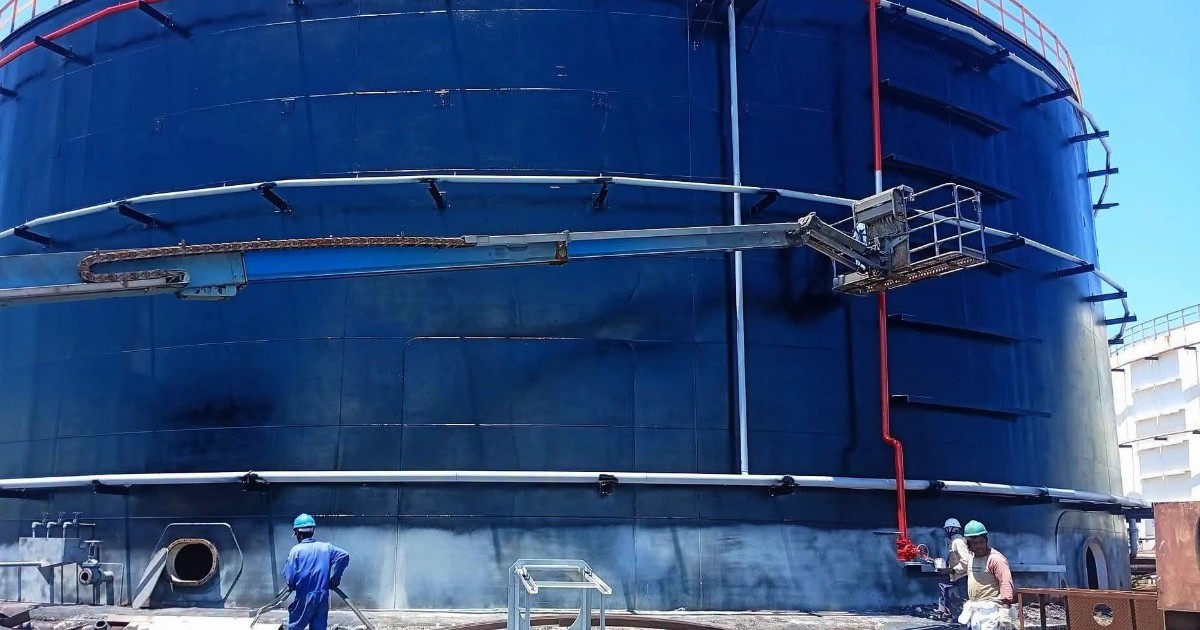
The Ministry of Energy and Mines (MINEM) along with the state-run company CUPET have countered a report from Friday by the official Matanzas newspaper, Girón, which claimed an incident involving a fire at a tank within the Supertanker Base of Matanzas during maintenance work.
According to Girón, "an accident occurred causing a fire that was controlled by the Fire Department and other cooperating entities from the Ministry of the Interior and additional agencies," while asserting that "the incident posed no risk of spreading or threat to nearby residents."
MINEM swiftly addressed these claims through a Facebook statement, clarifying, "Regarding the reported fire at one of the Supertanker Base tanks, we confirm there was no fire. During maintenance operations, sulfur accumulated on the surface caused smoke, which was rapidly mitigated."
Further clarification came from CUPET, which issued a more detailed technical explanation of the occurrence.
Understanding the Sulfur Reaction
The state petroleum company explained the tank in question was empty at the time. The event was attributed to a natural chemical reaction associated with Cuban oil: "The tanks storing Cuban oil, due to their high sulfur content, accumulate elemental sulfur on the roofs. During maintenance, when oxy-fuel cutting is used to remove the roof, this sulfur can ignite."
To prevent ignition, water is applied before cutting begins; however, "a dense gray smoke column can still form, which is quickly contained without spreading," CUPET elaborated.
Continuing Operations Amid Confusion
Both MINEM and CUPET confirmed that operations in the industrial zone proceeded smoothly on Saturday.
This incident highlights internal tensions within the regime's information apparatus: a local state media outlet published a narrative that national energy authorities publicly refuted, unnecessarily alarming a site already grappling with past trauma.
The Supertanker Base represents Cuba's largest petroleum and derivative storage facility, and it was the site of the worst industrial disaster in recent Cuban history: on August 5, 2022, a lightning strike hit tank 52, sparking a fire that consumed four of the eight tanks, resulting in 17 fatalities, over 140 injuries, and an estimated $66 million in damages.
Rebuilding and Remembrance
Since that catastrophe, Cuban and Chinese crews have been working on reconstructing the facility, focusing on four new 50,000 m³ tanks.
In April 2026, CUPET stated that repairs on another tank were expected to conclude in May, and on August 5, a tribute was held to honor the victims on the fourth anniversary of the disaster.
This new incident—smoke without actual fire—occurs at a time of heightened sensitivity, as Cuba endures a severe energy crisis characterized by prolonged blackouts and fuel shortages, making any news from this base highly significant to the public.
Key Questions About the Supertanker Base Incident
What caused the smoke at the Supertanker Base?
The smoke was caused by sulfur accumulated on the surface of the tank, which ignited during maintenance when oxy-fuel cutting was used to remove the roof.
Was there an actual fire at the Supertanker Base?
No, there was no actual fire. The incident involved smoke from sulfur combustion, which was quickly controlled and did not spread.
How does this incident affect Cuba's energy situation?
While the incident itself did not impact operations, it occurs during a critical period of energy shortages and could exacerbate public concern.
What is the historical significance of the Supertanker Base?
The base is notable for being the site of Cuba's worst industrial disaster in August 2022, when a lightning strike triggered a fire that resulted in significant loss of life and damage.