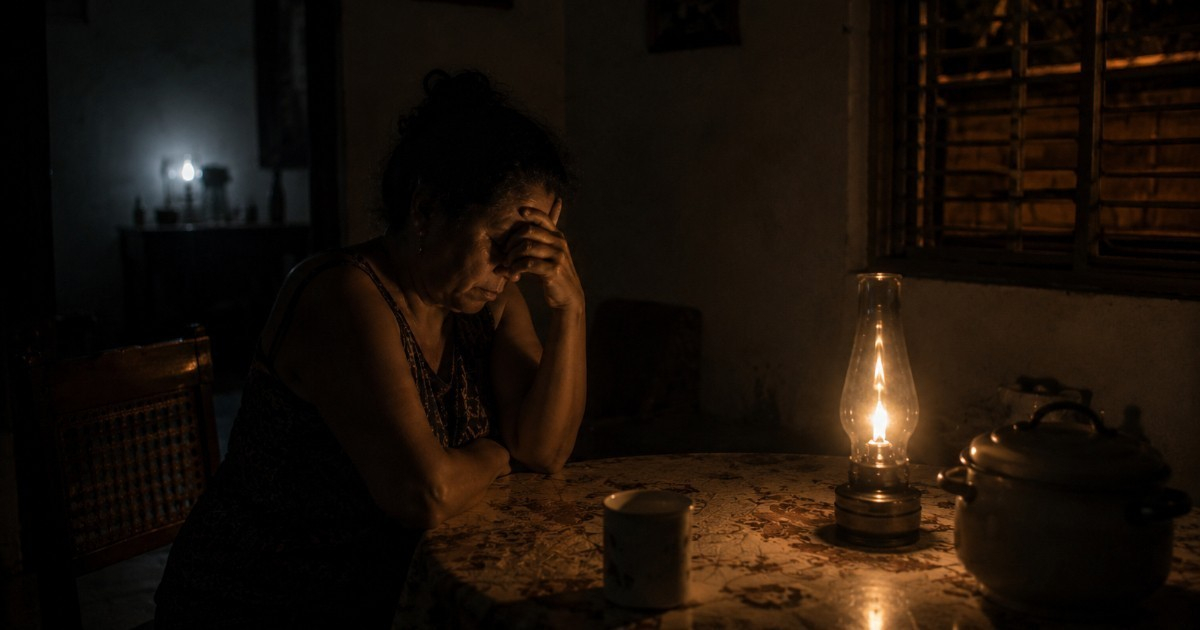
A Cuban mother living on 5th Street, between B and Lindero, in the Havana municipality of San Miguel del Padrón, has publicly raised concerns about enduring 17 days without electricity due to a faulty transformer that authorities have yet to fix. She shared images depicting her young children sleeping on the sidewalk because of the unbearable conditions inside their home.
"Look at what the Electric Company has done to me: my children are sleeping on the sidewalk because they haven't resolved the transformer issue," the distressed mother posted on social media, addressing the Electric Company of Havana directly.
The photos reveal two children, aged between two and five, lying on a mattress placed on the concrete ground, set against a backdrop of stone walls during the night.
Expressing frustration over more than two weeks of waiting without any response from the authorities, she demanded: "How long is this going to continue, folks? This is utterly disrespectful. Stop this abuse already."
Furthermore, she claimed that they were asked to pay 70,000 pesos to rectify the transformer problem, alleging that such equipment is being sold. These claims are based on her account and have not been independently verified.
She concluded her account with a statement reflecting the desperation felt by countless Cuban families: "I am just a mother demanding a right that is owed to me for the sake of my children, who are the ones suffering."
Recurring Power Outages Across Cuba
This situation is not an isolated incident. San Miguel del Padrón has reported numerous transformer failures throughout 2026, with incidents documented on various streets in August and September. Just this past Saturday, the H343 circuit of the municipality experienced nearly seven hours of disruption due to a generation shortfall, in addition to local outages.
In July 2025, residents of the Diezmero neighborhood, also in San Miguel del Padrón, blocked a street after enduring five days without electricity due to a broken transformer; only then did the Electric Company replace it with a new one.
The pattern is consistent island-wide. Residents in Veguita de Galo, Santiago de Cuba, reported 26 consecutive days without power due to a transformer malfunction. In Camagüey, outages lasting up to 105 days were documented owing to damage to special transformers. In Artemisa, a resident reported eight days without electricity following the theft of dielectric oil from a transformer in her area.
Theft of Dielectric Oil Worsens Energy Crisis
The theft of dielectric oil has become a critical factor exacerbating Cuba's energy crisis in 2026: thieves puncture equipment during outages to drain the fluid, selling it on the black market as an alternative fuel for prices ranging from 600 to over 1,000 pesos per liter, rendering transformers inoperative and extending local blackouts for weeks.
Nationally, Cuba has experienced at least seven widespread blackouts of the National Electric System so far in 2026, with generation deficits exceeding 60% of demand. This Saturday, the forecast predicted a maximum disruption of 2,008 MW across the country, with only 1,287 MW available against an anticipated demand of 3,300 MW.
In Havana, residents of Lawton, Santos Suárez, El Vedado, and other neighborhoods have resorted to protests and banging on pots and pans due to continuous blackouts lasting 24 to 48 hours, as the capital remains embroiled in months of electrical collapse with no solution in sight.
Understanding Cuba's Power Challenges
What is causing the power outages in Cuba?
The power outages in Cuba are primarily due to faulty transformers and a lack of maintenance. Additionally, the theft of dielectric oil has rendered many transformers inoperative, exacerbating the issue.
How are Cuban families affected by the electricity crisis?
Cuban families are severely impacted by the electricity crisis, often forced to endure long periods without power. Many resort to sleeping outdoors due to unbearable conditions inside their homes.
What responses have been made by the authorities?
Authorities have been slow to respond to power outages, with many communities waiting weeks for repairs. There have been reports of required payments to replace or repair transformers.