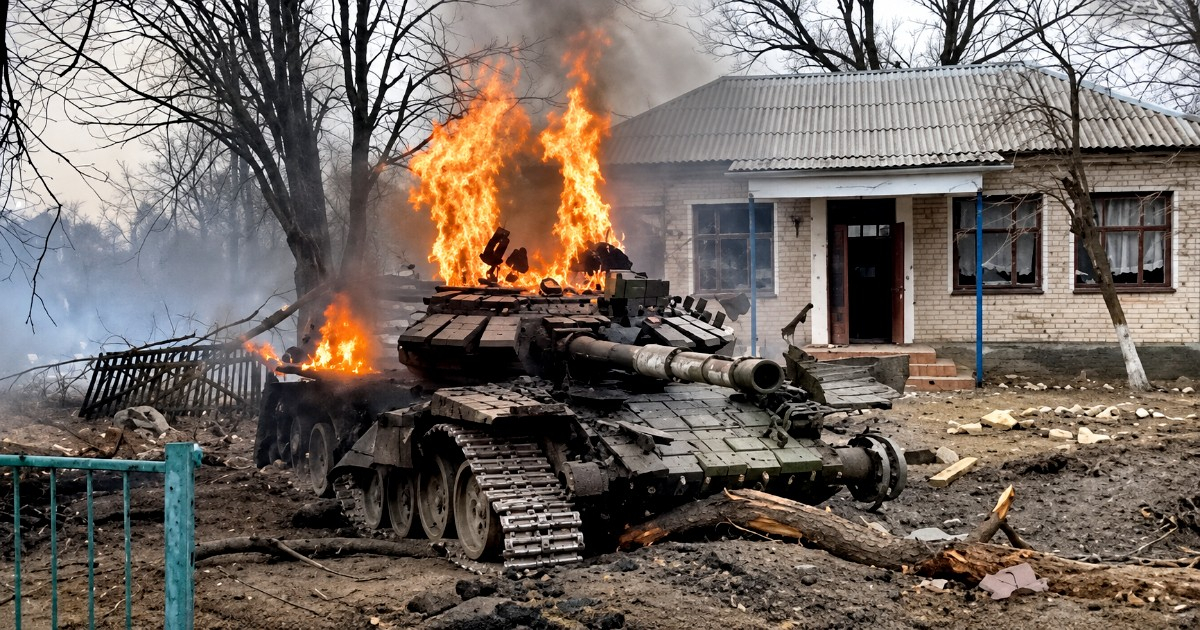
On Friday, the United Kingdom's military intelligence disclosed that approximately half a million Russian soldiers have perished in the ongoing conflict in Ukraine since the full-scale invasion began in February 2022. This revelation was made by Air Chief Marshal Sir Rich Knighton, the leader of the British Armed Forces, as reported by Sky News.
Knighton elaborated that the total Russian casualties, comprising both fatalities and injuries, have soared to 1.5 million troops. The majority of these losses have occurred since January 2023, during which Russia managed to seize only an additional 2% of Ukrainian territory.
Contrasting Estimates and Stark Statistics
These figures starkly contrast with other significant assessments. As of September 11, the General Staff of Ukraine reported 1,503,880 Russian personnel casualties, with 1,490 added in just one day.
The Institute for the Study of War (ISW) estimated that in August 2026, Russia incurred 42,020 casualties in just one month—marking the second consecutive month with losses exceeding 40,000—for a mere gain of 90.35 square kilometers of land.
Meanwhile, the BBC and Mediazona have verified the deaths of at least 223,539 Russian soldiers by name, suggesting this number could represent between 45% and 65% of the actual death toll.
Ukrainian President's Statements
Ukrainian President Volodymyr Zelensky asserted in July that nearly 700,000 Russian soldiers had been killed in combat. In February, he indicated that Ukraine was eliminating between 30,000 and 35,000 Russian troops per month since December 2025, resulting in a net loss of 8,000 to 10,000 troops per month for Moscow.
Knighton did not hold back when reflecting on the human cost of these statistics: "That's half a million photos hanging on the walls of homes shattered and overshadowed throughout Russia. It means half a million families will never see their father, son, brother, or husband again."
The Futility of Russia's Sacrifice
The British military leader described Russia's sacrifice as senseless: "I believe these figures clearly illustrate the pointless and futile waste of human life for such meager progress, all in pursuit of President Putin's illegitimate objective."
The conflict has now dragged on for 1,660 days, surpassing the combined Russian involvement in both World Wars. What the Kremlin initially portrayed as a brief operation has turned into the deadliest conflict for Russian lives since 1945.
Ukraine's Technological Edge
Despite its numerical disadvantage, Ukraine has leveraged unprecedented technological advancements. The extensive use of unmanned systems—conducting over 22,000 drone missions in three months—and ground robots like the Ratel and TerMIT has redefined defensive tactics, even allowing for the capture of enemy positions without infantry involvement.
Economic Strains on Russia
Economically, the outlook for Moscow remains grim. Ukrainian attacks on Russian refineries impacted 24 out of the 34 major facilities between January and July 2026, and oil revenues plummeted by 45.4% year-on-year in the first quarter, with the federal deficit already exceeding the annual target.
The chief economist of a state-run Russian bank was dismissed after warning that the economy was in decline, with a recession evident in civilian sectors.
Despite these challenges, Western officials cautioned that neither the massive casualties nor the economic downturn have altered Putin's ambition to bring Ukraine under Moscow's influence.
Key Questions on Russia's Military and Economic Struggles
What is the estimated number of Russian casualties in the Ukraine conflict?
British intelligence reports approximately 1.5 million Russian casualties, including 500,000 deaths, since the invasion began in 2022.
How has Ukraine compensated for its numerical disadvantage against Russia?
Ukraine has utilized advanced technology, including over 22,000 drone missions and ground robots, to redefine defensive strategies and capture enemy positions without infantry.
How has the conflict affected Russia's economy?
Russian oil revenues have dropped by 45.4% year-on-year in the first quarter, with significant impacts on major refineries and a federal deficit surpassing annual targets.