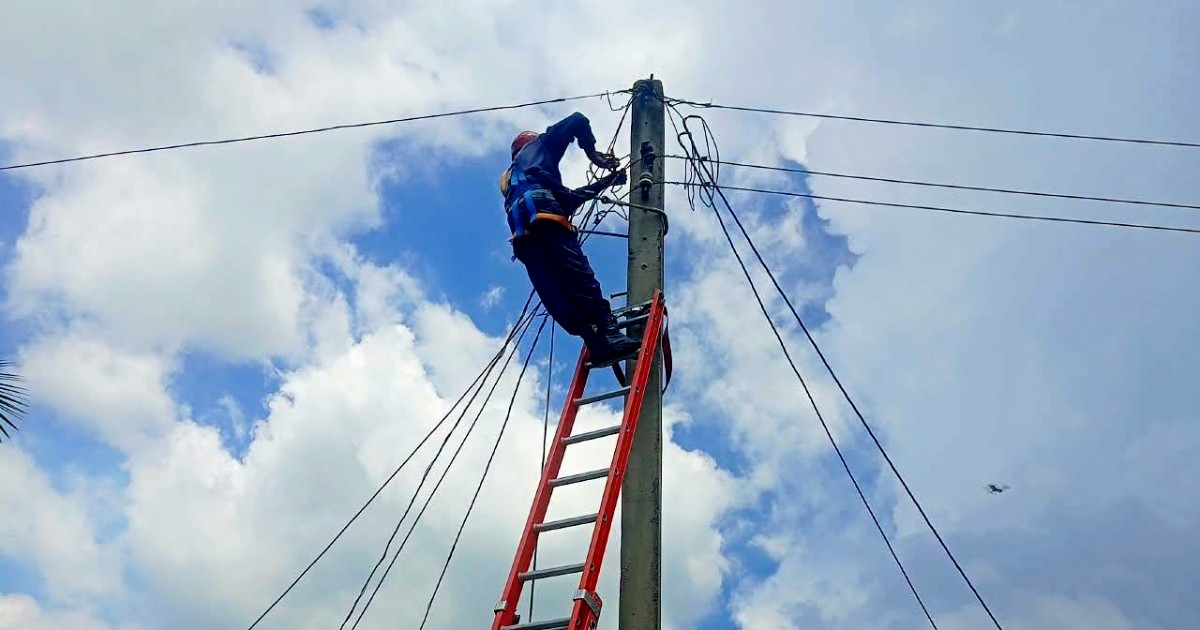
A tragic incident in Juraguá, Cienfuegos, has claimed the life of Mario Vives Mesa, a skilled electric lineman from Palmira. Vives Mesa was electrocuted on Friday while working on the new power line for the Solar Park.
His colleague, Ridier Molina León, also an experienced lineman from the same town, is currently in intensive care following the same accident.
The Cienfuegos Electric Company announced the unfortunate event on their social media: "With deep sorrow, the Cienfuegos Electric Company reports the death of Mario Vives Mesa, a specialized electric lineman, and the hospitalization of Ridier Molina León, his colleague, both residents of Palmira, after a workplace accident in Juraguá during the construction of the new Solar Park power line."
The company stated that "safety and emergency protocols were immediately activated" and they are cooperating with authorities to determine the accident's cause. The Ministry of Energy and Mines also expressed condolences for Vives Mesa's passing in a social media message.
This incident occurred just a week after Edisvey Rolando Pérez Rodríguez, a 32-year-old lineman from the Electric Company of Sancti Spíritus, was electrocuted in Guanabacoa, Havana, while repairing a transformer. Witnesses suggested that an illegal connection might have caused the current to return to the cable he was working on.
These cases add to the death of Osmani Rosales Núñez, a worker from the Electric Company of Cárdenas, who died from an electric shock in Tenería, Matanzas, on June 13, 2026. At least three linemen have died in workplace accidents this year.
These tragedies unfold amid an unprecedented energy crisis. As of September 2026, the Cuban electric grid is operating with a capacity of only 1,000 to 1,287 megawatts, far below the 3,300 megawatts demanded, leading to deficits over 2,000 megawatts and blackouts affecting up to 70% of the country simultaneously.
By early September, eleven out of the sixteen thermoelectric units in the country were out of service due to failures or maintenance. The situation is exacerbated by deteriorating protective equipment, poorly maintained vehicles, and fuel shortages that define the working conditions in the sector.
The exodus of qualified personnel further complicates the scenario: around 15,000 workers left the electric sector in 2021 and 2022 due to low wages and worsening work conditions, according to union statements, putting additional strain on those who remain.
In 2025, the National Office of Statistics and Information reported five fatalities in the Electricity, Gas, and Water sector alone, out of a national total of 38 deaths and 701 injuries, highlighting a systemic risk pattern that the 2026 crisis has only deepened.
"We reaffirm our strong commitment to the safety, health, and well-being of all our workers," declared the Cienfuegos Electric Company in their statement, a sentiment that starkly contrasts with the series of fatalities plaguing the sector this year.
Cuban Energy Crisis and Worker Safety Concerns
What caused the recent electrocution of linemen in Cienfuegos?
The electrocution occurred during the construction of a new power line for the Solar Park in Juraguá. The exact causes are under investigation, with safety protocols having been activated immediately after the incident.
How is the Cuban energy crisis impacting safety in the electric sector?
The energy crisis is leading to severe strain on the electric grid, with significant power deficits and widespread blackouts. The deteriorating equipment and lack of resources are worsening safety conditions, contributing to a rise in workplace accidents.
What measures are being taken to address the safety of electric linemen in Cuba?
The Cienfuegos Electric Company has stated that safety, health, and well-being are priorities, with protocols in place. However, the ongoing crisis and loss of skilled workers present ongoing challenges to ensure safety standards are met.