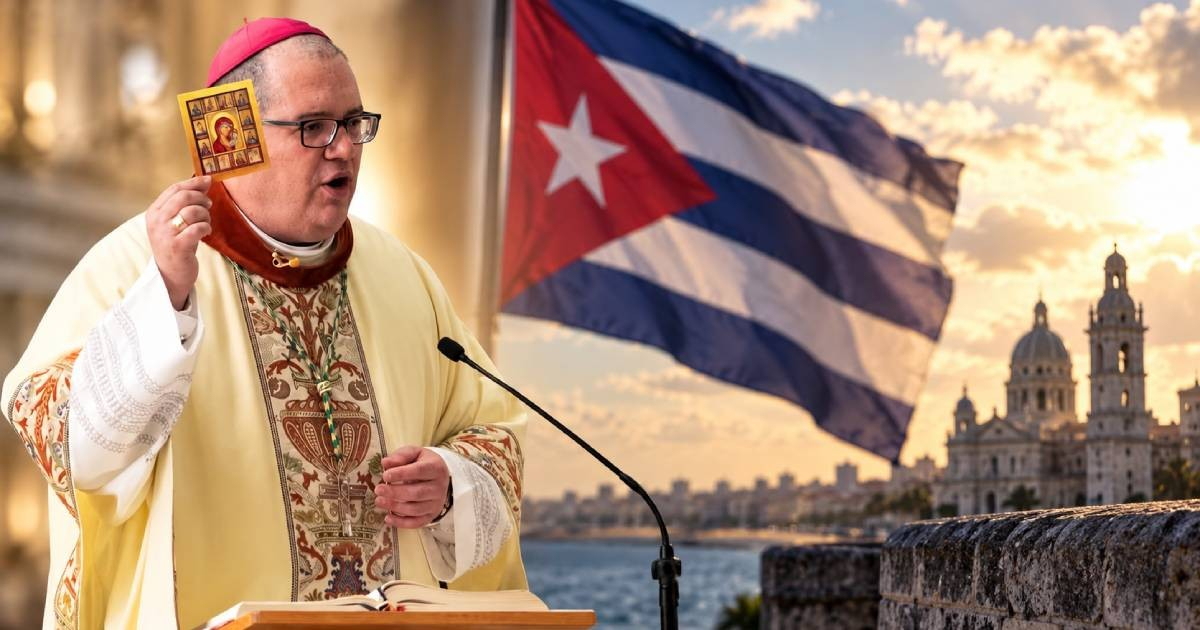
"Cuba deserves to be free. No nation was created to live on its knees," declared Bishop Manuel de Jesús Rodríguez of Palm Beach in a message from Rome directed at the Cuban community in South Florida, on the occasion of the Feast of Our Lady of Charity of El Cobre.
The Cuban bishop, currently in the Vatican attending courses for new bishops, made a strong call for the island's freedom during a celebration held on Tuesday in West Palm Beach.
"Cuba deserves to be free. No nation was created to live on its knees, and no chain is eternal before the One who breaks all bonds," Rodríguez's message stated. This was read to the Cuban community by Father Ducasse François at St. Juliana Church during a mass led by Father Alfredo Hernández, as reported by ACI Prensa.
At 52, Bishop Rodríguez is the first Hispanic bishop in the history of the Diocese of Palm Beach. He also requested prayers for those imprisoned for political reasons and for Cuban families suffering due to the crisis and exile.
"Let us pray for the prisoners of conscience who remain jailed for defending the truth; for mothers awaiting news of their children; for families divided by exile; for a people who have long suffered from hunger, fear, and silence," he urged.
His words come amid increasing statements from Catholic Church figures about Cuba's situation. Human rights organizations report over a thousand political prisoners on the island, while the Cuban Catholic Bishops’ Conference called in January for "structural, social, economic, and political changes" in response to the severe national crisis.
Rodríguez visited Cuba in March, marking his first return to the island in over 25 years, to attend the installation of Osmany Massó Cuesta as Bishop of Bayamo-Manzanillo. After his visit, he described a "deep and worsening humanitarian crisis," characterized by food shortages, long lines, and difficulties accessing medicine and healthcare.
His message also coincided with renewed pressure against the Ladies in White. On September 8, as Cubans celebrated their patroness, activists reported a police operation to prevent members of the movement from attending religious events in Havana.
During his stay in Rome, Rodríguez also met with Pope Leo XIV, presenting a bandana from the Diocese of Palm Beach as part of preparations for the World Youth Day 2027 in South Korea, where the diocese plans to send around 700 pilgrims.
Cuba's presence reached the Pontiff through another channel as well. Cuban Bishop Osmany Massó Cuesta presented the Pope with a photo of Our Lady of Charity of El Cobre, taken by Santiago photographer Rubén Aja Garí.
Rodríguez concluded his message by focusing again on Cuba's future: "Let us ask Our Lady of Charity, who has accompanied Cubans through every dark hour of their history, to hasten the day of freedom, reconciliation, and return."
The bishop also announced his intention to join a pilgrimage to the Shrine of Our Lady of Charity in Miami on September 19, alongside around one hundred faithful from Palm Beach.
"I eagerly look forward to joining you," the bishop expressed, assuring that the day will be dedicated to praying for Cuba and for "that new day we all long for."
Understanding the Call for Freedom in Cuba
Why did Bishop Rodríguez deliver this message?
Bishop Rodríguez delivered this message to emphasize the right of the Cuban people to live freely and to call for prayers and support for those suffering under the current regime.
What is the significance of the Feast of Our Lady of Charity of El Cobre?
The Feast of Our Lady of Charity of El Cobre is an important religious celebration for Cubans, honoring their patroness and symbolizing hope and faith amidst adversity.
How has the Catholic Church responded to the situation in Cuba?
The Catholic Church, through various figures and organizations, has been vocal about the need for political and social reforms in Cuba, highlighting the ongoing humanitarian crisis and advocating for the rights of political prisoners.