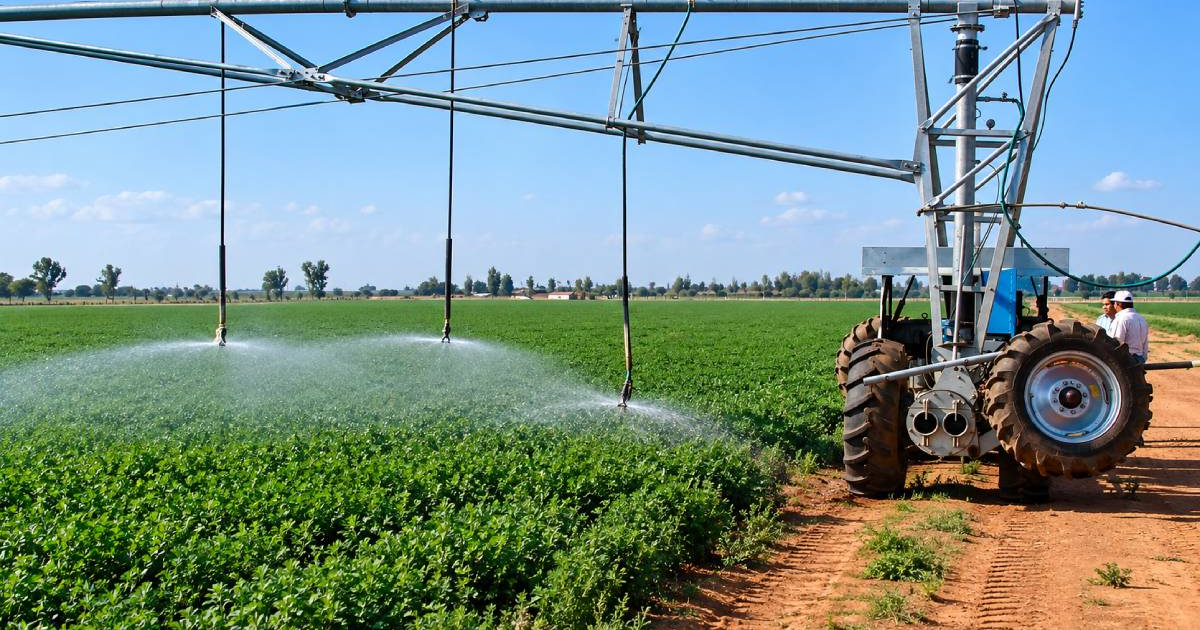
The Cuban Council of State has enacted Decree-Law 125 of 2026, revising the current regulations governing agricultural mechanization, irrigation, drainage, and water supply for livestock. This initiative aims to bolster the country's agricultural production recovery.
Published on Wednesday in the Official Gazette No. 75 Ordinary of 2026, spanning pages 55 to 60, the new decree amends 21 articles of Decree-Law 2 from 2019, which had previously set the foundational framework for these agricultural activities.
The document highlights that the "Economic and Social Transformations approved to promote agricultural recovery necessitate revising the regulations within Decree-Law 2 of 2019 concerning mechanization, irrigation, agricultural drainage, and water supply for livestock, thus warranting this update."
Key Changes in Agricultural Equipment Regulations
The Ministry of Agriculture (MINAG), led by Ydael Jesús Pérez Brito, will oversee the development, implementation, and management of policies related to mechanization, irrigation, agricultural drainage, and livestock water supply.
One of the notable changes is the specific recognition of single-axle tractors—referred to as motor-cultivators, moto-hoe machines, and two-axle mini-tractors with up to 20 HP—as agricultural equipment, a detail not clearly defined in previous legislation.
Impacts on Service Provision and Equipment Acquisition
Both individuals and entities can now provide machinery and irrigation services. Agricultural producers are allowed to acquire farming equipment according to procedures outlined in the Regulation.
For non-state sector investments, state testing and equipment validation will be optional and require a formal request from the client. However, all equipment must undergo technical assessment by the Agricultural Engineering Research Institute.
Decentralization and Coordination Efforts
Agricultural motor vehicles must be registered at the municipal Office of Tractors and Self-Propelled Harvesters. This decentralization simplifies a process that previously required higher-level bureaucratic steps.
MINAG is also tasked with collaborating with the National Institute of Water Resources (INRH) to manage activities related to agricultural irrigation and livestock water supply. The ministry aims to promote comprehensive agricultural engineering systems that incorporate irrigation, drainage, mechanization, energy, post-harvest, and environmental conservation technologies.
Context and Broader Legislative Changes
Decree-Law 125 marks the second major revision of Decree-Law 2/2019, which was previously amended in September 2023 with Decree-Law 75.
This regulation is part of a broader legislative package published in the same Gazette No. 75, featuring 19 provisions, including Law 185 on land ownership and use for agriculture and forestry. It is one of the 176 economic and social transformations announced by the regime in 2026.
The update comes amid a severe agricultural crisis, highlighted by a drop in rice production from 304,000 tons in 2018 to 111,000 tons in 2025, according to official figures.
Agricultural mechanization is currently stalled due to shortages of fuel, spare parts, and operational machinery, forcing the use of animal traction, windmills, and solar pumps in some farming tasks.
Frequently Asked Questions on Cuba's Agricultural Reform
What is the purpose of Decree-Law 125 in Cuba?
Decree-Law 125 aims to update the regulations concerning agricultural mechanization, irrigation, drainage, and livestock water supply to enhance the recovery of Cuba's agricultural production.
How does the new regulation affect agricultural equipment registration?
Agricultural motor vehicles must now be registered at the municipal level, streamlining a process that previously involved higher-level bureaucratic procedures.
Who oversees the implementation of these agricultural policies in Cuba?
The Ministry of Agriculture (MINAG), led by Ydael Jesús Pérez Brito, is responsible for overseeing the formulation and management of policies related to mechanization, irrigation, and agricultural drainage.