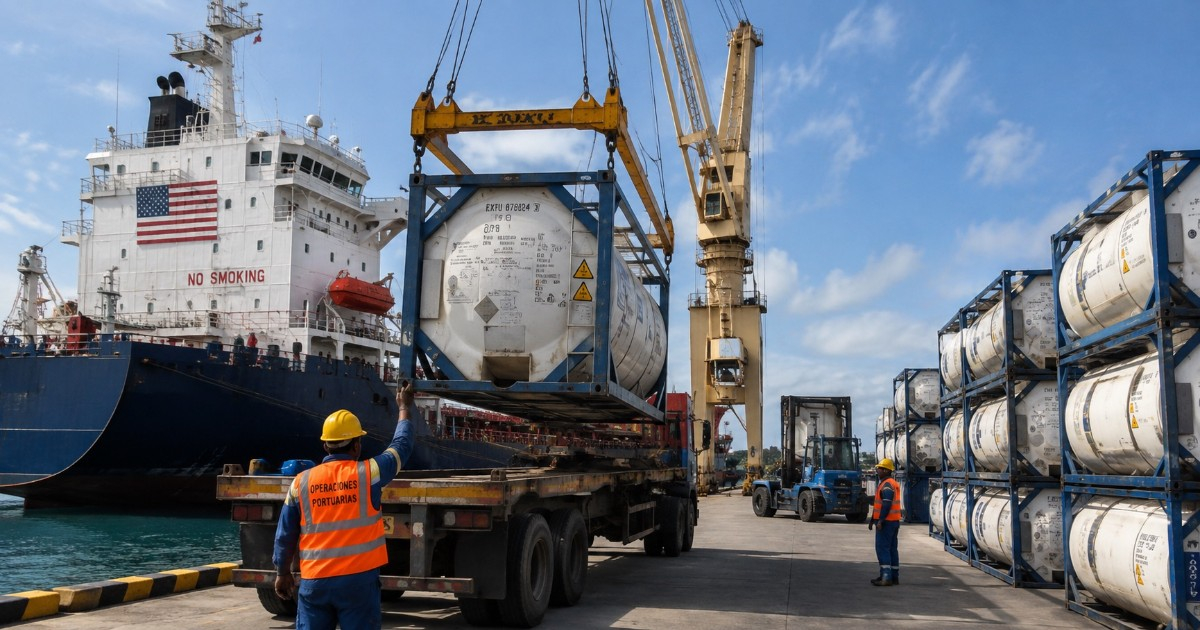
The Cuban regime purchased over $500 million worth of American goods from January to July 2026, as reported by the U.S.-Cuba Trade and Economic Council.
In July alone, exports from the United States to the island reached $148.9 million, bringing the total for the year to $674 million, according to analysis by the Census Bureau.
Three main categories dominate these imports: food and agricultural products ($254.2 million from January to July), fuels and petroleum derivatives ($156.8 million), and vehicles, motorcycles, parts, and bicycles ($91 million).
Significant Rise in Fuel Imports
The most notable change this year is in the fuel sector. In the first seven months of 2026, fuel imports have already exceeded $156 million, compared to just $311,558 in all of 2025 and $938,894 in 2024. In July alone, gasoline, kerosene, and oil exports totaled $61.1 million, primarily shipped from Houston and Miami ports.
This surge can be attributed to a guideline issued on February 25, 2026, by the U.S. Department of Commerce’s Bureau of Industry and Security (BIS), under the "Support for the Cuban People" exception. This policy permits the sale of fuels to private Cuban entities—such as small businesses and self-employed individuals—while excluding the government and state-owned enterprises.
Growth in Vehicle Exports
Since 2022, when the first BIS license was granted for exporting automobiles to Cuban individuals and private businesses, vehicle exports have surpassed $318 million. The growth has been steady: $89,848 in 2022, $10.5 million in 2023, $67.2 million in 2024, $149.4 million in 2025, and already $91 million in the first seven months of this year.
In July, the most exported item in this sector was used passenger vehicles with engines over 3,000 cc, totaling $7.16 million for the month and $34.9 million for the year. Miami is the hub for most of these shipments.
Fluctuating Agricultural Exports
Although food and agricultural products remain the largest import category, there has been a decline. In July, exports amounted to $35.4 million, a drop from $42.4 million in July 2025, marking a 16.4% decrease. The January-July total of $254.2 million represents an 11% reduction compared to $285.7 million during the same period last year.
Among agricultural exports in July, notable items included solar panels and modules worth $4.6 million, liquefied propane, coin-operated washers, and fridge-freezer combos. Cuba ranked 50th among 220 markets for U.S. agricultural exports that month.
This trade operates under specific regulatory frameworks: the Trade Sanctions Reform and Export Enhancement Act (TSREEA) of 2000, the Cuban Democracy Act of 1992, and guidelines from the Office of Foreign Assets Control (OFAC), the BIS, and the State Department.
In August, the Trump-Vance administration renewed the provisions of the Trading with the Enemy Act concerning Cuba, yet these export channels to the island's private sector remain active.
Alongside commercial trade, humanitarian donations from the U.S. to Cuba in July 2026 accounted for $26.47 million, recorded separately from commercial exports.
Since 2022, the cumulative value of all authorized exports under these frameworks has exceeded $766 million, according to the U.S.-Cuba Trade and Economic Council.
Understanding U.S. Exports to Cuba
What are the main categories of U.S. exports to Cuba?
The primary categories include food and agricultural products, fuels and petroleum derivatives, and vehicles, motorcycles, parts, and bicycles.
Why have fuel imports to Cuba increased significantly in 2026?
The increase is due to a new guideline issued by the U.S. Department of Commerce’s Bureau of Industry and Security, allowing the sale of fuels to private Cuban entities.
How have vehicle exports to Cuba evolved since 2022?
Since the first BIS license for vehicle exports was granted in 2022, there has been a steady increase, with exports surpassing $318 million by 2026.
What regulatory frameworks govern U.S. exports to Cuba?
U.S. exports to Cuba are governed by the Trade Sanctions Reform and Export Enhancement Act of 2000, the Cuban Democracy Act of 1992, and regulations from the OFAC, BIS, and the State Department.