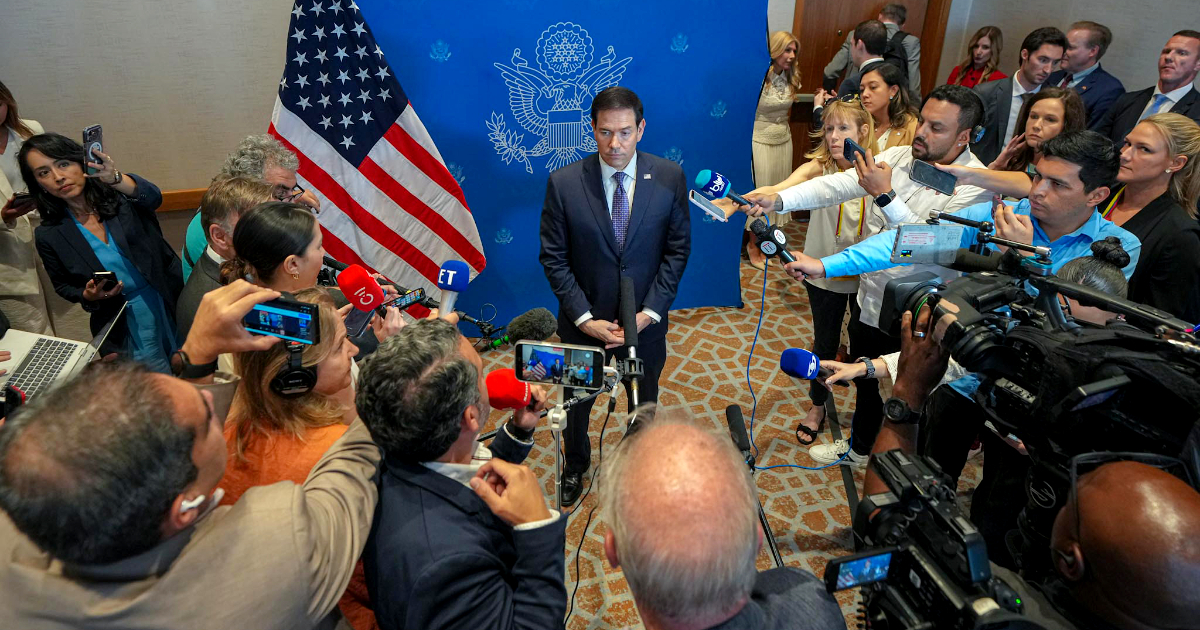
This past Wednesday, "Razones de Cuba" addressed recent remarks made by U.S. Secretary of State Marco Rubio concerning Cuba's ongoing energy crisis. However, the platform sidestepped one of the most challenging questions facing the regime: Why did Cuba allocate significant resources to hotel construction while its electrical system was falling into disrepair?
On social media, the platform, which is linked to Cuba's State Security, echoed Rubio's assertion: "Resources that should have been used for the energy system were instead funneled into building hotels and lining the pockets of the government."
Instead of refuting this claim or providing evidence to counter the Secretary of State, "Razones de Cuba" questioned his motives and swiftly shifted the focus to U.S. sanctions.
Shifting Blame Instead of Providing Answers
The publication highlighted a critical point: "Razones de Cuba" accused Rubio of politically exploiting the suffering caused by blackouts, yet it failed to address the argument it had just cited.
The platform did not clarify whether the prioritization of hotel investments over the energy system was false, nor did it disclose how much money was allocated to each sector or why the regime maintained this investment strategy for years.
In essence, while attributing a distraction tactic to Rubio, "Razones de Cuba" itself avoided addressing the concrete and verifiable aspect of his accusation: the allocation of the country’s resources.
The Role of U.S. Sanctions and GAESA's Dominance
Following this, "Razones de Cuba" focused its response on blaming U.S. sanctions, claiming that these sanctions are the "real framework" within which Cuba struggles to keep an aging electrical system operational.
Yet, no figures were presented to prove Rubio wrong about investment priorities. The publication did not explain why hotel construction continued amidst the crisis, nor did it discuss the role of GAESA—the military-controlled conglomerate that oversees much of the tourism industry and other strategic sectors—in the state's skewed investment practices.
Rubio's Persistent Accusations
The remarks prompting the platform's response were made by Rubio during his visit to Colombia. The Secretary of State argued that Cuba's blackouts predate recent Washington policies and linked the crisis to years of inadequate investment and the regime's economic priorities.
This is not a new argument. In May, Rubio directly criticized GAESA and questioned why the substantial revenues from hotels, banks, and other businesses under its control were not used to purchase fuel or modernize power plants.
He has consistently portrayed GAESA as a fundamental part of a model that concentrates resources within structures controlled by the military elite, while the general population endures blackouts, shortages, and deteriorating basic services.
Official Statistics Highlight the Discrepancy
The issue of hotel investments is not solely reliant on U.S. accusations. Cuba's own official statistics have long illustrated the priority given to tourism over essential sectors.
Data from the National Office of Statistics and Information (ONEI), previously cited by CiberCuba, revealed that in the first half of 2024, nearly 40% of investments were directed towards tourism-related activities, while Health and Social Assistance received a mere 2.7%, and agriculture 2.5%.
From 2021 to 2023, about 36% of governmental investment was funneled into hotel infrastructure, compared to roughly 1.9% for Health and 1.3% for Education.
This historical context underscores the significance of what "Razones de Cuba" fails to address. The platform could have challenged Rubio's figures, justified the prioritization of hotels, explained the origin of these resources, or demonstrated why they could not be redirected to revamp the electrical infrastructure.
Nevertheless, it chose to avoid these issues altogether.
Returning to Political Narratives
Instead, the publication opted to steer the discussion into political territory, blaming the U.S. for the crisis.
"To claim that the issue is the Cuban economic model and not the deliberate strangulation by a power over a nation of eleven million people is a fallacy," it asserted.
"Razones de Cuba," a platform previously documented by CiberCuba for its ties to State Security and involvement in propaganda campaigns against dissidents, activists, independent journalists, and regime critics, devoted much of its publication to condemning Washington's actions and U.S. military exercises in Puerto Rico.
This maneuver ultimately diverted attention from the original accusation.
After citing Rubio, the publication failed to explain how much the regime invested in hotels while power plants aged, why it adhered to this strategy amid worsening blackouts, or what happened to the resources managed by GAESA.
"Razones de Cuba" responded to Rubio with their typical propaganda about the "blockade," but once again left unanswered the very question that the official statistics make hard to ignore: Why so many hotels and so little investment in vital sectors while Cuba's electrical system was collapsing?
Understanding Cuba's Investment Priorities Amid Crisis
What did Marco Rubio claim about Cuba's investment priorities?
Marco Rubio claimed that resources that should have been directed to Cuba's energy system were instead used to build hotels and enrich the government.
How did "Razones de Cuba" respond to these accusations?
"Razones de Cuba" did not refute the accusations directly but instead shifted the focus to U.S. sanctions, alleging that they are the real cause of Cuba's struggles with its aging energy infrastructure.
What is GAESA, and why is it significant in this context?
GAESA is a conglomerate controlled by the Cuban military that oversees much of the country's tourism industry and other strategic economic sectors. Rubio and others criticize it for concentrating resources while essential services deteriorate.