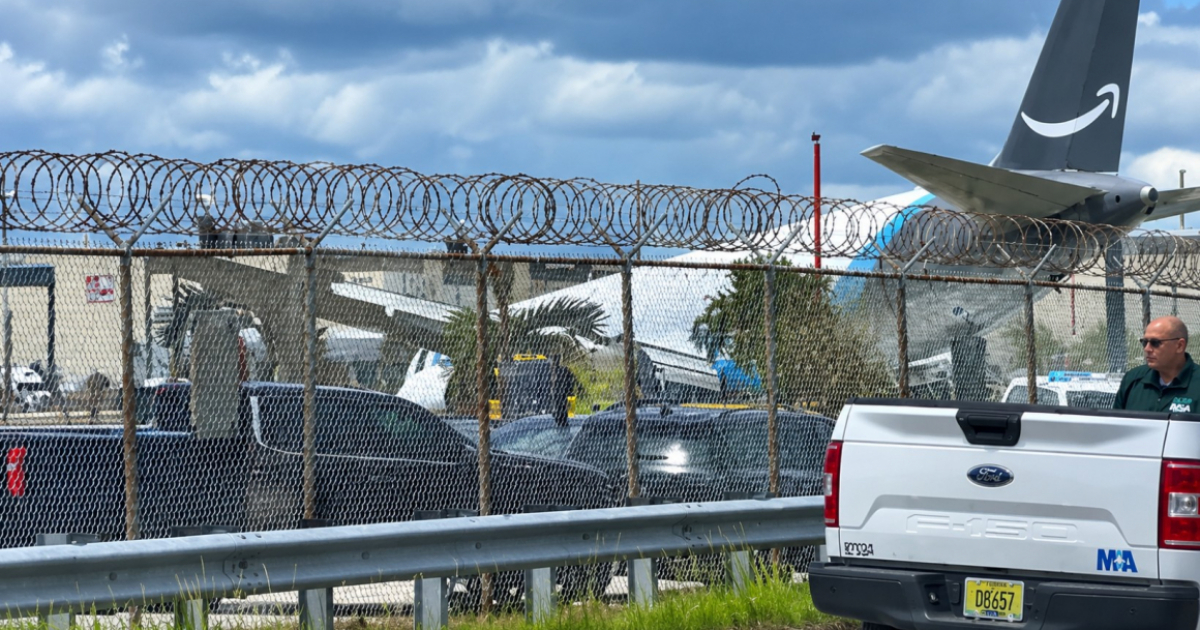
Investigators from the National Transportation Safety Board (NTSB) have painstakingly pieced together the final half-minute of the Amazon cargo flight that veered off the Miami International Airport runway last Sunday, resulting in five fatalities and several injuries, according to preliminary information released by the agency.
The Boeing 767-300, operated by 21 Air for Amazon Prime Air, landed at a speed of 158 knots, which is considered high for that stage of the flight.
Seven seconds after making initial contact with the runway, the brakes were applied as the aircraft was rolling at 146 knots. Four seconds later, the left main wheel touched the asphalt at 134 knots, according to the lead investigator, Chihoon Shin, during a press briefing.
One of the most critical moments in the investigation occurred next: 15 seconds before the recording ended, the brakes were suddenly released, and the throttle levers were pushed forward to settings indicative of an aborted landing, known as a "go-around."
Nonetheless, just four seconds later, the crew reversed their decision: the engines were throttled back to idle, and the brakes were reapplied, staying engaged until the end of the recording.
The final speed recorded by the black box was 65 knots, by which time the plane had overrun the runway and was headed toward vehicles parked outside the airport's perimeter.
A key focus for investigators is the absence of evidence that the crew deployed the speed brakes or thrust reversers, both systems designed to slow the aircraft during landing.
"There are no signs in the recorded data that the speed brakes or thrust reversers were deployed," Shin stated, though he refrained from making any premature conclusions, adding, "I will not speculate on what should have occurred at this point."
NTSB Chair Jennifer Homendy confirmed that the cockpit voice recorder contained "more than two hours of high-quality audio," but the agency has opted not to release its contents until they complete their interviews with the pilots, scheduled for Wednesday.
"We will interview the pilots as we are keen to hear their account of the accident before releasing the cockpit voice recorder transcript," Homendy explained.
After skidding off the runway, the Boeing broke through a perimeter fence, collided with a Toyota Corolla Cross LE, and subsequently struck a white van owned by Professional Ocean Service Corporation, which was carrying seven cleaning workers. The five individuals who perished in the Miami air disaster were in that van; none were aboard the plane.
Among the victims was Rolando Alemán León, a 55-year-old Cuban national, who had only started working for the company in January. The other four deceased were identified as Yoel Rodríguez Naranjo (53), Julio C. Pineda (75), Carlos Acosta Fajardo (53), and Javierkys Reyes Quevedo (47).
Miami-Dade Sheriff Rosie Cordero Stutz reported that three injured individuals remain hospitalized: two in critical condition and one stable.
The two pilots survived the crash. A video captured one pilot leaping from the cockpit door and running as the aircraft was engulfed in flames.
Miami Airport lacks the Engineered Materials Arrestor System (EMAS), a bed of crushable material at runway ends found in over 120 U.S. airports, credited by the Federal Aviation Administration (FAA) with saving at least 497 lives in 26 incidents.
The NTSB anticipates spending approximately a week gathering physical evidence at the scene, while the comprehensive investigation—which will include operational documents, maintenance records, and further interviews—is expected to take months to complete.
Key Insights into the Miami Plane Crash
What caused the Amazon cargo plane to crash in Miami?
The exact cause is still under investigation, but preliminary findings indicate possible issues with brake application and the lack of speed brake and thrust reverser deployment.
Who were the victims of the Miami plane crash?
The five victims were in a van struck by the plane after it left the runway. They included Rolando Alemán León, Yoel Rodríguez Naranjo, Julio C. Pineda, Carlos Acosta Fajardo, and Javierkys Reyes Quevedo.
What is EMAS and why is it important?
EMAS, or Engineered Materials Arrestor System, is a safety feature at runway ends made of crushable material that helps to stop overrunning aircraft, credited with saving numerous lives in past incidents.