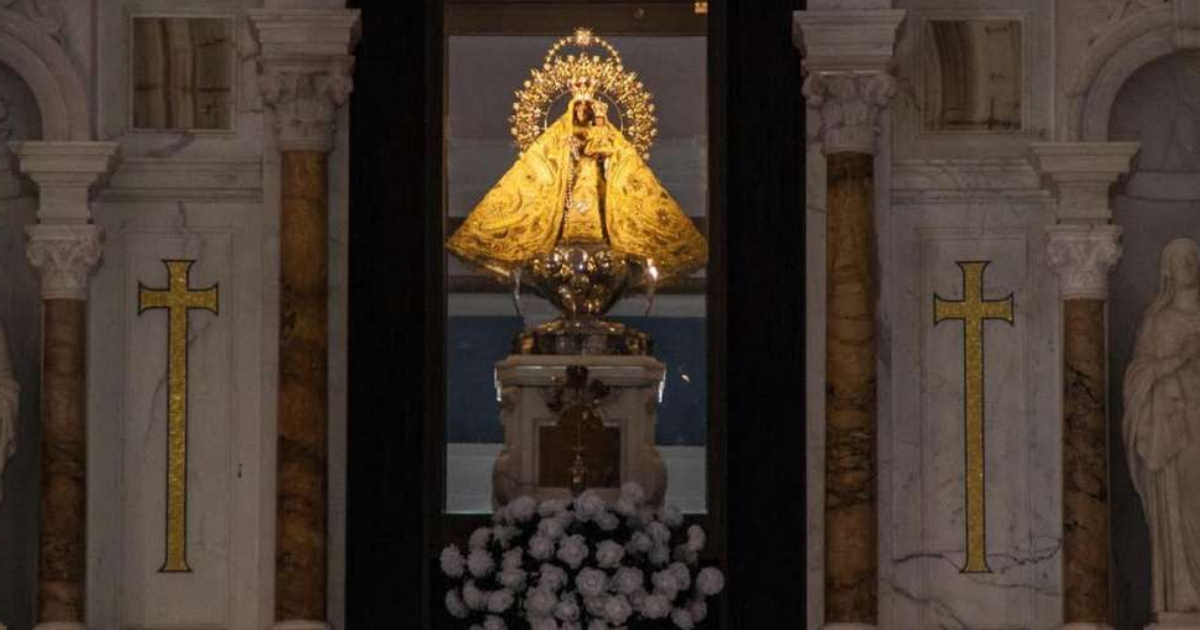
On the feast day dedicated to Our Lady of Charity, Laritza Camacho, a Cuban broadcaster, actress, and presenter, shared a poetic prayer on her Facebook. Addressed to Cuba's patroness, the prayer captures the climate of repression and self-censorship enveloping the island, poignantly concluding with the line: "Here we can't even shout our prayers."
This poem, crafted in the first-person plural, transforms the prayer into an act of symbolic resistance on one of the most sacred days in Cuba's religious calendar.
"Virgin, like yesterday, there is a storm today. Nothing can be seen in the dark human ocean we inhabit. Charity sustains us, hand to hand, like alms in a slumbering nation amidst chaos. If you listen closely, Grant us the miracle. Here we can't even shout our prayers."
The Stormy Seas and the Legend of the "Three Juans"
The imagery of stormy seas is intentional, directly referencing the legend of the "Three Juans" who discovered the Virgin's image floating in Nipe Bay around 1612-1613. This metaphor speaks to present-day Cuba, where a "dark human ocean" symbolizes a society mired in blackouts, shortages, and fear.
Camacho is among the public figures who have consistently criticized the regime via social media throughout 2026.
On July 11, she declared, "I am against the Cuban government because the Cuban government is against Cuba."
Weeks later, on August 5, she issued a direct message to officials: "Leave because we don't need you."
A Spiritual Dimension to the Critique
Camacho's prayer adds a spiritual layer to her critical voice, resonating with other religious expressions surrounding the feast day.
Father Alberto Reyes had earlier implored the Virgin to help preserve "the courage to speak the truth" amidst "so much repression."
On the same Tuesday, Reyes urged young Cubans not to stop dreaming and to believe that "freedom and opportunities are possible" in Cuba, rather than feeling compelled to emigrate.
Commemorating 110 Years of Patronage
The celebrations on September 8, 2026, at the El Cobre sanctuary in Santiago de Cuba, featured masses, a procession at five in the afternoon, and a Marian music concert under the theme "Charity Unites Us."
In Havana, the Vedado parish organized a procession with the image on a pedestal, adorned with yellow and white flowers.
This year's festivity carries additional significance: it marks 110 years since Our Lady of Charity was declared Cuba's patroness, a recognition granted by Pope Benedict XV on May 10, 1916, following a request from veterans of the Liberation Army.
Amidst collective devotion and ongoing crisis, Camacho's prayer concludes with its starkest image: a populace unable to even raise their voices in prayer aloud, yet still beseeching their patroness to "grant the miracle."
Understanding the Significance of Our Lady of Charity in Cuba
Who is Our Lady of Charity?
Our Lady of Charity, also known as the Virgin of Charity of El Cobre, is the patroness of Cuba, celebrated for her miraculous appearance to three fishermen in the early 17th century.
Why is the feast day of Our Lady of Charity significant in Cuba?
The feast day is a pivotal religious event in Cuba, marked by cultural and spiritual traditions that unite the nation in hope and prayer, especially during challenging times.
How does Laritza Camacho's prayer reflect current Cuban challenges?
Camacho's prayer highlights the repression and self-censorship faced by Cubans, using symbolic language to critique the regime and call for divine intervention.