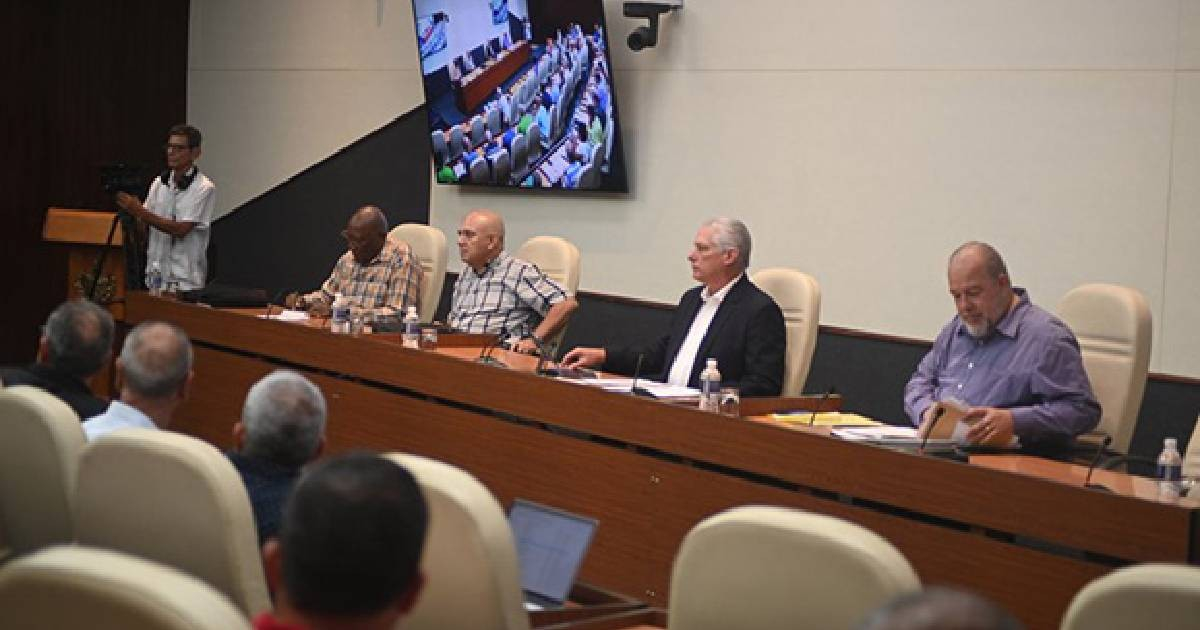
On Tuesday, Cuban leader Miguel Díaz-Canel convened with over thirty leaders of state-owned enterprises at the Palacio de la Revolución to reaffirm his trust in the state-run business system. The meeting celebrated progress in implementing the 176 Economic and Social Transformations, even as Cubans grapple with food prices that exceed the average national salary by more than thirteen times.
The president expressed to the business executives that "the leadership of the Party, the Government, and the State reaffirms its full confidence in the capacity of the Cuban socialist state enterprise system to provide what the country needs." He assured them, "We will transform and move forward," as reported by Cubadebate.
The event, overseen by Roberto Ricardo Marrero, president of the National Institute of State Enterprise Assets, was also attended by Prime Minister Manuel Marrero Cruz, Vice President Salvador Valdés Mesa, and Deputy Prime Minister Inés María Chapman Waugh.
State Enterprise Leaders Echo Optimism
Several executives mirrored the optimistic tone. Oscar Carvajal Serrano from the Automotive Group of the Ministry of Transportation declared that "none of its enterprises will end the year with losses and will increase contributions and profits," while acknowledging that "challenges won't be resolved overnight."
Edel Gómez Gómez, director of the industrial electronics company Comandante Camilo Cienfuegos, claimed that the transformations "allow us to be on equal footing with other economic players" and that they "remove obstacles and hurdles, enabling us to advance more quickly."
Reality Contradicts Official Rhetoric
The official narrative starkly contrasts with the day-to-day reality on the island. According to the National Office of Statistics and Information (ONEI), annual inflation reached 20.70% in July 2026, with food and non-alcoholic beverages accounting for 63.18% of the total increase in the consumer price index that month.
August prices highlight the severity of the issue: rice is sold at 330 Cuban pesos per pound, oil at 3,650 pesos per liter, chicken at 6,800 pesos per package, and chicken breast at 10,500 pesos, while the official average salary closed in 2025 at just 6,930 pesos per month, equivalent to between 10 and 15 dollars at the informal exchange rate.
Economists estimate that meeting basic needs requires around 96,000 pesos monthly, a figure more than thirteen times the average salary.
Economic Challenges Persist
The state's own figures dispute the leadership's optimism: net sales of the state enterprise system fell by 29.2% from January to May 2026, pre-tax profits dropped by 31.5%, and the number of loss-making companies rose from 252 to 363 in that period. The Economic Commission for Latin America and the Caribbean (CEPAL) forecasts a 6.5% contraction in Cuba's GDP in 2026, following a 3.8% decline in 2025.
In response, the regime approved the 176 Economic and Social Transformations in June 2026, organized into 23 thematic axes, aimed at granting state companies more autonomy to export, import, retain foreign currency, and set prices and wages. In July, the regime also removed through Decree 156 the 155-peso per pound cap on rice, transferring price setting to the Ministry of Finance and Prices, further exacerbating the situation for consumers.
Díaz-Canel announced that future meetings would bring together state, non-state, and cooperative enterprises, "so we integrate as that unique business system conceived in our economic and social model." Meanwhile, the gap between the rhetoric from the Palacio de la Revolución and the empty tables of millions of Cubans remains the widest in decades.
Understanding Cuba's Economic Situation
Why are food prices so high in Cuba?
Food prices in Cuba have skyrocketed due to a combination of inflation, economic mismanagement, and a lack of sufficient domestic production and imports to meet demand.
What are the 176 Economic and Social Transformations?
The 176 Economic and Social Transformations are a set of reforms approved by the Cuban government aimed at granting state enterprises more autonomy in economic activities such as exporting, importing, and setting prices and wages.
How is the average Cuban salary affected by inflation?
Inflation in Cuba has severely diminished the purchasing power of the average salary, which is not sufficient to cover basic living expenses due to the high cost of goods and services.