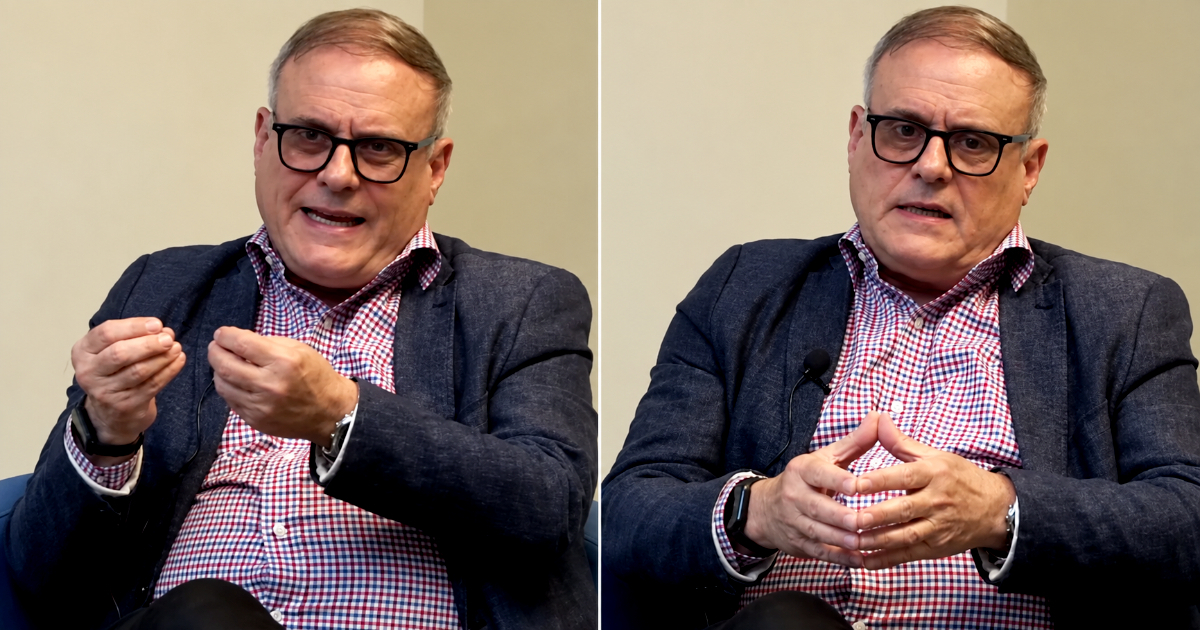
The Cuban economist Mauricio de Miranda has proposed that rebuilding Cuba will necessitate a large-scale economic assistance program, akin to the post-war European Marshall Plan.
His proposal, outlined at the III DDC Forum "For the Cuba of Tomorrow," organized by Diario de Cuba in Madrid, hinges on a political shift towards democracy and strong institutional guarantees.
De Miranda unequivocally noted that such a "flood of capital" is incompatible with the current model: "It would not be available under a totalitarian government that controls all power mechanisms with an entity like GAESA, a financial and military monopoly that dominates the critical sectors of the country's economy, governed by military standards and accountable to no one."
The academic, a professor at Pontificia Universidad Javeriana de Cali and holder of a doctorate in International Economics from the Complutense University of Madrid, emphasized that the lack of accountability is a fundamental flaw of the regime: "Neither the parliament demands it, nor do the courts, nor the General Comptroller of the Republic, absolutely nothing."
According to De Miranda, the assessment is clear-cut: "The centrally planned economic model in Cuba has collapsed," and measures like the so-called Tarea Ordenamiento only worsened the situation, describing them as "completely wrong" and "a disaster."
Economic Dependency and Future Vision
He stated that "Cuba has become impoverished, its underdevelopment has deepened, and today, Cuba is more internationally dependent than it was in the 1960s."
In light of this scenario, the economist advocated for a social market economy where the market allocates resources, but with a democratic state that regulates without stifling. He criticized that in Cuba, "the word regulation is often confused with control," and argued that universal health care and education should be rights guaranteed by institutions, not commodities.
He suggested replacing the current "elephantine" state apparatus with a smaller, more efficient one that coexists with a robust and socially responsible private sector. "It's crucial to remember that the country's economy is related to the political system," he warned.
Funding and Historical Context
Regarding funding, De Miranda identified three sources: international cooperation from governments, private capital from the Cuban community abroad, and Cuba's reintegration into multilateral credit institutions.
He recalled that the Island was a founding member of the IMF and World Bank in 1944 and that the Havana Charter of 1947 provided legal support to the multilateral trade system. "Cuba mistakenly left [these institutions], which was a grave error," he asserted.
In terms of productivity, he dismissed the import substitution industrialization models of the 1960s, advocated for protecting agriculture to ensure food security, and aimed to integrate Cuban industry into global value chains.
De Miranda's proposals are part of a debate that has gained momentum throughout 2026.
In July, the economist joined the "Cuba Transformation" group along with Pedro Monreal, Omar Everleny, Ricardo Torres, and Pavel Vidal, presenting a three-phase roadmap to transition towards a social market economy with a democratic rule of law.
Meanwhile, Cuban-American entrepreneur Carlos Saladrigas estimated in March 2026 that the initial stabilization phase would cost between $6 billion and $10 billion, primarily funded by the diaspora and the United States, in a framework he also termed a "Marshall Plan" for Cuba.
A group of experts in Miami estimated in July that comprehensive reconstruction could reach between $275 billion and $375 billion over 10 to 15 years.
Frequently Asked Questions about Cuba's Reconstruction Plan
What is the main goal of Mauricio de Miranda's proposal?
The primary aim of Mauricio de Miranda's proposal is to rebuild Cuba through a significant economic assistance program, similar to the post-war Marshall Plan, contingent upon a shift toward democracy and robust institutional guarantees.
Why does De Miranda believe the current Cuban model is incompatible with his proposed plan?
De Miranda believes the current Cuban model is incompatible with his proposed plan because it is a totalitarian system that monopolizes economic power, particularly through GAESA, which follows military criteria and lacks accountability.
What alternatives does De Miranda suggest for Cuba's economic model?
De Miranda suggests transitioning to a social market economy where the market allocates resources, but with democratic state regulation. He emphasizes the importance of a smaller, efficient state apparatus and a robust private sector.