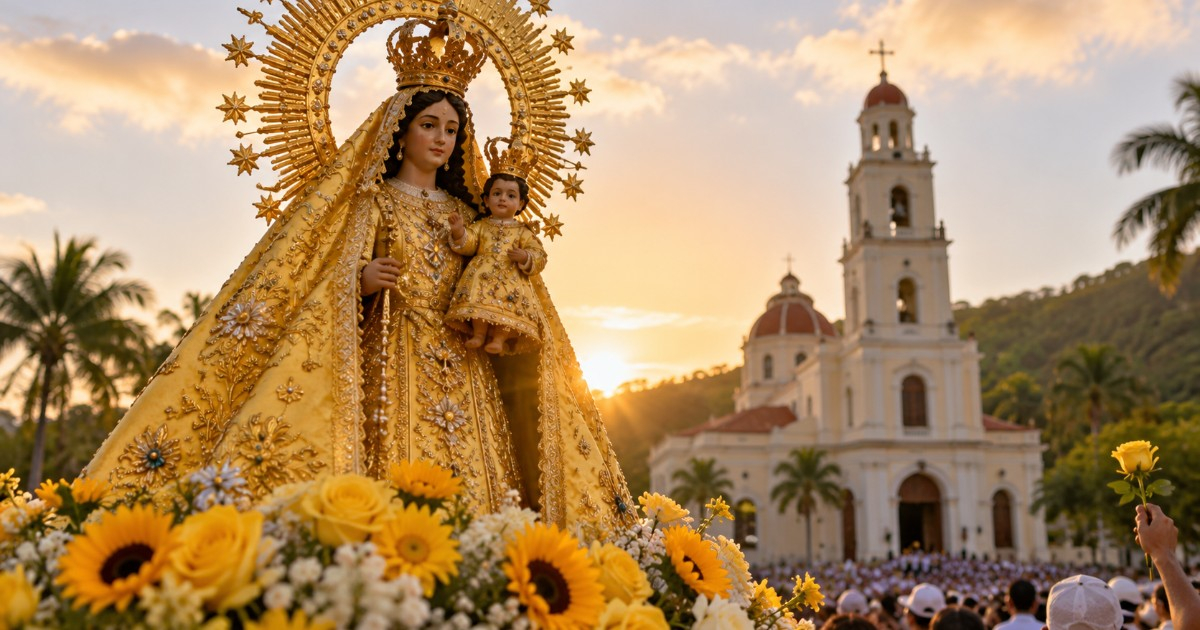
This Tuesday, countless Cubans, both on the island and abroad, are celebrating the Feast of Our Lady of Charity, the official patron saint of Cuba. This devotion, which began over four centuries ago in the waters of eastern Cuba, continues to unite believers from various religious backgrounds in a celebration marked by the color yellow.
The Origins of a Sacred Icon
The story of this revered figure traces back to the early 1600s when three men, known as the Three Juans, were navigating the Bay of Nipe in search of salt for the local copper mines. These men were Juan Moreno, an African-descended child, and the indigenous brothers Juan and Rodrigo de Hoyos. After enduring a fierce storm, they discovered a small statue of the Virgin Mary, holding the Child Jesus, floating on the sea. Remarkably, the image bore the inscription: "I am the Virgin of Charity."
What astonished the men most, according to tradition, was that the statue was completely dry despite being found on the water.
A Continued Devotion Through History
The statue was initially taken to Barajagua and eventually to the town of El Cobre, where it became the center of an enduring devotion among miners, farmers, and the residents of eastern Cuba.
During the 19th-century wars of independence, Cuban fighters, known as mambises, carried images of the Virgin for protection during battles. After the war, veterans requested Pope Benedict XV to declare her the patroness of Cuba, a request granted on May 10, 1916, officially naming her the Principal Patroness of Cuba. This title celebrates its 110th anniversary this year. In 1936, she was canonically crowned in Santiago de Cuba.
Her sanctuary has welcomed three popes: John Paul II prayed before her image during his landmark visit to Cuba in 1998; Benedict XVI visited in 2012 for the 400th anniversary of the discovery; and Pope Francis, in September 2015, prayed for Cuba's journey towards justice, peace, freedom, and reconciliation.
A Unique Blend of Faiths
Our Lady of Charity holds a unique place in Cuban popular religiosity, as she is syncretized with Ochún, the Yoruba orisha of love, sweetness, fertility, and rivers. This syncretism emerged during colonial times when African slaves identified their deities with Catholic saints to preserve their beliefs. Thus, September 8 is sacred for both Catholics and practitioners of Afro-Cuban religions, with yellow symbolizing both traditions during celebrations.
The National Shrine of Our Lady of Charity, located about 20 kilometers from Santiago de Cuba, is a major Caribbean pilgrimage site. Notable offerings include the Nobel Prize medal donated by Ernest Hemingway in 1954 as a gesture of gratitude to the Cuban people.
The devotion traveled with the Cuban diaspora. In 1961, Luis Gutiérrez Areces secretly brought a replica to Miami, just in time for the first celebration of the patron saint in the city, attended by over 30,000 exiles. Gutiérrez Areces passed away on July 22, 2026, at the age of 89, weeks before this year’s celebration, adding emotional significance to the occasion.
Celebrations Beyond Borders
In Santiago de Cuba, the 2026 festivities included the continuous opening of the sanctuary from Monday afternoon, a midnight mass led by the archbishop, a morning mass, and a 5 p.m. procession of the image under the theme "Charity Unites Us." In Miami, events included a rosary, procession, and solemn mass led by Archbishop Thomas Wenski. Cuban communities in Madrid, Mexico City, Tampa, and New Jersey also held masses and family gatherings in honor of the patroness.
The tale of Our Lady of Charity, originating from the waters of the Bay of Nipe over 400 years ago, continues to be passed down through generations, serving as one of the deepest connections uniting the Cuban people, no matter where they may be.
Understanding the Legacy of Our Lady of Charity
Who were the Three Juans?
The Three Juans were Juan Moreno, an African-descended boy, and the indigenous brothers Juan and Rodrigo de Hoyos, who discovered the statue of Our Lady of Charity.
How is Our Lady of Charity celebrated in different locations?
Celebrations include masses, processions, and gatherings in places like Santiago de Cuba and Miami, with additional observances in cities like Madrid and New Jersey.
What is the significance of the color yellow in these celebrations?
Yellow is a shared color symbolizing both the Catholic devotion to Our Lady of Charity and the Afro-Cuban veneration of Ochún, reflecting the syncretism of these traditions.