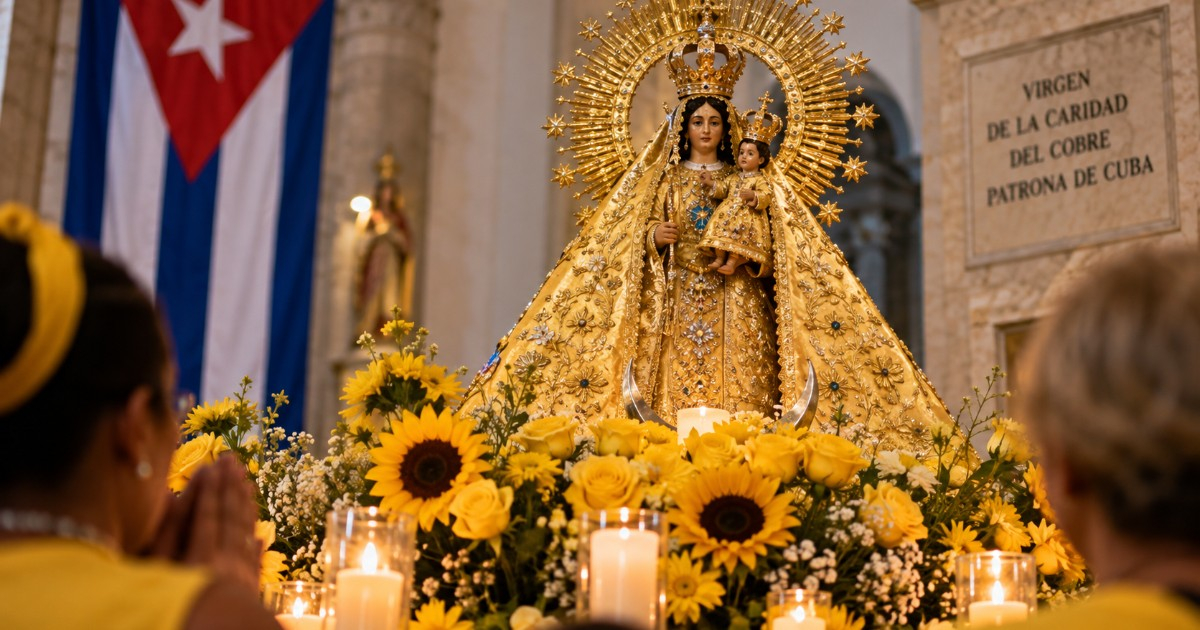
On September 8th, countless Cubans, both on the island and around the world, come together to celebrate Our Lady of Charity, the patron saint of Cuba and one of the most revered religious figures in the nation. This day is a convergence of Catholics, practitioners of African-origin religions, and those who, regardless of faith, uphold a tradition deeply intertwined with Cuba's national identity.
Affectionately known as Cachita, Our Lady symbolizes hope, protection, and solace for many Cubans during challenging times. In the Yoruba religion practiced on the island, she is also associated with Ochún, the orisha of love and prosperity, a testament to the religious syncretism defining Cuban culture.
Ways to Honor Our Lady of Charity Today
There is no single way to celebrate this day, as each believer experiences it uniquely. Nonetheless, certain traditions are widespread among Cubans:
Attending a mass or joining a procession in her honor. Visiting a church or shrine where her image is displayed. Lighting a white or yellow candle as a symbol of faith, hope, or gratitude. Offering prayers for health, protection, prosperity, or family welfare. Placing yellow flowers or sunflowers as offerings. Wearing yellow or gold clothing, colors linked to both Our Lady and Ochún. Sharing food with family, neighbors, or those in need as an act of solidarity.
Common Rituals Among Devotees
The following practices are part of popular tradition and are common among many devotees.
Spiritual cleansing bath: Some individuals prepare a bath with water, yellow flower petals, and a few drops of perfume or cologne. This ritual signifies renewal, spiritual cleansing, and the opening of new paths.
Offerings of honey and fruits: Followers of the Afro-Cuban tradition often present honey, pumpkin, melon, oranges, sweets, or yellow flowers as a sign of respect and gratitude to Ochún.
Writing a petition: Another custom involves writing a wish or a note of thanks on paper and placing it near an image of Our Lady while dedicating a moment to prayer or reflection.
A moment of silence and gratitude: Many take this day to express gratitude for health, family, or work, and to seek strength in the face of adversity. Beyond religious beliefs, it's a day inviting reflection and hope.
A Tradition Passed Down Through Generations
Devotion to Our Lady of Charity began over four centuries ago with the renowned discovery of her image in the Bay of Nipe by the so-called Three Juanes. Since then, her presence has accompanied significant moments in Cuba's history and remains a symbol of unity for millions of Cubans worldwide.
Every September 8th, the National Shrine of El Cobre in Santiago de Cuba welcomes thousands of pilgrims fulfilling promises, giving thanks for favors, or simply paying homage to the nation's patroness. Simultaneously, churches and homes in cities like Miami, Madrid, Mexico City, and other Cuban diaspora communities commemorate the day with masses, altars, and family gatherings.
Through prayer, a candle, an offering, or a simple act of solidarity, the Day of Our Lady of Charity remains one of the most significant religious and cultural celebrations for Cubans, weaving faith, tradition, and identity into a single day.
Understanding the Significance of Our Lady of Charity
Why is Our Lady of Charity important to Cubans?
Our Lady of Charity is a symbol of hope, protection, and unity for Cubans, deeply embedded in the national identity and religious syncretism.
What are common ways to celebrate this day?
Common celebrations include attending mass, lighting candles, making offerings, and sharing food, reflecting personal beliefs and community spirit.
How does the celebration reflect religious syncretism in Cuba?
The celebration blends Catholic and Yoruba traditions, linking Our Lady of Charity to Ochún, showcasing Cuba's unique cultural and religious fusion.