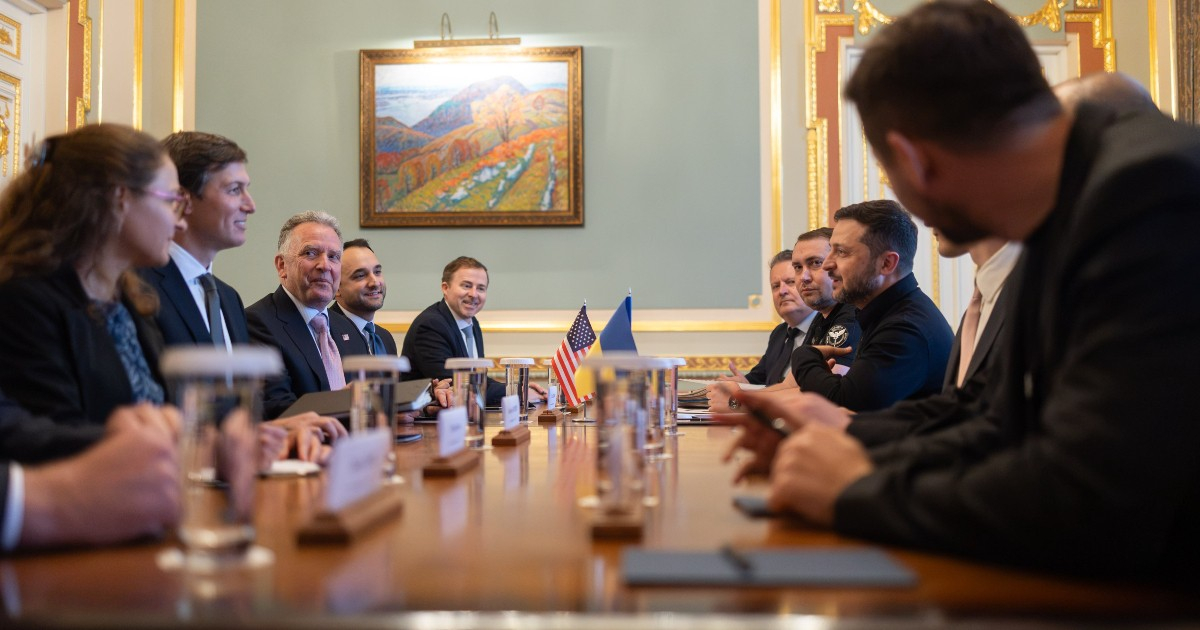
American diplomatic envoys Steve Witkoff and Jared Kushner completed a significant diplomatic mission on Monday, which included stops in Moscow followed by Kyiv. Their journey has opened the door for potentially renewed trilateral discussions among the United States, Russia, and Ukraine aimed at ending the ongoing conflict.
On Saturday, Witkoff and Kushner engaged in a lengthy meeting with Russian President Vladimir Putin at the Kremlin's Grand Palace, lasting over three hours. While Moscow described the talks as "very useful," no concrete progress was announced.
The following day, the envoys traveled to Ukraine's capital, where they consulted with President Volodymyr Zelensky about their discussions with Putin. This marked the first visit to Kyiv by either envoy since the conflict began.
In addition to meeting with Zelensky, Witkoff and Kushner also held discussions with representatives from Germany, France, and the United Kingdom in Kyiv.
In a social media post, Witkoff summarized the diplomatic tour's outcome, stating, "Significant progress was made, including readiness to schedule new trilateral talks."
An unnamed senior Ukrainian official told the AFP news agency that the envoys presented "new and more effective" proposals for ending the war. However, Zelensky cautioned that fighting would likely continue through the winter months.
President Zelensky shared on Facebook that he met with his negotiating team and is advancing preparations, writing, "We are coordinating our next steps. We are preparing for upcoming meetings and communications."
From Moscow, Kremlin spokesman Dmitry Peskov did not rule out the possibility of a new dialogue format. "We do not exclude the resumption of the tripartite format, but it is still too early to discuss specific venues and dates," he told reporters, expressing gratitude for the efforts of the American negotiators by noting that "every attempt is a step towards peace."
This diplomatic tour occurs amid a standstill in negotiations. The last formal round of talks between Moscow and Kyiv was held in Geneva in February 2026, organized by Washington, and ended without resolving territorial disputes. A major sticking point remains the Donbas region, which Russia insists on retaining as a condition for any peace agreement, a demand Ukraine opposes.
Washington's diplomatic efforts had lost momentum in previous months, partly due to the Trump administration's shift in focus to the conflict with Iran. During this time, Putin dismissed Zelensky's proposal for direct negotiations in a neutral third country and continued his military campaign.
The war, initiated by Russia's full-scale invasion in 2022, has resulted in the deaths of at least 15,000 civilians, according to the United Nations, which warns that the actual toll is likely much higher. The total number of casualties, including military losses, is in the hundreds of thousands.
On Monday, the UN High Commissioner for Human Rights, Volker Türk, voiced concern over the use of fully autonomous drones in the conflict and called for an urgent ban on weapons capable of killing without human intervention.
The prospect of resuming trilateral dialogue comes weeks after Zelensky met with Trump at the White House to discuss reactivating diplomatic efforts. However, neither Moscow nor Washington has set a date or location for potential new talks.
Trilateral Negotiations on Ukraine: Key Questions
What was the purpose of Witkoff and Kushner's visit to Moscow and Kyiv?
The visit aimed to explore the possibility of renewing trilateral talks among the United States, Russia, and Ukraine to resolve the ongoing conflict.
Did the meetings result in any concrete agreements?
While significant progress was reported, no concrete agreements were announced following the discussions.
What are the major obstacles to peace talks between Russia and Ukraine?
The main hurdle remains the status of the Donbas region, with Russia demanding control as a precondition for peace, which Ukraine opposes.