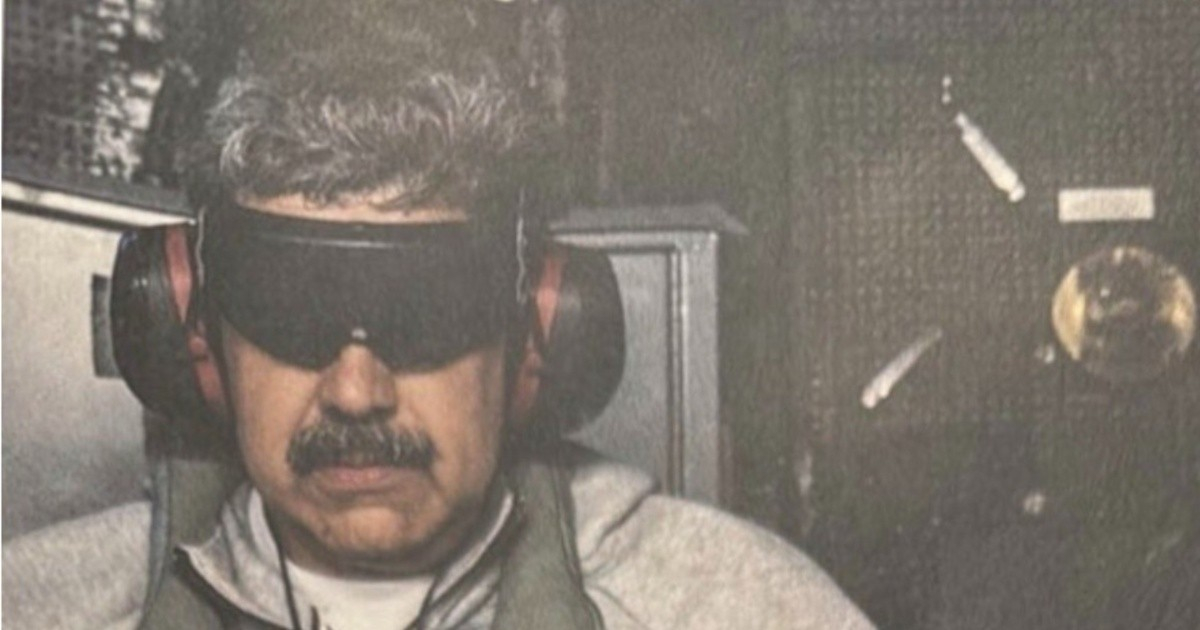
An intelligence report accessed by Infobae uncovers that Nicolás Maduro disregarded a clear warning from his own Defense Minister about an impending U.S. military operation aimed at capturing him, just six days before the operation was successfully executed.
The document reveals that the warning was issued on December 28, 2025, during a high-level meeting held just hours before the presidential address at the Venezuelan Naval Academy. Attendees included Cilia Flores, Diosdado Cabello, Jorge Rodríguez Gómez, General-in-Chief Vladimir Padrino López, and other senior military officials.
Padrino López was the one who "warned of the potential for a military attack by the United States" and advised the cancellation of holiday leaves, strengthening of military units, and increased operational activity nationwide.
Maduro reacted to the warning with disbelief. According to the report, he assured those present that intermediaries acting as liaisons between his government and U.S. officials had assured him there would be no military actions "against state institutions or against him or his family."
The then-president was convinced that the deployment of Operation Southern Spear was merely a pressure tactic and not a prelude to direct action. This interpretation was supported by Cabello and Jorge Rodríguez, who argued that cancelling holiday leaves "would cause panic within the Armed Forces and could trigger internal uprisings."
The document is explicit: "both Maduro and Cilia Flores dismissed the warning as credible and did not believe Padrino López possessed the necessary strategic capabilities" to assess the threat during such a tense period.
While this meeting took place in Caracas, parallel diplomatic efforts were underway outside Venezuela. According to a disclosure by The Washington Post, Cardinal Pietro Parolin, the Vatican's Secretary of State, urgently summoned U.S. Ambassador to the Holy See, Brian Burch, just before Christmas to offer Maduro a negotiated exit: asylum in Russia with guarantees from President Vladimir Putin, protection for his inner circle, and the possibility of retaining his assets abroad.
The Trump administration rejected this proposal. President Donald Trump insisted that Maduro should be brought to the United States to face narcoterrorism charges, along with a $25 million reward for his capture.
The report also notes, citing Reuters, that Trump administration officials had contact with Diosdado Cabello before and after January 3, 2026. Cabello was reportedly warned not to activate repression mechanisms or mobilize the ruling party's bases or shock groups against the opposition. The document suggests that agreements were in place to ensure the continuity of the Chavista power structure after Maduro's departure, which may explain why both Cabello and Jorge Rodríguez dismissed Padrino López's warning without hesitation during that meeting.
On January 3, U.S. military forces carried out Operation Absolute Resolution, extracting Maduro and Cilia Flores from Venezuelan territory. The operation resulted in casualties and material damage at Fuerte Tiuna in Caracas.
Following the capture, the entire military command was overhauled. Padrino López and the head of the Ceofanb, Domingo Hernández Lárez, were dismissed by interim President Delcy Rodríguez on March 18, 2026. The head of the Aerospace Defense Command, José Luis Tremont Jiménez, was replaced just hours after the extraction, and his successor lasted only seven months before being replaced in August of this year.
The Vatican later confirmed it had attempted to mediate an exit for Maduro but described the leak of that confidential conversation as "disappointing," noting that the leaks did not accurately reflect the true content of the dialogue.
Key Insights on the U.S. Operation to Capture Maduro
What led to the U.S. military operation against Nicolás Maduro?
The operation was prompted by allegations of narcoterrorism against Maduro, with the U.S. offering a $25 million reward for his capture, and the belief that diplomatic measures were ineffective.
Why did Maduro ignore the warning about the U.S. operation?
Maduro dismissed the warning due to assurances from intermediaries that there would be no military action against him, believing the U.S. deployment was merely a pressure tactic.
What role did the Vatican play in the situation?
The Vatican attempted to mediate a negotiated exit for Maduro, offering asylum in Russia with protection and asset retention, although these efforts were ultimately rejected by the U.S.