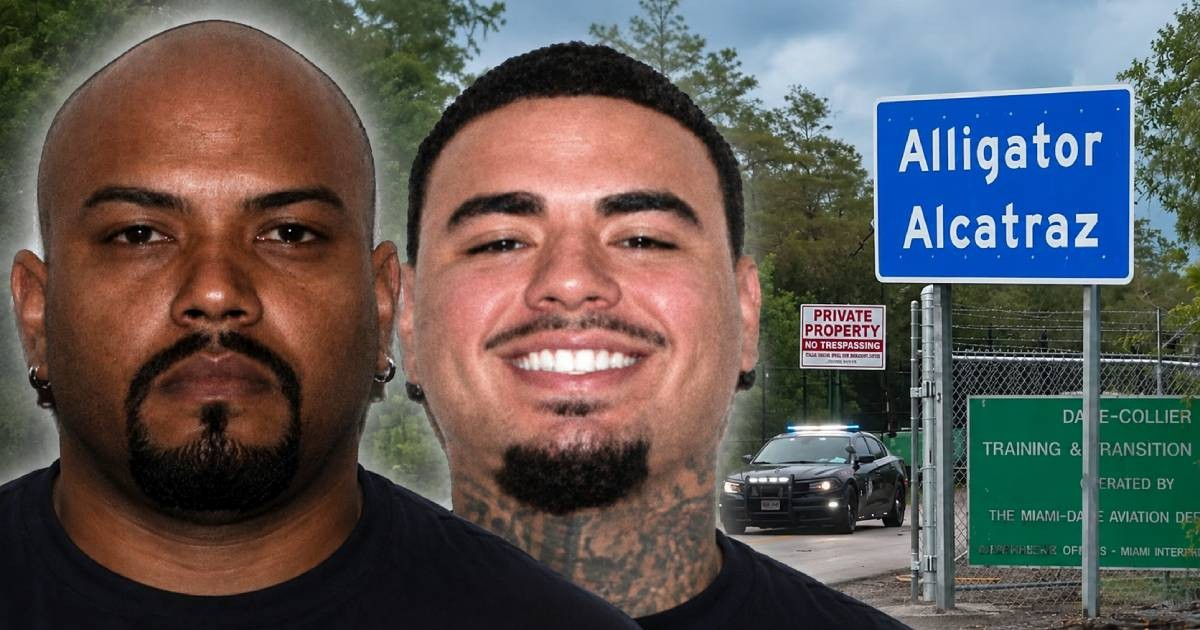
Two former guards from the controversial immigration detention center known as "Alligator Alcatraz" are facing criminal charges for allegedly assaulting Rigoberto Rodríguez Arce, a 42-year-old Cuban who was detained at the facility in the Everglades, Florida.
According to court records from Collier County, cited by Univision, Stephen Jordan Trejos and Andre Junior Seenaraine have been charged with physical assault, a first-degree misdemeanor in Florida, following an incident on January 25. Both have pleaded not guilty to the charges.
Rodríguez Arce was taken into custody by Immigration and Customs Enforcement (ICE) on December 9, 2025.
Protest Incident Leads to Assault
The incident occurred during a detainee protest where individuals were banging their handcuffs against metal benches to demand food and water after being deprived for hours, as reported by sources.
Frank Rivera, another migrant who witnessed the event, stated that Trejos lifted Rodríguez Arce and threw him to the ground before assaulting him. In a separate area of the facility, Seenaraine allegedly struck the Cuban in the face.
Following the assault, Rodríguez Arce was transferred to Camp East Montana, a detention center near El Paso, Texas.
Conflicting Accounts and Legal Proceedings
His attorney, Yaritssa Plasencia, described his condition upon arrival: "He was in a blood-stained uniform, with a bandaged hand and a black eye."
However, Trejos' defense presents a different narrative, requesting the case be dismissed. His lawyers claim that security footage shows the guard using a control maneuver after Rodríguez Arce allegedly spat at him.
The Florida Department of Law Enforcement (FDLE) conducted an investigation. A Collier County judge issued arrest warrants in late June, and Seenaraine was apprehended in August. Both defendants were released on a $1,000 bail each.
Wider Allegations Against "Alligator Alcatraz"
These accusations add to other complaints from Cuban immigrants who were held at "Alligator Alcatraz." In April, Raiko López Morffi reported being assaulted by eight guards after protesting the difficulties in making phone calls. He claimed to have been placed in isolation for nine days without proper medical care.
The facility, officially known as the South Florida Reception Center, began operations in July 2025 at the former Dade-Collier Training and Transition Airport in the Everglades, as part of Florida's immigration strategy in collaboration with the federal government.
The contentious center was permanently closed in June 2026, less than a year after opening. The last detainees were either moved to other facilities or deported, and the state ordered the complete dismantling of the site. Governor Ron DeSantis reported that approximately 22,000 people passed through the center during its operation.
The facility was embroiled in controversy due to its high cost and allegations concerning detainee conditions. Amnesty International documented what it described as "inhumane" conditions, including overcrowding, lack of access to potable water and medical care, and punitive practices against detainees.
The Department of Homeland Security (DHS) consistently denied the allegations regarding detention conditions, asserting that individuals in immigration custody received adequate food and medical care.
The criminal proceedings against Trejos and Seenaraine remain active in Collier County.
This case highlights the evolving landscape of immigration. Stay informed on detention centers, immigrant rights, and more in our U.S. Immigration section.
Frequently Asked Questions about "Alligator Alcatraz" and Immigration Issues
What were the charges against the former guards of "Alligator Alcatraz"?
Stephen Jordan Trejos and Andre Junior Seenaraine were charged with physical assault, a first-degree misdemeanor in Florida, for allegedly attacking a Cuban detainee at the facility.
Why was "Alligator Alcatraz" controversial?
The facility faced criticism for its high cost and reported poor conditions for detainees, including overcrowding and lack of access to basic necessities, which led to numerous complaints and its eventual closure.
How did the authorities respond to the allegations of poor conditions?
The Department of Homeland Security (DHS) repeatedly denied these allegations, maintaining that detainees received proper food and medical care.