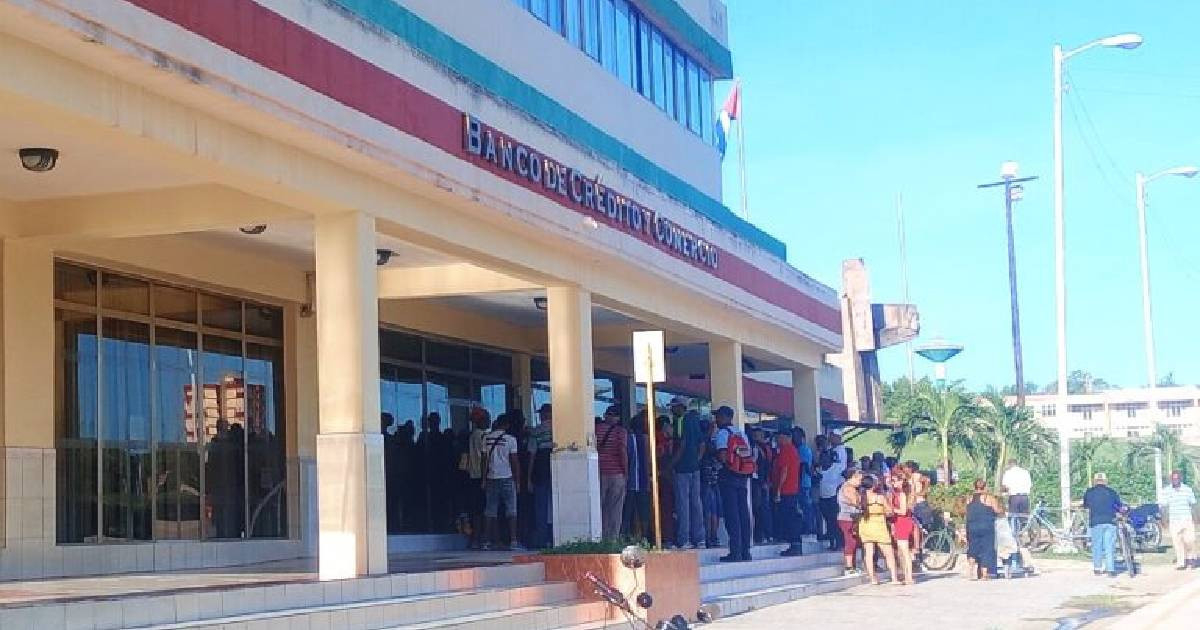
On Saturday, provincial leaders in Guantánamo discussed expanding pension payments through private enterprises, cooperatives, and self-employed workers. This move aims to ease the burden on banks and spare the elderly long waits that have plagued them for months.
This issue was the focal point of a daily review meeting on the operational, economic, and social status of the province, led by the top officials of the Cuban Communist Party (PCC) and territorial government, with all municipalities attending via audioconference, according to Radio Guantánamo.
Guantánamo is home to over 49,600 pensioners, highlighting the urgent need to involve private microbusinesses, non-agricultural cooperatives, and self-employed individuals as alternative payment centers, reducing reliance on bank branches.
Governor Alis Azahares Torreblanca emphasized the need to expedite agreements between non-state actors and banks to advance this initiative.
Yoel Pérez García, the PCC's first secretary in the province, directed the National Association of Small Farmers to coordinate with cooperatives and production forms to integrate them into the scheme, facilitating pension payments to farmers.
This renewed effort follows weeks after the scheme, launched in mid-August, showed insufficient results. Initial data revealed that 113 private businesses were disbursing pensions to over 3,000 retirees, falling short of the goal to enable 70% of Guantánamo's pensioners to receive payments this way.
An article from the official Venceremos newspaper noted that Guantánamo had a total of 68,000 retirees, with 18,000 receiving cash payments via post offices and the remaining 50,000 through cards.
The failure of the banking process became evident when pensioners once again crowded outside the BPA on Prado Street in Guantánamo City, waiting in the sun for cash withdrawals.
"It's a horror, very sad what is happening, and many elderly even faint there," commented one citizen in a video circulating on social media.
The crisis stems from a systemic liquidity shortfall that the provincial government acknowledged in July: Bandec was capturing only 35% of the nearly 15 million pesos needed daily to function, while Venceremos admitted the situation "has evolved from a banking issue into a social problem."
The national adoption of private payment schemes was formalized under Central Bank of Cuba's Resolution 74/2026, effective since July 20, as part of 176 economic transformations approved by the National Assembly. The pilot began in April in four Havana municipalities and expanded in May to Holguín.
The irony of the model is not lost, as the government mandates private businesses to accept electronic payments under threat of penalties, while simultaneously charging them with distributing the cash that state banks lack.
Economist Elías Amor criticized the scheme as "madness," noting that pension payment "is a state responsibility that cannot be offloaded onto the private sector."
Cuba has over 1.7 million retirees with a minimum pension of 4,000 pesos monthly, less than $10 at the informal exchange rate, while a basic basket of goods is estimated to cost over 50,000 pesos monthly.
Guantánamo Pension Payment Reforms
Why is Guantánamo shifting pension payments to the private sector?
The shift aims to alleviate congestion in banks and reduce wait times for elderly pensioners, allowing for more efficient payment processes through private entities.
What challenges are associated with this new payment scheme?
Challenges include the limited success of private businesses in handling the volume of payments and the systemic liquidity issues faced by the state banks.
How many retirees are affected by these changes in Guantánamo?
The changes impact over 68,000 retirees in Guantánamo, with a significant portion currently depending on bank branches for their pension payments.