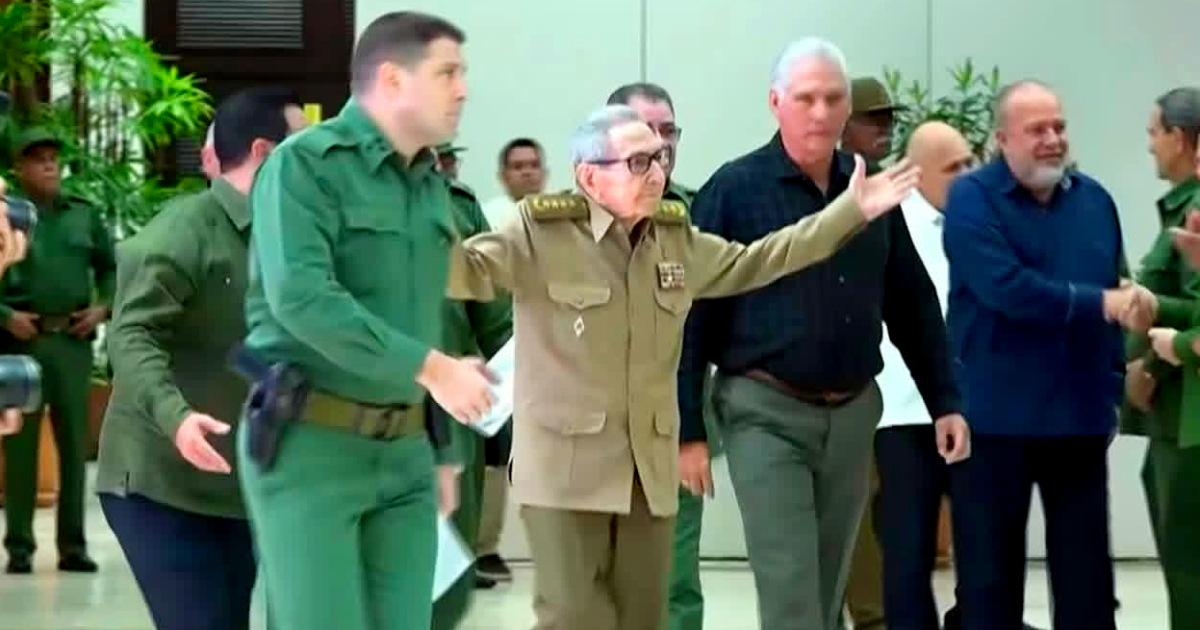
This past weekend, the Cuban regime once again leaned on one of its favorite propagandistic images to portray Raúl Castro: that of the seasoned warrior who, despite his years, remains ostensibly ready for battle.
During a ceremony in Havana marking the 65th anniversary of the Ministry of the Interior's Personal Security Directorate, attended by Castro and Miguel Díaz-Canel, Brigadier General Emir Mesa Corona asserted that the 95-year-old former leader remains "at the ready, poised to defend the Revolution."
The phrase is neither accidental nor new. It has become a staple in the propaganda surrounding Castro since he formally stepped down from the leadership of the Communist Party of Cuba (PCC) in 2021.
In his farewell address, Raúl himself declared he would continue as a "revolutionary combatant, prepared to contribute modestly until the end of life" and would remain "ready to defend the homeland, the Revolution, and socialism with more vigor than ever."
The Symbolic Power of Raúl Castro
Since then, official media has repeatedly invoked this equestrian metaphor to convey a specific message: although Raúl has relinquished his formal titles, he retains his symbolic power and role as guardian of the Castro-built system.
This time, Cuban leadership took the rhetoric even further. In their account of the event, the presidency described Castro as a man of "steadfastness" and an "invincible guerrillero," while Mesa Corona lauded him as an "example of austerity" and "paragon of organization, planning, demand, and discipline."
The head of Personal Security further claimed that Raúl "has dedicated his life to upholding the principles of the Socialist Revolution" and posited that he teaches that "no battle is impossible to win."
An Old Warrior in a New Light
This epic portrayal starkly contrasts with the protagonist's age and the persistent rumors about his health that accompany his frequent absences from public view.
On Saturday, Castro remained seated in the front row throughout the ceremony, received acknowledgment as the "Founding Chief" of the Personal Security Directorate, and listened to the tributes prepared in his honor. His appearance was particularly significant given the recent speculation about his health.
CiberCuba has previously documented how each wave of rumors about Castro tends to spark an official response aimed at publicly reaffirming his political vitality.
From "Raúl is Raúl" to "Ready for Battle"
One notable instance occurred in September 2025. Following the circulation of false reports about the general's death, state institutions, ministries, official media, and regime-affiliated accounts launched a coordinated campaign under the slogans "Raúl is Raúl" and "Still Here."
The posters shared identical colors, designs, and messages. In them, Castro appeared in olive green, once more accompanied by the slogan "Ready for Battle."
The Ministry of Tourism even declared, "Still ready for battle. He hasn't stepped down, he hasn't left. His presence continues to mark the way."
The phrase "Raúl is Raúl" also echoes an older tactic of Cuban official discourse: using the leader's name as enough justification for his authority.
For decades, "Fidel is Fidel" served as an expression of the exceptionalism attributed to the regime's founder. In 2022, even Prime Minister Manuel Marrero Cruz resorted to the phrase "Fidel is Fidel and Raúl is Raúl" while discussing the need to maintain Cuban trust in their leaders.
The Surviving Legacy of Epic Narratives
The regime's insistence on portraying Castro as an active warrior is particularly significant as they face the inevitable aging and passing of the generation that seized power in 1959.
CiberCuba noted in 2023 the contradiction between the announced generational shift and the continued presence of Raúl Castro and other historical leaders in power spaces. A year later, following the deaths of several generals of his generation, the outlet revisited the "ready for battle" image to highlight the growing contrast between propaganda of vitality and the relentless passage of time.
Nevertheless, the official apparatus has doubled down on this representation. The recent appearance once again demonstrates this. The propaganda does not simply present a 95-year-old former leader attending a commemorative ceremony: it constructs the image of a perpetual warrior, surrounded by guards turned "family," lurking enemies, martyrs serving as examples, and fighters ready to defend the leadership.
More than five years after formally leaving the Communist Party's leadership, Raúl Castro continues to ride the official narrative on the same imaginary horse.
And the regime insists he still has one foot in the stirrup.
Understanding Raúl Castro's Enduring Influence
Why does the Cuban regime continue to portray Raúl Castro as a warrior?
The portrayal of Raúl Castro as a warrior serves to maintain his symbolic power and reinforce the image of him as a guardian of the revolutionary system, despite his official retirement from leadership roles.
What is the significance of the phrase "Raúl is Raúl" in Cuban propaganda?
"Raúl is Raúl" is a slogan used to emphasize his enduring presence and authority, much like the earlier "Fidel is Fidel," highlighting his unique status and ongoing influence within the regime.