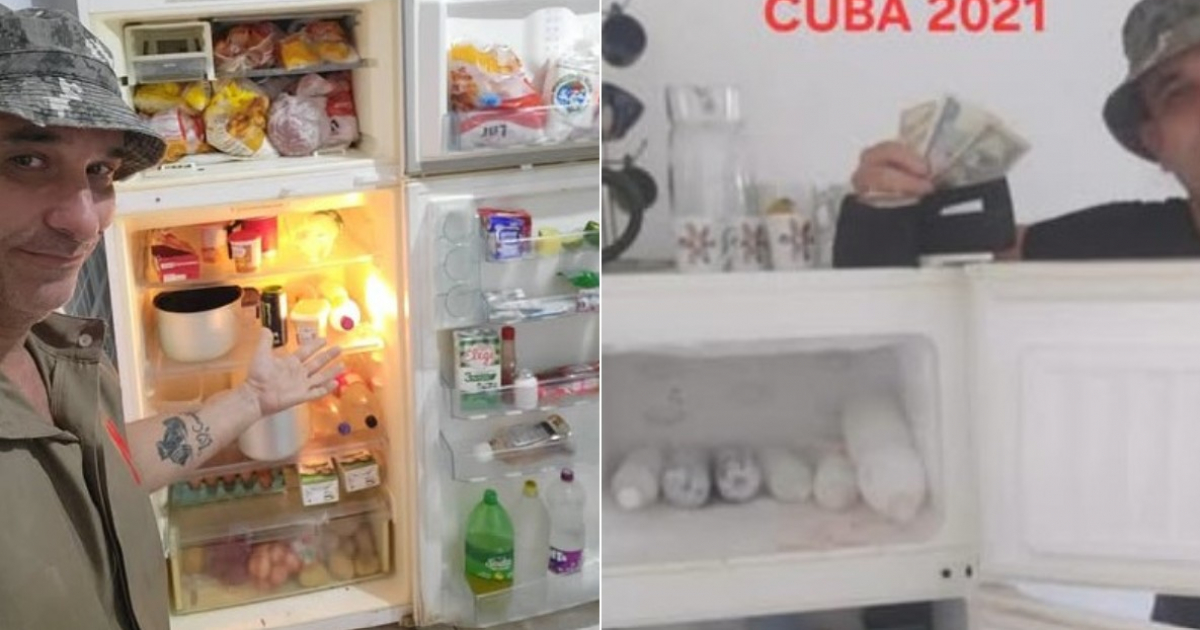
A Cuban lawyer who relocated to Brazil in January shared two telling photos on Facebook, encapsulating his life before and after leaving Cuba. The first image, from 2021, reveals a nearly empty refrigerator, while the second, more recent photo, displays the same appliance abundantly stocked with food.
Manuel Viera, recognized on social media as "Manuel Viera Porelcambio," used these contrasting images to critique the Cuban regime with a touch of irony.
Stark Contrast Between Cuba and Brazil
In the photo labeled "CUBA 2021," Viera is seen peeking from behind an open fridge, sparsely filled with a few packages of ground meat and water bottles in the freezer, alongside half an avocado on the middle shelves. The rest of the shelves are entirely bare.
The "BRAZIL 2026" image depicts a dramatically different scene: Viera, smiling widely, takes a selfie beside a two-door Bosch refrigerator brimming with a variety of products.
Life Transformation in Brazil
Viera has been in Brazil for just seven months and no longer practices law. "Not as a prominent lawyer advising companies, but as a stock clerk in a market," he noted.
He summed up the stark difference with a phrase rich in irony: "It’s the refrigerator of an experienced lawyer in unproductive socialism versus the fridge of a Cuban fighter striving to get ahead while stacking boxes in a capitalist market. Socialism of 'social justice' vs. inhumane and cruel capitalism. No better image."
Challenging the Cuban Regime
He concluded his post with a sarcastic thank you: "Thank you, Communist Party of Cuba. Thank you, State Security Department. Grateful to all of you."
Viera has a significant history of activism in Cuba. In October 2021, he was summoned for questioning at Villa Marista, the Cuban intelligence headquarters in Havana, after penning a public letter to Díaz-Canel denouncing the food crisis and the struggle to find orthopedic boots for his daughter. Upon release, he remarked, "Cuba will not be happy until profound social, structural, political, and economic changes occur."
A Painful Goodbye
In September 2024, he announced the sale of his home in Playa municipality, built "stone by stone," and his car—a vintage Argentine Dodge inherited from his father—to emigrate. He was candid about his motivations: "I am not leaving Cuba because of financial issues; I am leaving due to political problems. I cannot bear the thought of my daughter growing up in a broken society that no one wants to fix."
The farewell process was emotionally draining. When potential buyers came to view the house, he would retreat to the garage inside the car: "I don't have the courage to negotiate my life," he admitted then.
Reflecting a Broader Cuban Exodus
His experience highlights a widespread trend in the current Cuban exodus.
In 2025, Cubans filed over 41,900 asylum applications in Brazil—a surge of 88% from the previous year—making them the leading nationality seeking refuge in the country.
From January to April 2026, there were 13,414 new applications, according to the International Migration Observatory (OBMigra). This figure accounts for 58% of all asylum requests (22,938) recorded in Brazil during that four-month period.
Understanding Cuba's Migration Crisis
Why did Manuel Viera leave Cuba?
Manuel Viera left Cuba primarily due to political issues. He expressed his dissatisfaction with the societal and political conditions in Cuba, stating that he could not tolerate the idea of his daughter growing up in a broken society.
What changes did Viera experience after moving to Brazil?
After moving to Brazil, Viera experienced a significant improvement in his quality of life, as illustrated by the stark contrast between his empty refrigerator in Cuba and the well-stocked one in Brazil. He now works as a stock clerk in a market, a shift from his previous role as a lawyer.
How has the Cuban asylum-seeking trend in Brazil changed over recent years?
Cuban asylum applications in Brazil have surged, with a reported 88% increase in 2025 compared to the previous year. In the first four months of 2026 alone, Cubans accounted for 58% of all asylum requests in Brazil, reflecting a growing trend of emigration from Cuba.