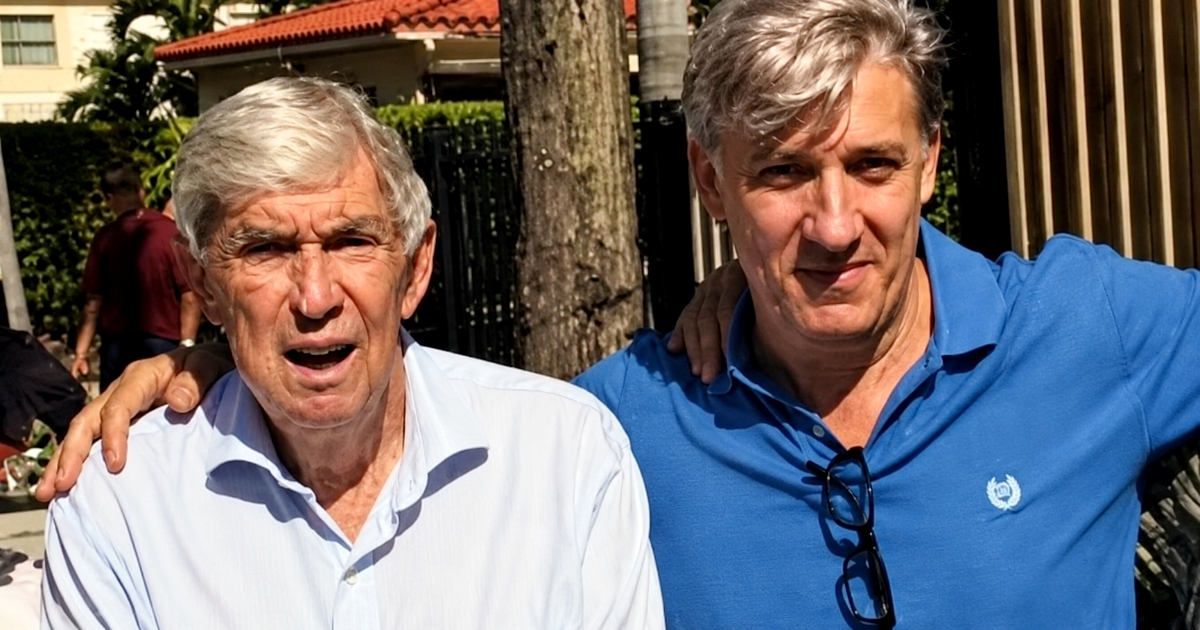
Long before the recent deportation of Fernando Armando Valdés Pérez, a Cuban-Guatemalan national identified by U.S. authorities as a Cuban intelligence asset, suspicions about his activities were already circulating within the inner circle of Luis Posada Carriles.
Several close associates of the prominent anti-Castro activist had harbored doubts about Valdés's behavior for years. One of them claims to have alerted the FBI as early as 2006.
An investigation by journalist Nora Gámez Torres, published in the Miami Herald, reveals how Valdés managed to infiltrate and remain active in Cuban exile circles in Miami, based on testimonies from those close to Posada.
Valdés's Infiltration in Exile Organizations
The Immigration and Customs Enforcement (ICE) asserts that Valdés, now 61, was tasked by Cuban intelligence to penetrate exile organizations since at least the 1990s.
Luis Posada Carriles, a veteran of the Bay of Pigs invasion and former CIA collaborator, was one of the most controversial figures in the Cuban exile community, known for his efforts to overthrow Fidel Castro. Havana blamed him for the 1976 bombing of a Cubana de Aviación plane, which killed 73 people, among other violent acts.
Early Warnings Ignored
Among those who began to distrust Valdés were Orlando González, director of Rescate Jurídico and friend of Posada, and Ernesto Abreu, another close ally.
Alarm bells started ringing in Panama, where Posada and three other men were imprisoned in 2000, accused of plotting to assassinate Castro during an Ibero-American summit. Valdés frequently visited the prisoners, which raised suspicions among González and Abreu due to his lack of prior connection and his ability to afford the costs of bringing food to the detainees. Despite González voicing concerns to the prisoners, including Posada, his warnings were largely dismissed.
Questionable Actions and Offers
One of the most notable incidents, as reported by Gámez Torres, involved Valdés allegedly encouraging Posada to escape from prison by claiming he had cut the perimeter fence and could provide him with a weapon.
In another episode, González recounted how Valdés unexpectedly took him to a meeting in El Salvador with men posing as military personnel offering to supply arms for anti-Castro activities, which he perceived as a potential setup.
Valdés's behavior continued to raise red flags, such as an incident where he was caught trying to make a phone call from a public phone in the early hours, claiming he was contacting his wife. This, coupled with his apartment’s proximity to the Cuban consulate, heightened suspicions.
The FBI's Involvement
González eventually took his concerns to U.S. authorities. Around 2006, after returning from a trip to El Salvador, he reported to the FBI that Valdés might be linked to Cuban intelligence. During his questioning, he interpreted the FBI's inquiries as a sign they might already have information on Valdés.
This raises questions about what U.S. authorities knew about Valdés and why it took so long to act, a mystery that still puzzles Posada’s former associates.
A Direct Confrontation
González also confronted Valdés during a visit to Posada in the hospital, informing him of his suspicions and FBI reports. Valdés’s chilling response suggested that if he were indeed a Cuban spy, he could have killed both Posada and González. González retorted that an agent follows orders, not personal vendettas, criticizing Valdés for infiltrating exile organizations and mingling with Cuban-American political figures.
Valdés's arrest on July 10 at the Miami International Airport during a joint operation by ICE, the FBI, and Customs and Border Protection (CBP) confirmed long-held suspicions. He was deported to Guatemala on August 7 for concealing his intelligence ties during immigration proceedings. No criminal charges for espionage have been announced against him.
Understanding the Impact of Cuban Espionage
Who is Fernando Armando Valdés Pérez?
Fernando Armando Valdés Pérez is a Cuban-Guatemalan national identified by U.S. authorities as a Cuban intelligence asset involved in infiltrating exile organizations.
What were the suspicions about Valdés?
Valdés raised suspicions among Luis Posada Carriles's associates due to his frequent visits to imprisoned anti-Castro activists, unexplained financial resources, and proximity to the Cuban consulate.
How did the U.S. authorities respond to the suspicions?
The FBI was reportedly informed of Valdés's potential links to Cuban intelligence around 2006, but it wasn't until 2023 that he was detained and deported for concealing these ties.