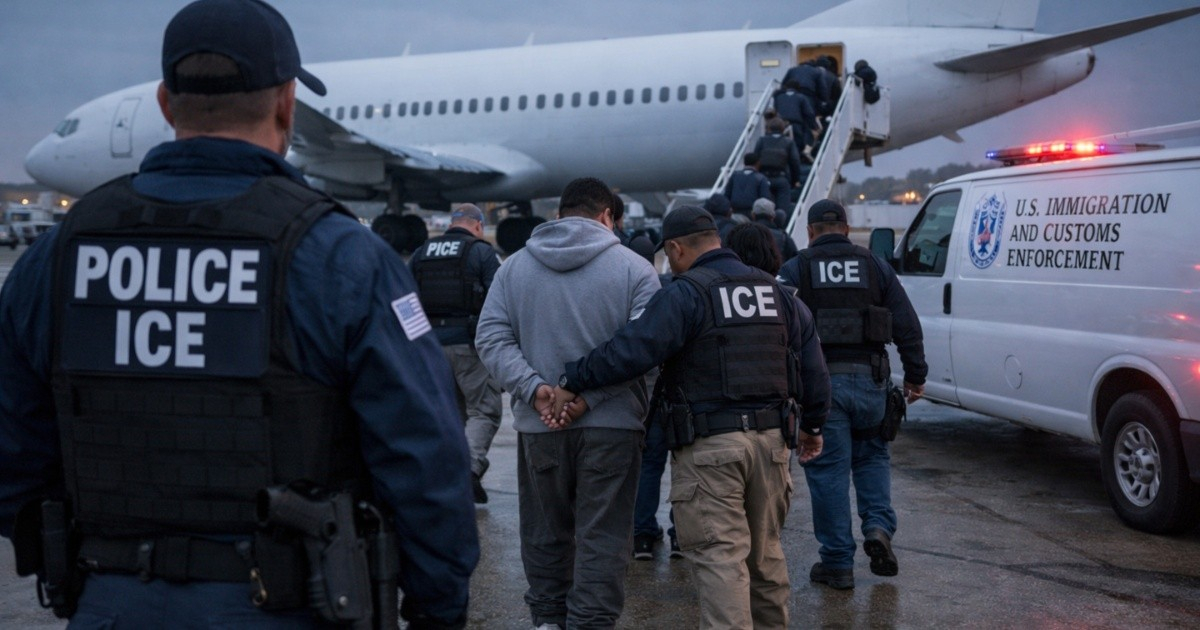
On Saturday, the government of Guyana revealed its decision to accept migrants deported from the United States, marking its entry into the network of migration agreements promoted by the Trump administration, as reported by AFP.
The official statement from President Irfaan Ali's administration outlines stringent conditions: Guyana will only accept a "limited and verified" number of individuals without criminal records who have voluntarily chosen to be relocated to its territory.
Guyana's government portrays this agreement as "an extension of Guyana's longstanding commitment to human rights and international cooperation," according to the official text.
Deportation agreements between the U.S. and other countries continue to expand. Stay updated on all immigration changes in the U.S. and their potential impact on the Cuban community.
The agreement is temporary. Guyana emphasized that the pact "is strictly transitional and does not constitute permanent resettlement," stating that deportees will remain in the country under specific conditions while their migration cases are resolved.
Regarding the ultimate destination of the migrants, the government specified: "Depending on the resolution of each individual case, migrants may return to their country of origin or be relocated to a third destination of their choice."
This announcement aligns with Donald Trump's immigration policy, which since his return to the White House in January 2025, has involved large-scale deportations and negotiations with third countries to accept migrants expelled from the U.S., regardless of their nationality.
Negotiations between Georgetown and Washington are not new. Guyana's Foreign Secretary, Robert Persaud, confirmed in early January 2026 that both countries had been engaged in "productive discussions" about a framework to accept nationals from third countries deported from the U.S. The specialized tracker Third Country Deportation Watch notes that the agreement was signed on November 25, 2025, and made public in March 2026.
Guyana now joins a growing list of nations cooperating with Washington under this scheme. Notably, El Salvador's Center for the Confinement of Terrorism (CECOT) received 250 Venezuelans deported from the U.S.
In August 2026, Liberia received its first deportee flight under an agreement that includes up to 1,200 migrants over 12 months; this group included Cubans among the first deported to Liberia. Eswatini, in turn, signed a pact to accept up to 160 deportees in exchange for $5.1 million in financial assistance.
The bilateral relationship between Guyana and the U.S. has grown concurrently: in August 2026, both countries signed a memorandum of understanding to strengthen security cooperation against drug trafficking, reflecting a broader common agenda.
Guyana also hosts a significant Cuban migrant population. In February 2026, Guyanese authorities intervened in a building in Georgetown housing 77 Cubans, and President Ali urged Cubans residing in Guyana to work through legal channels under the same conditions as Guyanese workers.
According to Amnesty International, Guyana is among at least 15 countries in the Americas that have similar agreements with the U.S. to receive deportees from third countries.
Understanding Guyana's Agreement with the U.S.
What are the conditions for Guyana to accept deported migrants from the U.S.?
Guyana will only accept a limited and verified number of migrants without criminal records who have voluntarily chosen to be relocated to its territory.
Is the agreement between Guyana and the U.S. permanent?
No, the agreement is strictly transitional and does not constitute permanent resettlement. Deportees will remain in Guyana under specific conditions while their migration cases are resolved.
What prompted Guyana to enter into this agreement with the U.S.?
The agreement is presented as an extension of Guyana's commitment to human rights and international cooperation, aligning with the broader immigration policy of the U.S. under Donald Trump's administration.