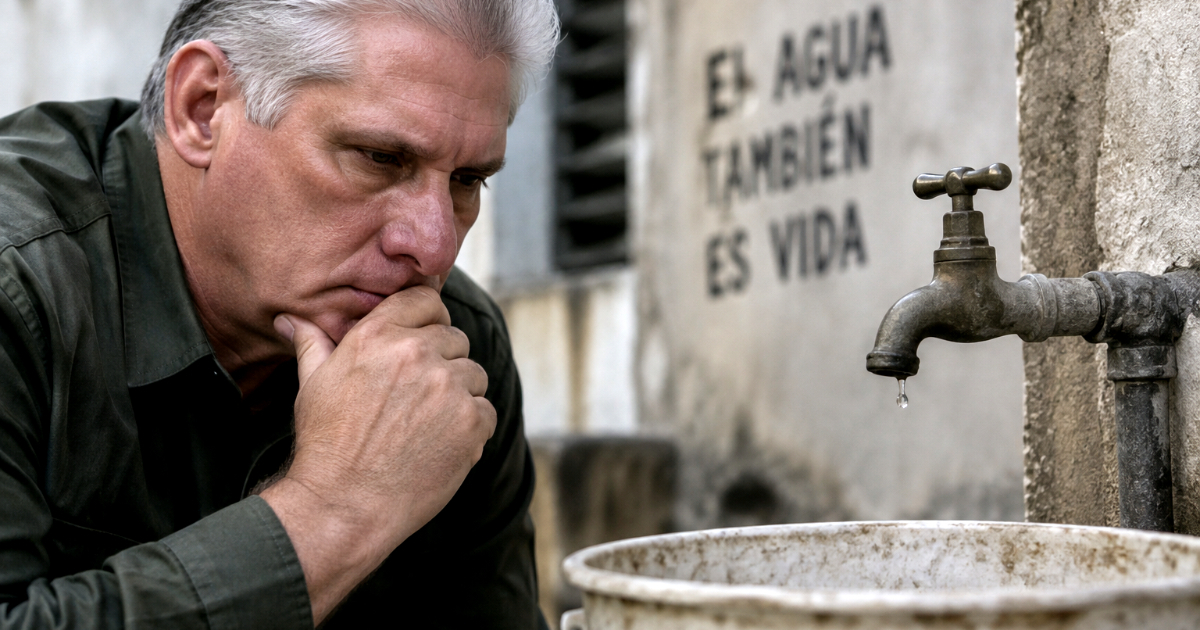
President Miguel Díaz-Canel has announced a new timeline for enhancing Havana's water supply: the end of September.
According to the Cuban Presidency's website, he claims that improvements should start to become evident in two or three of the main water systems by then, with further consolidation of sources expected in October. Additionally, renewable energy solutions are anticipated to be implemented before the year's conclusion.
While the deadline may seem significant, it’s not due to any newfound trust in Díaz-Canel. On the contrary, after eight years of unmet promises, revisions, and plans that seldom deliver the expected results, the end of September stands as a potential test of his credibility.
The fundamental question is no longer what the leader has promised. Instead, it's a straightforward inquiry: what reason do Cubans have to believe him this time?
A Deep-Seated Crisis: More Than Just Another Promise
The issue the new plan aims to address is not a temporary one. In July, over half a million Havana residents were affected by water shortages, a significant increase from the 200,000 affected in April and more than 376,000 in May. Nationally, about 2.7 million Cubans face challenges in consistently accessing water.
This crisis is not solely dependent on rainfall or the condition of reservoirs. Approximately 87% of Havana's pumping system relies on electricity, while the infrastructure has suffered from decades of neglect. Aging pipelines, with 60 to 70 years of use, lead to water loss rates between 40% and 70%, and deteriorated pumping equipment exacerbates the problem.
The government now plans to respond with power generators for 29 water sources, repairs, and later, solar generation and storage systems. However, they have yet to disclose the program's cost, the fuel required, or the number of residents who should regain stable service to consider the first phase complete.
The Electric Paradox: Unkept Promises Amidst Increasing Outages
The connection between water and electricity makes the new announcement particularly uncomfortable.
Díaz-Canel acknowledges that the water systems need 10 to 12 continuous hours of stable electricity to operate effectively. Yet, electricity is one of the areas where the government has repeatedly promised recoveries that never materialized.
Since 2019, Díaz-Canel has talked about eliminating blackouts, stabilizing the system, restoring thermoelectric plants, and transforming the energy matrix. In 2021, he even had to inform the population about the timing of "undesirable blackouts." The government pledged to minimize blackouts by the end of 2022. By 2024, after again banking on repairs and maintenance, Díaz-Canel stated, "We must provide light to our population before the year's end."
However, there was no sustained recovery. In 2024, national disconnections and new fuel crises occurred; by 2026, deficits in the National Electric System exceeded 2,000 megawatts, with some areas experiencing day-long blackouts.
This is the immediate backdrop to the water promise: the same government that failed to secure the electricity needed for pumping now claims it can guarantee water using equipment, fuel, investments, and energy-dependent solutions.
A Repeated Pattern: The Gap Between Words and Actions
Electricity is not an isolated case. It's the most visible example of a larger issue: the disparity between Díaz-Canel's declarations, his government's actions, and the actual outcomes.
In agriculture, the government admitted in 2020 that it failed to meet its rice, bean, and pork production targets. In 2022, Díaz-Canel acknowledged that Cuba lacked "food, livestock, and fish," yet years later, he insisted, "we will eat what we are capable of producing."
The economic recovery promise has also not materialized. Estimates cited by CiberCuba place the 2025 real GDP more than 15% below the 2018 level.
Tourism, touted as one of the country's major engines, concluded 2025 with just 1.81 million international tourists and a hotel occupancy rate of 18.9%. The Minister of Economy admitted that exports only met 62% of the plan.
These figures need not be isolated accusations. Together, they illustrate something more critical: eight years on, the government continues to announce solutions to issues it had already vowed to resolve.
Currency Stores: When Reality Contradicts Rhetoric
The case of MLC stores is another example of the gap between rhetoric and reality.
In 2020, Díaz-Canel denied that Cuba would dollarize and assured that CUP and CUC stores would continue. The first currency stores were introduced as a concrete measure to attract resources and support the economy.
However, a different scenario unfolded: the network expanded, basic products shifted to these circuits, and dollar-only establishments emerged. The government itself acknowledged the existence of a "partial dollarization."
Meanwhile, CiberCuba documented the expansion of dollar-only stores and the shortages in MLC establishments.
The lesson is not that a measure cannot change. It's that what is announced, what is done, and what the population experiences can be vastly different.
From "Prosperity" to 176 Economic Measures
In 2018, upon assuming the presidency, Díaz-Canel promised to progress towards a "prosperous and sustainable socialism" and assured that there would be no "capitalist shifts" in Cuba.
Eight years later, the government had to resort to a package of 176 economic measures that expanded the space for private activity, foreign investment, and various market mechanisms.
Determining whether this change signifies abandoning socialism is not necessary here. The point is this: the same leader who promised prosperity ended up having to fundamentally alter economic rules because reality did not deliver the promised prosperity.
This is the context in which the water promise now arrives.
The Real Test Will Be Results
Therefore, the end of September should not be judged by the number of generators installed, meetings held, or repairs announced. The assessment should be much simpler.
How many Havanans regain access to water? For how many hours? With what regularity? How many stations operate stably? What happens when the National Electric System fails again?
These are the indicators that will reveal if the plan works. Everything else is rhetoric.
Díaz-Canel has stated that it is necessary to "reinvent the entire water supply management system." That may be true. But this statement also acknowledges that the system the government has managed for decades now requires reinvention.
After years of promises regarding electricity, food, growth, wages, tourism, and basic services, the issue is no longer about what the leader announces. It is about how much credit his word deserves.
By the end of September, the first answer will not come from Díaz-Canel. It will come from the faucet.
Understanding Cuba's Water and Electricity Challenges
What are the main challenges with Havana's water supply?
The main challenges include outdated infrastructure, with pipelines decades old leading to high water loss rates, and a heavy reliance on electricity for pumping, which is unstable due to frequent blackouts.
How does electricity impact water supply in Havana?
Electricity is crucial for operating the water pumping systems. Frequent power outages disrupt these systems, exacerbating the water supply problem as stable electricity is needed for consistent water distribution.
What solutions has the government proposed for the water crisis?
The government plans to use power generators, implement repairs, and later introduce solar generation and storage systems to improve water supply stability.