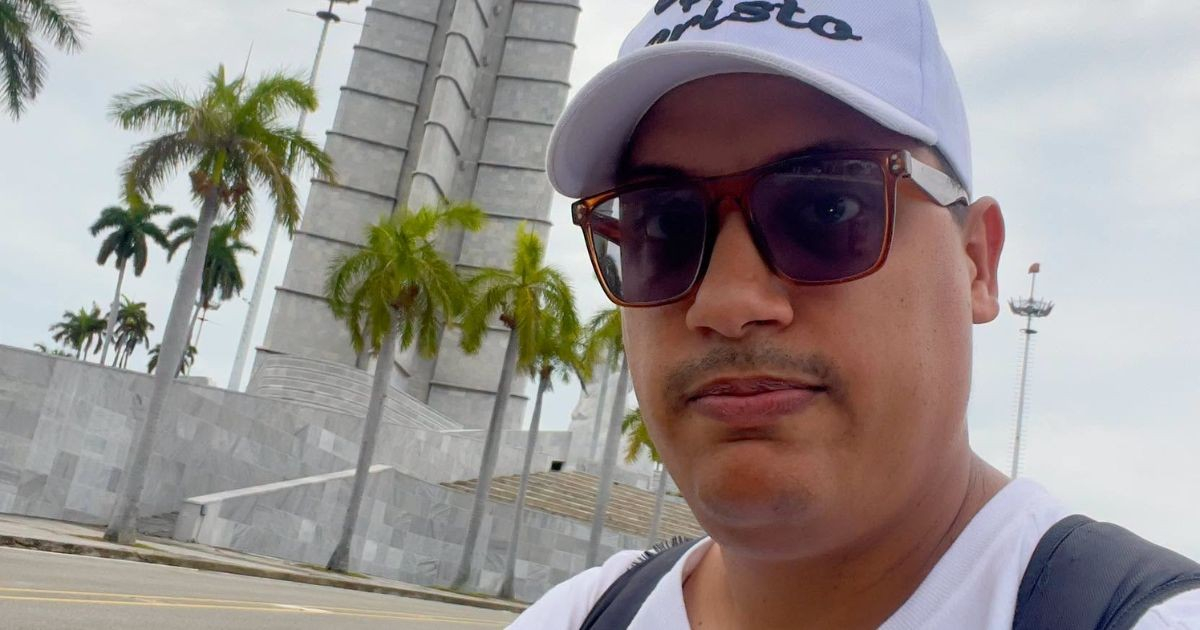
David Espinosa, a Christian activist and young father, raised concerns on Thursday about the tenth-grade official Political Culture textbook in Cuba. He revealed that it includes a chapter portraying international coverage of the July 11, 2021 protests as "fake news," thus transforming the suppression of that social uprising into indoctrination material for Cuban teenagers.
Espinosa shared images of the textbook on his Facebook profile, showing a dialogue seemingly from the state-run program Mesa Redonda. The conversation involves its host, Randy Alonso, and then-President Miguel Díaz-Canel. The book also features screenshots of international news marked with "FAKE NEWS" and "BULO" in red.
"Perhaps Cuba lacks scientific or economic advancements… but our children will certainly be up-to-date on the ideological narratives preferred by our government," Espinosa commented with evident sarcasm.
Indoctrination in Cuban Education
Among the content labeled as misinformation is a headline from ABC Internacional, described by Alonso as "a Spanish Francoist newspaper." It reported the alleged resignation of the First Deputy Minister of the Interior due to disagreements over excessive force against protesters.
The textbook also includes statements from Díaz-Canel denying the extent of the crackdown: "Where are the thousands of dead? Where are the cases of deaths in Cuba? We acknowledge one casualty and are conducting a thorough investigation."
Contrasting Narratives
In contrast, independent human rights organizations documented over 1,400 arrests related to the 11J protests. Human Rights Watch cited this number, sourced from Cuban organizations like Cubalex, in its report on the crackdown published a year after the demonstrations. At least 701 individuals remained imprisoned according to Amnesty International, starkly opposing the official version in the school textbook.
The text also accuses international media of using misleading images. According to Díaz-Canel, a photo purported to show Havana's Malecón was actually of Alexandria, Egypt, and another depicted Argentine celebrations for the Copa América.
Systematic Political Indoctrination
Espinosa views this as part of a systematic pattern pervasive throughout Cuban life: "Political indoctrination in Cuba spans from birth to death—on TV, in hospitals, on street billboards, in schools, and in state workplaces."
Despite some false or misleading images circulating after the massive 11J protests, the regime's lack of transparency has historically contributed to misinformation. However, the reality documented in numerous citizen videos and various reports significantly differs from the Cuban dictatorship’s narrative, which downplays the events as minor disturbances.
The Political Culture textbook is part of a mandatory pre-university curriculum in Cuba, published by the Editorial Pueblo y Educación under the Ministry of Education's supervision. The Academic Freedom Observatory previously warned in September 2024 that the so-called Third Education Enhancement redesigned 506 textbooks with heavy doctrinal content, glorifying figures like Fidel Castro, Che Guevara, and Díaz-Canel himself.
Espinosa is no stranger to the repression he denounces. The regime has attempted to silence him multiple times: he's been summoned by the Ministry of the Interior, State Security agents have tried to recruit him as an informant, and ETECSA has cut off his phone lines in coordination with his wife, Laidy García, and other activists.
Despite these challenges, the activist continues to voice his resistance through social media, drawing strength from his Christian faith.
The 11J protests, the largest social uprising in Cuba in decades, originated in San Antonio de los Baños due to power outages and shortages of food and medicine, spreading to over forty cities and towns across the island. Five years later, the regime not only keeps hundreds of protesters imprisoned but has also embedded its narrative of the events into mandatory educational content for Cuban youth.
Understanding the Impact of Cuban Textbook Indoctrination
What does the Cuban Political Culture textbook say about the 11J protests?
The textbook portrays international coverage of the 11J protests as "fake news," using it to indoctrinate Cuban teenagers with the regime's narrative.
How does David Espinosa view the content of the textbook?
David Espinosa criticizes the textbook's content, seeing it as part of a wider pattern of political indoctrination that affects all aspects of Cuban life.
How many people were affected by the repression following the 11J protests?
Over 1,400 people were documented as detained, with at least 701 still imprisoned a year after the protests, according to reports from human rights organizations.