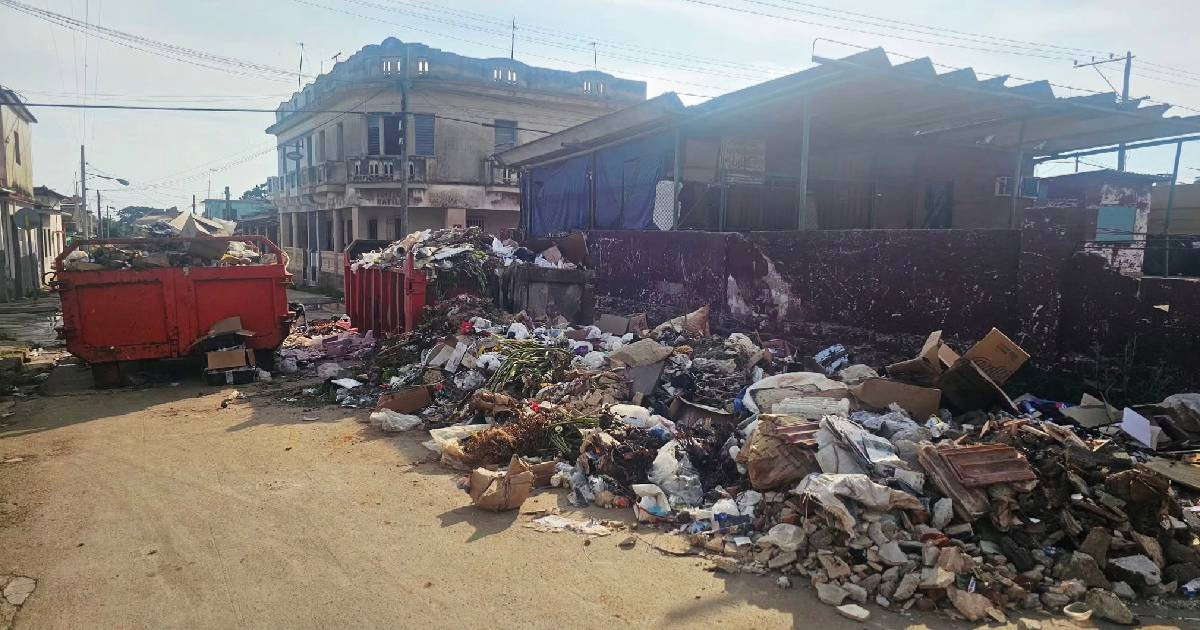
A photograph shared on the Facebook group Compra y Venta Artemisa this Friday revealed a street in the city completely engulfed by massive piles of debris, rubble, and household waste stretching for dozens of meters in front of homes, alongside two overflowing compacting bins.
The individual who reported this issue stated that the authorities attempted a cleanup effort that, rather than solving the problem, resulted in the public road being blocked by two "overfilled" containers, leaving the street "entirely impassable" and plagued by foul odors for over a week.
Residents pinpointed the location at the corner of Colón Market, one of the city's busiest areas. "I just passed by there today, and it's true. Such a busy corner. The corner of Colón Market," commented one local resident on the post, which garnered dozens of outraged responses.
Public anger isn't just directed at the neglect but also at the corruption enabling it.
"The surplus fuel is reserved for meetings and offices, not for communal services. There's Artemisa trash flaunting on the flag," one neighbor criticized.
Another comment delved deeper into the issue: "The problem is that the little fuel available is in the hands of the leaders [...] what's shameful is that they sell it to the hardworking people for $2.70 USD per card and mockingly say, 'take as much as you want'.
In August 2025, the Cuban Institute for Freedom of Expression and Press (ICLEP) documented that Artemisa's garbage collection trucks were idled due to a lack of parts and fuel shortages.
Artemisa's Persistent Waste Woes
This isn't Artemisa's first appearance on the shame map. In June, an enormous dump overflowed next to the city's eight-story building, with household waste, rubble, sacks, and cardboard piling up uncontrollably.
Earlier in the year, residents of Bauta reported a massive dump set up next to the People's Power office, just meters away from cafes and the farmers' market.
The crisis has deep roots, as the Artemisa Communal Services Company acknowledged back in 2019 that there was no adequate landfill by demarcation, and trucks were consistently breaking down.
By 2023, the fuel shortage restricted garbage collection to main arteries, hospitals, and schools, turning several provincial towns into dumpsites.
Broader Consequences of the Crisis
The collapse isn't limited to garbage. More than 225,000 people, accounting for 65% of the provincial population, lacked regular water supply in July. Meanwhile, blackouts lasting up to 22 hours a day sparked protests in Toledo, culminating in clashes with a police patrol.
The accumulation of waste has direct health implications. "That's why there are so many viruses and bacteria, and people are getting sick, clearly all the conditions are set," warned a neighbor.
"Someone once said it wouldn't be the external enemy that would bring this down. It would be the Inept Friend from within, and it's coming true," summarized a citizen in the comments, echoing the sentiment of those living amidst the uncollected trash left by the regime.
The issue isn't unique to Artemisa. On Thursday, images exposed a Havana neighborhood intersection in Los Sitios trapped in waste and neglect, and this week, a dump in downtown Camagüey was reported, confirming that the collapse of communal services is a national pattern.
Understanding Artemisa's Waste Management Crisis
What triggered the waste crisis in Artemisa?
The crisis was triggered by a combination of inadequate landfill management, consistent truck breakdowns, and a severe fuel shortage that restricted garbage collection efforts.
How are residents responding to the garbage situation?
Residents have expressed outrage and frustration, pointing to governmental neglect and corruption. Social media platforms have become a venue for sharing images and voicing their concerns.
What are the health implications of the waste buildup?
The accumulation of waste is contributing to the spread of viruses and bacteria, leading to increased sickness among the population.