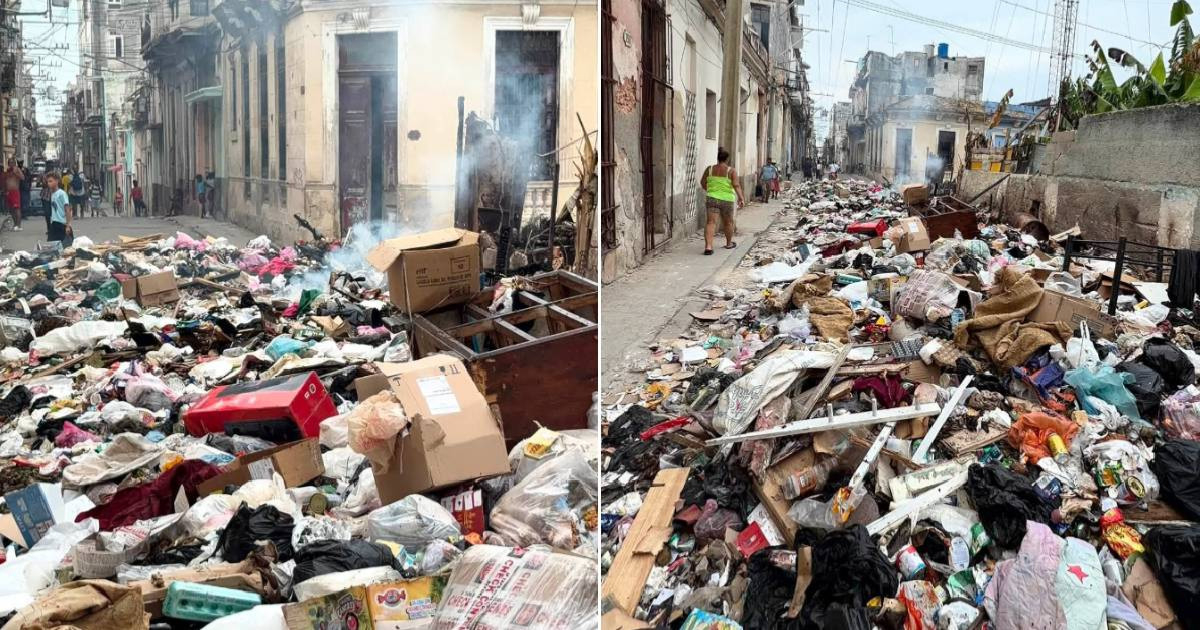
Photos shared on social media this Thursday reveal a dire situation at the corner of Lealtad and Maloja in the Los Sitios district of Central Havana. A mountain of trash clogs the area, spanning nearly an entire block, with columns of smoke rising from open-air waste burning.
The images, posted by user DisA on Facebook, depict plastic bags, cardboard boxes, clothing, wood, and decomposing organic waste littering the streets.
Pedestrians navigate narrow pathways on sidewalks flanked by crumbling colonial buildings.
One commenter pinpointed the location: "That's at Lealtad and Maloja, what a horror." Another user highlighted the broader issue: "It's not just Havana; this is happening all over Cuba."
The public's outrage was swift. "The government expects people to become garbage collectors," one user remarked.
Another added bluntly: "We're alive by a miracle." A third pointed to governmental responsibility: "Governments are obligated to handle waste collection; it's the norm worldwide."
Recurring Issues in Los Sitios
The scene at Lealtad and Maloja is neither unique nor recent. This very intersection witnessed a similar trash fire back in April amid a night-time blackout.
Throughout the year, Los Sitios has experienced similar incidents. A waste fire erupted at Sitios and División in May, and complaints about trash accumulation near the Church of St. Jude Thaddeus and St. Nicholas have been frequent.
In June, a garbage pile blocked the junction of San José and Escobar, also in Central Havana. By August, the park Trillo in the neighboring Cayo Hueso district was overrun with waste and maggots. Meanwhile, Perla Rosales, Deputy Director of the Office of the Historian, admitted that Old Havana couldn't remain clean for even two hours post-cleansing efforts.
Failed Solutions and Health Consequences
The government attempted to address the crisis with a pilot project using electric tricycles in the Rampa community area, but the initiative collapsed in August.
The president of the Popular Council in Vedado confessed that "unfortunately, the initial plan and goals for solid waste collection using electric tricycles have not been achieved."
Health repercussions are severe. By the end of 2025, Cuba reported at least 81,909 official cases of dengue and chikungunya with 65 fatalities, a situation linked by The New York Times directly to the trash crisis.
In July, over half a million Havana residents lacked regular access to potable water, escalating the epidemiological risks in densely populated neighborhoods like Los Sitios.
Root Causes of the Waste Crisis
The core of the problem is systemic. Earlier this year, it was revealed that out of 106 garbage trucks available in Havana, only 44 remained operational, hampered by fuel shortages and mechanical issues.
The city produces between 24,000 and 30,000 cubic meters of solid waste daily, yet up to 23,814 cubic meters remain uncollected each day. The shortage of containers worsens the situation, with the capital having around 10,000 containers when it requires 20,000 to 30,000.
Understanding the Waste Crisis in Havana
What is causing the waste crisis in Havana?
The crisis is primarily due to systemic issues like a lack of operational garbage trucks, fuel shortages, and insufficient waste containers. These factors result in large amounts of uncollected trash.
How does the trash problem affect public health in Havana?
The accumulation of waste contributes to the spread of diseases like dengue and chikungunya, exacerbating health risks, especially in areas with poor access to clean water.
What measures have been taken to address the waste issue?
The government attempted a pilot program using electric tricycles for waste collection, but it failed due to implementation challenges.