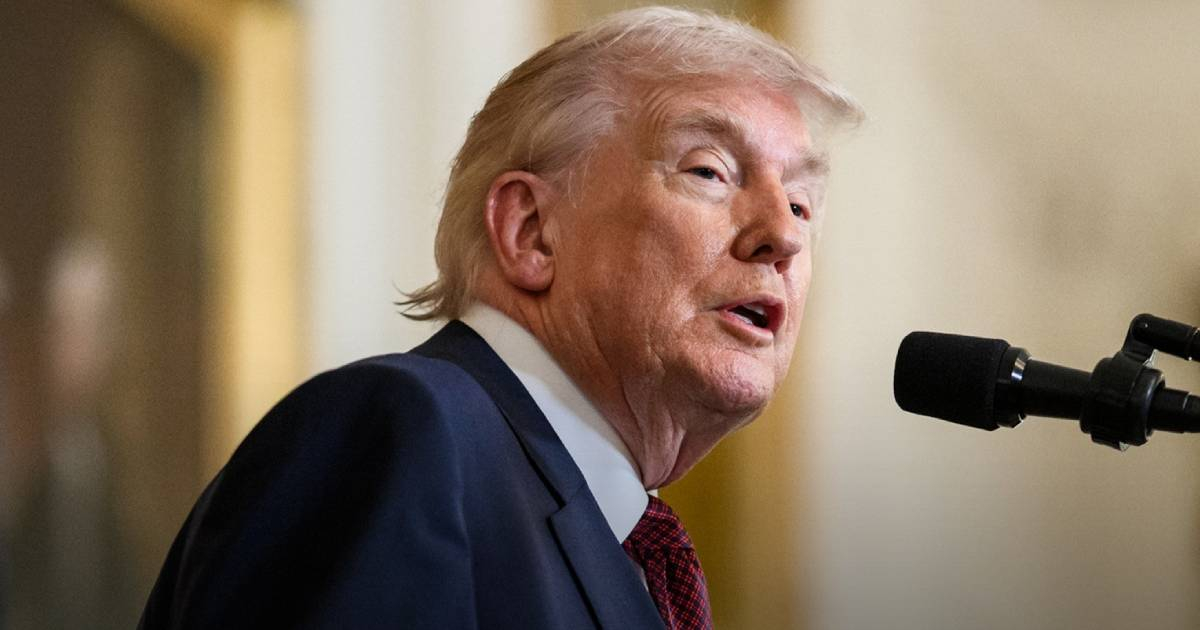
In a bold and unprecedented move, U.S. President Donald Trump issued a stark warning on Friday: if the Federal Reserve does not lower interest rates at its upcoming meeting, he will cease trading with all nations with which the United States has a trade deficit.
The announcement was made through a post on his social media platform, Truth Social, shortly after the Department of Labor released the August employment report, which revealed the creation of 162,000 jobs—almost three times what analysts had anticipated.
"Lower the rates or I'll stop trading with countries with whom we have deficits!" Trump declared on Truth Social, explicitly linking monetary policy with trade policy in a manner that is unusual even for his distinctive approach.
The President argued that the nation's robust economic state justifies lower interest rates and asserted that the United States should have "the lowest rate of any country in the world, just like in the old days."
He also cautioned that trade partners benefiting from significant surpluses with the U.S. only hold that status because Washington allows it, suggesting that could change swiftly: "If the U.S. chose not to allow them their large surpluses, something we could halt immediately, they would no longer be considered financial elites!"
Trump described the trade cut as a tool "better than tariffs," reminding that the Supreme Court itself, despite having struck down much of his tariff framework last February, recognized that the President holds the "absolute right" to determine with whom the world’s largest economy trades.
This threat is directed at the new Fed Chair, Kevin Warsh, who was confirmed by the Senate in May with 54 votes in favor and 45 against.
Trump demanded that the institution act "smartly" and be "patriotic," referring to Warsh, who has taken a more conservative stance than his predecessor and has prioritized reducing the central bank's balance sheet.
The Fed kept rates in the 3.50% to 3.75% range at its late July meeting, the second presided over by Warsh.
The implicit deadline in Trump's threat is the upcoming Federal Open Market Committee meeting, scheduled for September 15 and 16, when the central bank is expected to announce its decision on rates.
Trump’s trade escalation is not new. Following the Supreme Court's ruling that nullified his global tariffs based on emergency powers law, he redirected his tariff policy with a global levy of 10% under Section 122 of the Trade Act of 1974.
In July, he expanded tariffs to 60 countries with rates ranging from 10% to 12.5%, including the European Union, the United Kingdom, India, Japan, South Korea, and Mexico. Then, in August, he announced 50% tariffs on Canadian vehicles and steel starting January 1, 2027.
According to an analysis by the EFE agency, markets assigned about a 41.6% probability that the Fed will keep the current range unchanged in September, reflecting the uncertainty surrounding the decision amid political pressure and conflicting economic data.
Understanding Trump's Trade Threats and Their Implications
What prompted Trump's threat to cut trade?
Trump threatened to cut trade as a response to the Federal Reserve's potential decision not to lower interest rates in its next meeting, linking it to the existence of trade deficits with other countries.
How did Trump convey his message about trade deficits?
Trump conveyed his message through a post on Truth Social, where he expressed his demand for lower interest rates and threatened to stop trading with countries that maintain trade surpluses with the U.S.
What is the role of the Supreme Court in Trump's trade strategy?
The Supreme Court previously struck down much of Trump's tariff framework but acknowledged the President's right to determine trade partners, a point Trump emphasized in his recent threat.