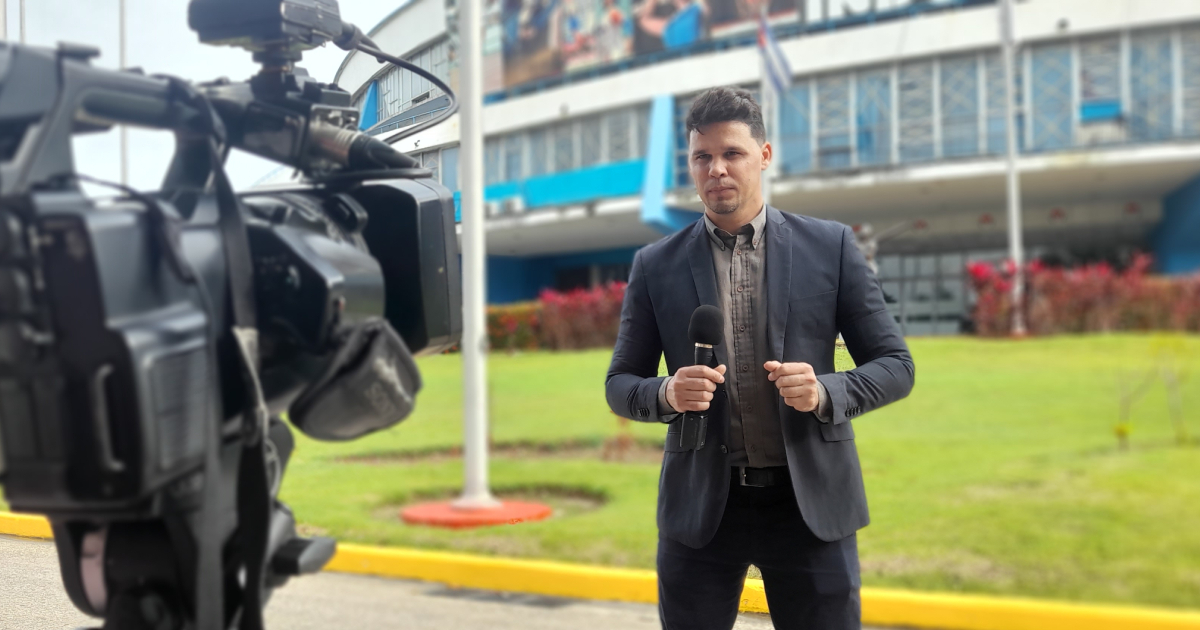
Alejandro Rodríguez's journey from athlete to sports journalist was anything but straightforward. Before stepping in front of a microphone or camera, he experienced sports firsthand. He engaged in taekwondo, baseball, kayaking, and water polo, studied at the "Marcelo Salado" sports school, and earned a degree in Physical Culture. This background rekindled his desire to narrate sports from a unique perspective.
Typically, I interview established sports figures or artists, but today, I'm speaking with a promising sports journalist who still has much ground to cover—Alejandro Rodríguez, who currently brightens Cuban television screens.
From Athlete to Storyteller
Your path to sports journalism was paved by your deep involvement in sports—participating, studying. It seems your future was clear from the start. Sports was always a passion, but there's a vast difference between playing them and being able to articulate them. From a young age, I was immersed in sports activities, be it taekwondo, baseball, kayaking, or water polo.
My father played a significant role in fostering my love for competition. By the age of four, I was already a "monitor" for a group of kids my age in taekwondo.
After attending a sports school, I was uncertain about my career path, but my passion for sports was undeniable. I considered fields like Journalism or Psychology, but with only two spots available for each, my ranking didn't allow it.
Upon completing my degree in Physical Culture and Sports, my interest in journalism resurfaced, largely influenced by Professor Jorge Alfonso Chacón. He offered an elective course in journalism and recognized qualities in me that could be honed in the field of communication. He taught me to view sports through a reporter's lens, to delve deep into its history, and to respect both the athletes and the audience.
Breaking into Television
After graduating, I took tests for a sports commentary course and was successful. I began my journey in radio and never settled for what I knew. I attended various courses, seminars, and workshops.
Your entry into television came through a casting call. How do you recall that moment and what did joining such a significant medium mean to you? Indeed, Canal Caribe, later the Cuban News Channel, needed its own professionals for the sports segments of the news programs, which also expanded in hours and slots. I remember the mix of nerves and excitement when I was chosen. Suddenly, I was sharing space with people I admired, and each broadcast was a thrilling experience.
That moment marked a turning point. Recognition in public, advice from peers, and new opportunities, even beyond sports, emerged. It was a complete shift in my professional journey.
The Legacy of Cuban Sports Journalism
There's an inevitable image: taking up spaces and podiums once occupied by legends like Eddy Martín, René Navarro, or Héctor Rodríguez. Does it feel like a privilege, a responsibility, an inevitable comparison, or a bit of everything? It's a mix of everything and more. It's a tremendous privilege because I grew up listening to them, watching them, admiring their narrations, often in the twilight of their careers. They are benchmarks for all communication professionals.
I had the chance to start young, but my goal is different; I focus on reporting, hosting, interviewing, and covering events on television. I've never narrated nor intend to; at most, I analyze and comment, which they also did. They remain a reference point.
After several years in television, with international coverage like the Pan American Games in Lima 2019 and the Central American and Caribbean Games in San Salvador 2023, as well as numerous national events, who are your current references in sports journalism, and which journalists or commentators would you have liked as mentors? You learn from everyone, even those you encounter daily. You learn from good and bad examples. In journalism, the documentary pieces from multi-sport games by Carlos Alberto González and others inspire me.
Times, resources, and norms change, but the essence—telling and moving—remains the same. I admire those who tell stories deeply, sincerely, without sensationalism. But I reiterate, mentors are everywhere, and I learn from each colleague daily.
Evaluating Cuban Sports Journalism Today
Do you think Cuban sports journalism has lost—or gained—compared to the generation that turned sports commentary into an art? Comparisons between generations often spark debate. Many say the past was better. Undeniably, that generation (Eddy, Navarro, Héctor, and others) crafted a unique narration style, with unmatched language skills and sports knowledge.
Yet, I wouldn't say sports journalism, commentary, or narration has declined. Today, there's a greater diversity of voices, broader coverage of disciplines, and a digital presence. Perhaps the fast pace of life has lessened the depth and literary weight required for chronicles and commentary. These are different times, with less room for reflection, yet the foundation remains!
The State of Cuban Sports Television
Let's venture into more uncomfortable territory. How do you see Cuban sports television today? Does it have the resources, journalists, and spaces Cuban sports need, or has it been losing quality, audience, and capacity to tell our stories? In this context, what is your opinion on the current state of the Sports Editorial Office and spaces like the NND? Cuban sports television holds immense potential but is severely constrained, like much in Cuba, by technical and economic resources, as well as poor decisions. However, we have prepared journalists and professionals, full of enthusiasm and perspective. There's often a lack of time, editorial will, and space to delve deeper, conduct investigative journalism, and tell the stories behind the medals. The immediacy and repetition of content work against us.
I'm not part of the Tele Rebelde Sports Editorial Office or the National Sports News, as I'm with the Cuban News Channel, but I've collaborated with them, and it remains a training ground for many, providing a platform for Cuban athletes and coaches to voice their stories.
Reflecting on Cuban Sports
Discussing Cuban sports, Cuba used to dominate the Central American and Caribbean Games; today, the reality is different. The results from the Central American Games in San Salvador 2023 have already shown this loss of dominance, and the recent results in the Dominican Republic were similar, with a third-place finish by country. What's happening?
It's a combination of factors; there's not a single cause. There's a reality: we got too used to reaching levels and comparisons that are now unsustainable. The world has changed. Today, countries that didn't prioritize sports now do.
Countries with more resources, larger populations, and better infrastructure. It's tough to maintain a diverse sports program without resources for traditional disciplines. We can't compare the active population of Mexico, Brazil, Colombia, Canada, Argentina, and their resources to develop athletes with our conditions... Even with a solid talent scouting and development base!
Additionally, the exodus of athletes and coaches is a severe blow, disrupting teams, projects, and years of work and development.
As a journalist narrating this reality, I believe criticism is necessary and should be constructive. It's not about tearing down but highlighting what's wrong to improve.
We must address issues with data, respect, and proposals, even if space to do so is limited. Like everywhere, there are limits and taboo topics, but today, there's more talk about professionalization, sponsorship, and necessary changes to rejuvenate the Cuban sports system. Unfortunately, many still fear criticism, and some dislike it even when constructive.
Looking Ahead
If I ask you about a bright future, what do you see? I hesitate to predict the future, but many things must change. Still, Cuban sports have an impressive human foundation. If we succeed in improving planning, investment, and talent retention, the future could be promising. But that requires structural changes, not just in sports.
I still believe that sports are one of the most powerful tools to unite and showcase who we are. Whether the future will be bright depends on the decisions made from now on. From my position, I'll try to contribute with honesty and passion, which I've never lacked.
Undoubtedly, Alejandro Rodríguez is a professional whose opinions deserve respect. Agreement or disagreement on certain points is not what matters; what's crucial is his way of observing and narrating sports from his era.
Generations don't repeat; they succeed each other. In this succession, a new wave of journalists emerges, with their voices, doubts, and convictions, who will have to learn to narrate the Cuba they face and the Cuban sports they live with.
Perhaps, between the memory of those who paved the way and the drive of those beginning to tread it, lies the future of our sports journalism. Because as long as there's an honest view, an open notebook, and a voice ready to say what's happening, there will always be a story to tell.
Exploring Cuban Sports Journalism and Television
What inspired Alejandro Rodríguez to pursue sports journalism?
Alejandro Rodríguez was inspired by his experiences as an athlete and the influence of his father, which fostered his passion for sports and storytelling. His education and the mentorship of Professor Jorge Alfonso Chacón also played pivotal roles.
How did Alejandro Rodríguez transition to television journalism?
Rodríguez transitioned to television journalism after successfully auditioning for a casting call at Canal Caribe, which later became the Cuban News Channel. His mix of nerves and excitement marked the beginning of a significant professional shift.
What is Alejandro Rodríguez's perspective on the current state of Cuban sports television?
Rodríguez believes Cuban sports television holds great potential but is limited by technical, economic, and editorial constraints. He emphasizes the need for deeper journalism and better storytelling opportunities to enhance coverage.