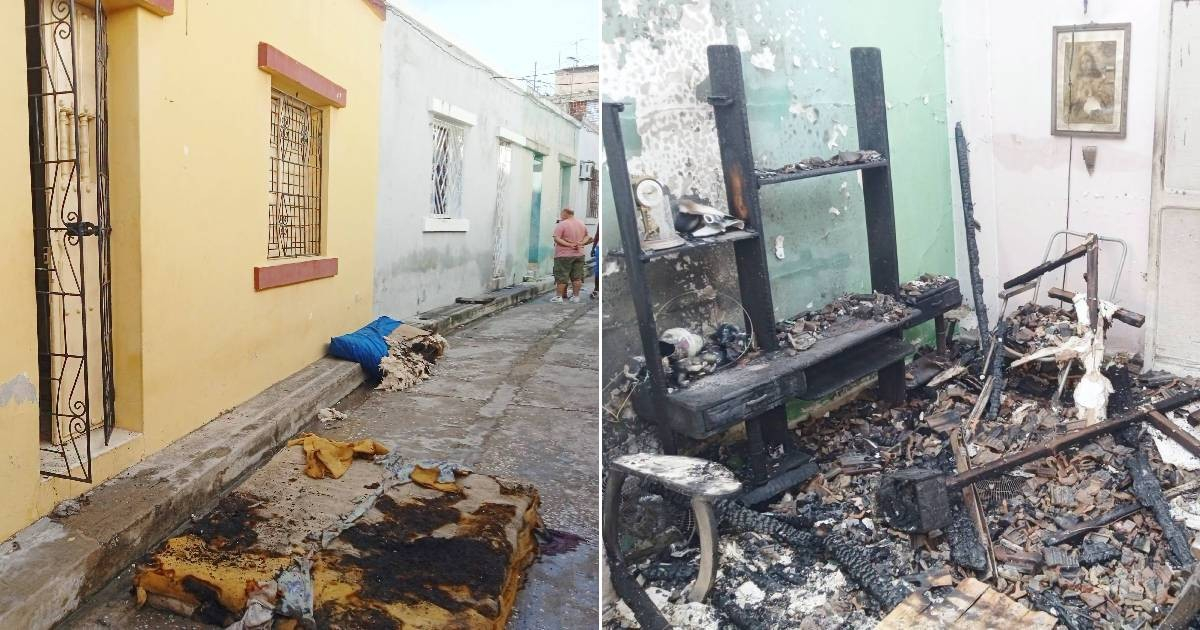
A devastating blaze swept through five homes in the heart of Santiago de Cuba on the evening of Wednesday, September 2, around 9:15 pm. The incident was reported by Aris Arias Batalla, the vice president of the Provincial Association of Volunteer Firefighters.
According to residents and those affected, the fire originated in house number 5, owned by Oliver Montalvo Romero, which was unoccupied at the time of the blaze.
The flames quickly spread, consuming houses number 2, belonging to engineer Alejandro Castillo Preves, and number 3, owned by Anni Leyda Varga Esteven, where the damage was particularly severe.
Houses numbered 7, 9, and 11 also sustained damage, with losses including mattresses, clothing, and household items throughout bedrooms, living rooms, and false ceilings.
Fortunately, there were no human casualties or injuries reported. However, a dog perished in house number 5, unable to be rescued due to the absence of its owners.
Before firefighters from Comando 1 Martí and Comando 4 Vista Alegre arrived, local residents valiantly attempted to douse the flames using available water from nearby pipes.
The narrow confines of Pasaje Soler posed significant challenges for the fire trucks, though the firefighting personnel acted swiftly to prevent further spread.
A resident from the Trocha neighborhood described the flames as "very high" and visible from her own home, while a directly affected individual expressed her distress: "I am desperate. My house and my mother's are on fire."
Castillo Preves, who managed to evacuate his physically impaired mother before their home was engulfed, praised the firefighters despite his grief: "I lost almost everything in minutes, but I commend the Provincial Fire Chief and his brave young firefighters. They are unafraid and courageous."
Medical staff from the Camilo Torres health area were on-site to attend to hypertensive and shocked neighbors.
Municipal government and housing officials arrived to assess the damage and coordinate debris removal once an investigation was conducted.
The heavy presence of police officers, including patrol cars and members of the Technical Investigations Department (DTI), raised concerns among locals. "More police and black berets than firefighters. Even the DTI. It seemed like they came to hinder more than to extinguish the fire," remarked an anonymous neighbor.
The Cuban authorities have not issued any official statements regarding the cause of the fire or the condition of those affected.
This incident is part of a troubling series of fires that have plagued Santiago de Cuba throughout 2026, exacerbated by an energy crisis that forces residents to use makeshift electrical connections and alternative cooking methods.
The Electric Company of Santiago de Cuba admitted in June it could not provide even two hours of daily electricity in many circuits, and in August, the country was meeting only 32% to 35% of the national electricity demand.
A previous fire in the Reparto Jiménez neighborhood occurred in June shortly after power was restored following an outage, suggesting an overload-induced short circuit—an issue prevalent in neighborhoods with aging, deteriorated housing.
Understanding the Santiago de Cuba Fire Crisis
What was the cause of the recent fire in Santiago de Cuba?
The exact cause of the fire in Santiago de Cuba has not been officially determined, but it began in an unoccupied home and spread rapidly.
How have the energy issues in Cuba contributed to the fire risk?
Cuba's ongoing energy crisis has led residents to use unsafe electrical setups and alternative cooking methods, increasing the risk of fires.
How did the firefighters manage to control the fire despite challenges?
Despite the narrow streets complicating firefighting efforts, the personnel acted swiftly to contain the blaze and prevent further spread.