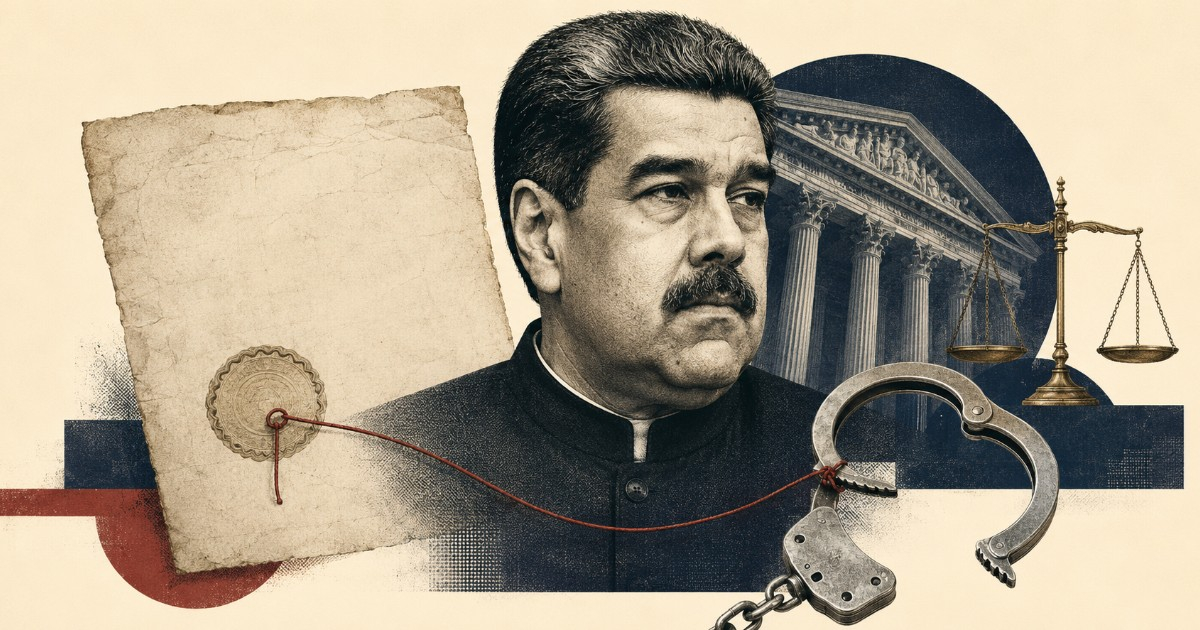
Nicolás Maduro's legal team submitted two motions on Wednesday to a federal court in Manhattan, seeking dismissal of the criminal charges he faces in the United States. They are invoking the principle of sovereign immunity and questioning the court's jurisdiction over his case.
According to EFE's report, attorney Barry Pollack filed an initial motion to dismiss the entire indictment, arguing that Maduro is entitled to immunity as the leader of a sovereign nation. A secondary motion focuses specifically on dismissing the charge of conspiracy involving narcoterrorism.
"The Court would lack jurisdiction over Mr. Maduro if he is entitled to either head-of-state immunity or conduct-based sovereign immunity. He is entitled to both," Pollack asserted in the court document.
In the second motion, the defense argued that the narcoterrorism charge "seeks to indict a foreign national" for "entirely foreign conduct without adequately alleging the jurisdictional element" and that it "exceeds Congress's authority to regulate."
Additionally, Pollack requested that the case be dismissed "with prejudice," a legal term that would prevent the charges from being brought again in the future.
Maduro is facing accusations of conspiracy to commit narcoterrorism, cocaine importation, and possession of automatic weapons, all carrying potential life sentences.
He was captured in Caracas on January 3, 2026, during the U.S. military operation "Absolute Resolution" and is currently held at the Metropolitan Detention Center in Brooklyn alongside his wife, Cilia Flores.
Since his initial appearance before Judge Alvin Hellerstein, Maduro has pleaded not guilty and described himself as a "prisoner of war."
Legal and Political Hurdles
Maduro's defense strategy to avoid trial faces significant legal challenges. Washington ceased recognizing Maduro as Venezuela's legitimate president in 2019, substantially weakening his claim to immunity.
Historical precedent also works against him. In 1990, the Eleventh Circuit Court of Appeals rejected the immunity claim of former Panamanian dictator Manuel Noriega—captured by U.S. forces in 1989—using similar reasoning: Washington never recognized him as a legitimate leader.
While his legal battle continues, Maduro has maintained communication with the outside world from Brooklyn. Late last month, he shared photographs taken in June from inside the prison, showing him in gray sportswear making a victory sign, accompanied by the message, "I want you to know that we stand firm."
The U.S. Department of Justice has until October 2 to respond to the motions to dismiss. Judge Hellerstein will hold a hearing on the dismissal attempt on November 17, and if the motions fail, the trial is scheduled to begin on June 1, 2027.
Understanding Sovereign Immunity and its Implications
What is sovereign immunity?
Sovereign immunity is a legal doctrine that protects a sovereign state or its leader from being sued or prosecuted in foreign courts without consent. It is based on the principle that one sovereign cannot impose its laws on another.
Why is the U.S. not recognizing Maduro's claim to immunity?
The U.S. ceased to recognize Nicolás Maduro as the legitimate president of Venezuela in 2019, which undermines his claim to sovereign immunity. Without recognition as head of state, his entitlement to immunity is significantly weakened.
What are the charges against Maduro?
Maduro faces charges of conspiracy to engage in narcoterrorism, cocaine importation, and possession of automatic weapons. These charges carry potential life sentences.