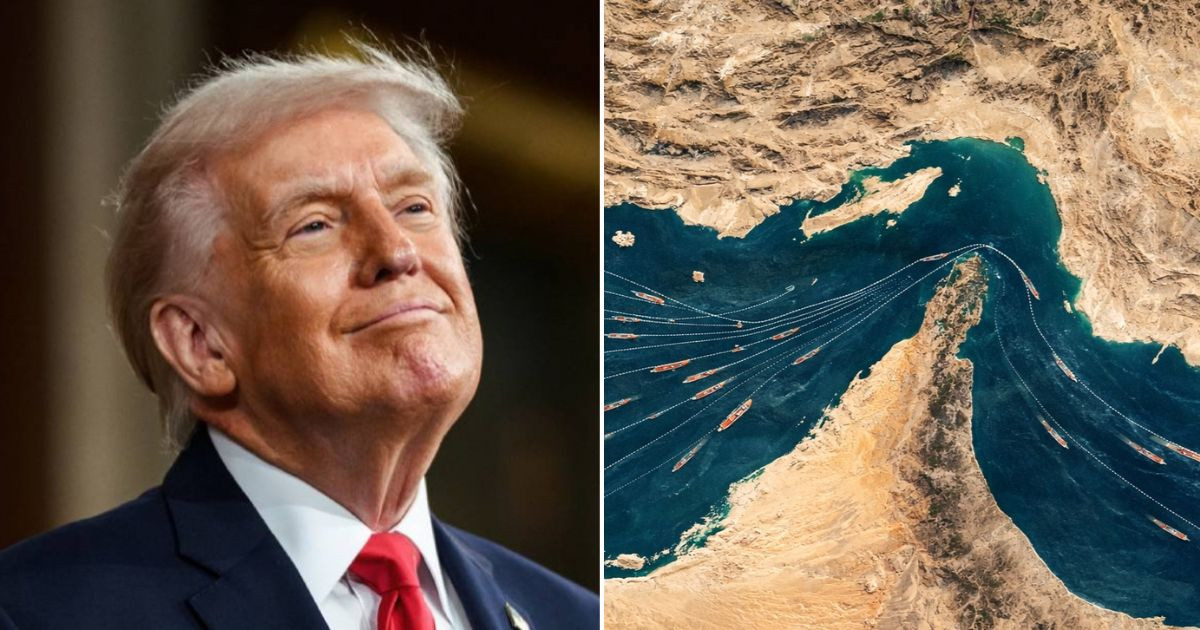
On Wednesday, former President Donald Trump floated the idea of renaming the Strait of Hormuz to "Trump Strait," asserting that the United States now exerts control over this vital maritime passage amid increasing military tensions with Iran.
"Now that it's under U.S. control, should we rename the Strait of Hormuz to TRUMP STRAIT? Like America itself, it would be hotter than ever! Thanks for your attention to this matter," Trump posted on Truth Social, signing off as "President DONALD J. TRUMP."
Rising Military Tensions
The suggestion comes during a period of heightened military confrontation between Washington and Tehran. On Sunday, U.S. forces targeted two Iranian launch pads on Larak Island within the Strait of Hormuz. According to U.S. Central Command, these were being readied by the Iranian Revolutionary Guard to deploy rockets with sea mines into this strategic waterway. On Tuesday, another wave of U.S. strikes targeted Iranian military sites, as reported by The Washington Post.
Trump described these military actions as "great and powerful," emphasizing that U.S. naval forces are actively escorting vessels through this critical maritime corridor. However, the control mentioned by Trump pertains to military or operational influence and does not imply U.S. sovereignty over the strait.
Global Reactions and Economic Implications
Iran has vowed to retaliate against the U.S. strikes, keeping the region as a major flashpoint between Washington and Tehran. The Strait of Hormuz is incredibly significant globally; it links the Persian Gulf with the Gulf of Oman and is bordered by Iran and Oman’s Musandam Peninsula.
As per the AP, roughly 20% of the world's oil supply moves through this corridor, making any disruptions potentially impactful on international energy markets.
The escalation has already prompted calls for restraint. U.N. spokesperson Stéphane Dujarric labeled the renewed exchange of attacks as "very regrettable," while China demanded respect for its interests in the region. Finance Ministers from the G20 have also urged for "free and safe" navigation to prevent further pressure on hydrocarbon prices.
Trump's Naming Practices
The notion of renaming the Strait of Hormuz is not unprecedented for Trump, who has previously attempted to rename geographical features. In January 2025, he instructed U.S. federal agencies to refer to the "Gulf of America" instead of the "Gulf of Mexico." Later, in August 2026, he signed an order to designate "Lake America" for Lake Ontario within the federal system.
However, any renaming of the Strait of Hormuz by Washington would be confined to U.S. nomenclature and would neither affect its international designation nor grant the U.S. sovereignty over the waterway, situated between Iran and Oman.
Understanding the Implications of U.S. Control Over the Strait of Hormuz
What is the significance of the Strait of Hormuz?
The Strait of Hormuz is a crucial maritime passage that connects the Persian Gulf with the Gulf of Oman. It is one of the world's most important oil transit chokepoints, with about 20% of global oil supply passing through it.
Why does the U.S. claim control over the Strait of Hormuz?
The U.S. asserts military or operational control over parts of the Strait of Hormuz to ensure the safe passage of vessels and protect its strategic interests amid tensions with Iran. This control is not equivalent to sovereignty over the strait.
Has Trump renamed other geographical locations before?
Yes, Trump has previously attempted to rename geographical areas. He proposed calling the Gulf of Mexico the "Gulf of America" and renaming Lake Ontario as "Lake America" within the U.S. federal system.