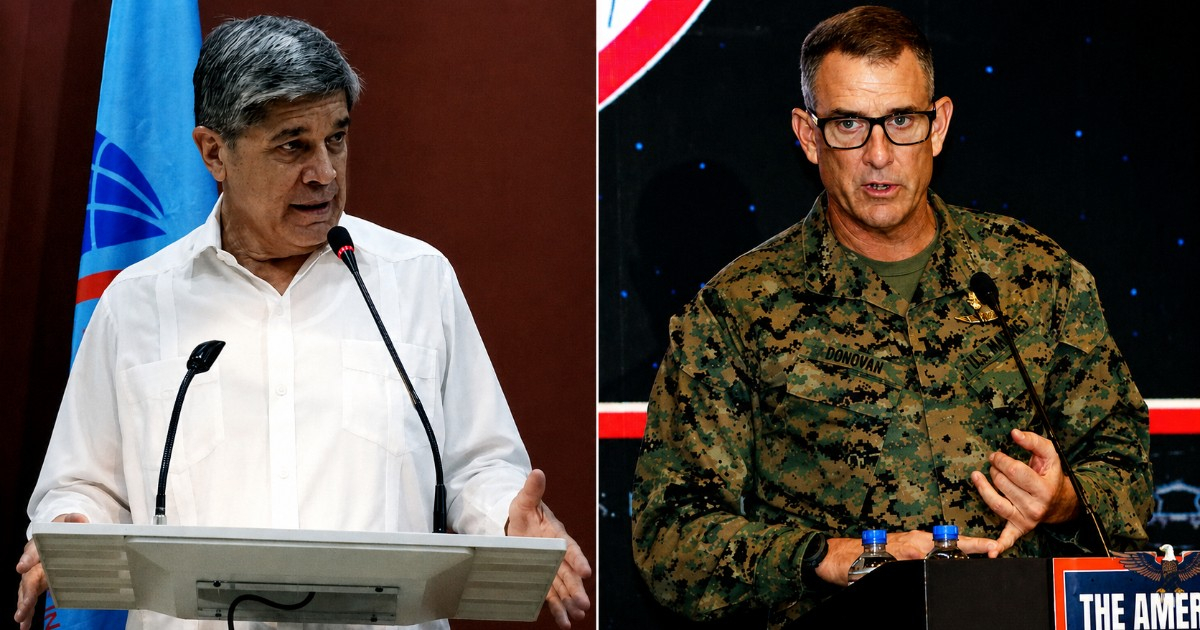
The Cuban government's Deputy Foreign Minister, Carlos Fernández de Cossío, took to social media to accuse the United States of financially supporting media articles that aim to "convince the public of the inevitability, natural occurrence, and eventual execution of a military assault on Cuba." He highlighted that the current hot topic is the military maneuvers happening in Puerto Rico.
Dated Sunday, August 30, the statement went beyond addressing the alleged aggression plan, taking a direct swipe at journalists and analysts reporting on U.S. military activities in the Caribbean.
Fernández de Cossío labeled these reporters as "contracted liars" tasked with "inflating the falsehood that Cuba constitutes or could become a threat to the U.S." He portrayed Washington as a superpower equipped with "5,200 nuclear warheads, 11 aircraft carriers, and military bases or presence throughout the hemisphere."
U.S. Military Activity in the Caribbean
The context behind these statements is well-documented. Throughout 2026, the Southern Command has increased its presence in the Caribbean, reopening Roosevelt Roads Naval Station in Ceiba, Puerto Rico—shut down since 2004—investing $79 million in the process, and deploying the 24th Marine Expeditionary Unit, boasting over 1,300 troops, as part of Operation Southern Spear.
Puerto Rico's Governor, Jenniffer González Colón, confirmed that more than 8,100 soldiers would conduct exercises on the island between May and August 2026. Since February, the U.S. has clocked over 150 hours of aerial surveillance around Cuba, utilizing P-8A Poseidon, RC-135V Rivet Joint, and MQ-4C Triton aircraft.
Rhetoric and Reality: Cuban Government's Stance
Direct warnings to the Cuban regime have not been lacking. In June, Defense Secretary Pete Hegseth cautioned from Guantánamo that Cuba would "quickly learn" the consequences of acquiring weapons that threaten U.S. territory, reiterating from Panama in mid-August that "all options are on the table."
What Fernández de Cossío's post fails to address is as telling as his accusations. He omitted mentioning the Chinese intelligence facilities on Cuban soil, documented by the State Department and the Center for Strategic and International Studies (CSIS), which identified operational sites in Bejucal, Wajay, Calabazar, and El Salao.
Just days earlier, the regime's senior official had dismissed these same allegations as "slanders," using the same rhetoric now directed at those covering military developments in Puerto Rico.
The Pattern of Denial and Aggression
Since the start of the year, a pattern has emerged. In March, Fernández de Cossío asserted that the Cuban military is "always ready"; in May, he threatened "fierce resistance" against any aggression; and in July, he accused Washington of attempting to intimidate the Cuban populace.
Under the banner of 2026 as the "Year of Defense Preparation," the regime conducts weekly exercises of the "War of All the People" doctrine, overseen by Miguel Díaz-Canel, including ambushes, mine placement, and evacuation drills.
Simultaneously, the regime has consistently denied the presence of Chinese military forces on the island, using the same fervor it now employs to denounce media coverage of U.S. military deployments in the Caribbean. Critics on social media have pointed out this contradiction, recalling that Havana similarly denied the presence of Cuban troops in Venezuela for years.
Frequently Asked Questions on U.S.-Cuba Military Tensions
Why is the U.S. increasing its military presence in the Caribbean?
The U.S. has heightened its military presence in the Caribbean as part of Operation Southern Spear, which involves reopening and investing in facilities like Roosevelt Roads Naval Station in Puerto Rico to enhance regional security.
What is Cuba's response to the increased U.S. military activity?
Cuba has accused the U.S. of planning a military aggression and criticized journalists covering the developments. The Cuban regime has declared 2026 as the "Year of Defense Preparation" and conducts regular military exercises in response.
Are there Chinese military facilities in Cuba?
Yes, according to the U.S. State Department and the Center for Strategic and International Studies, there are documented Chinese intelligence facilities in Cuba, although the Cuban government denies their existence.