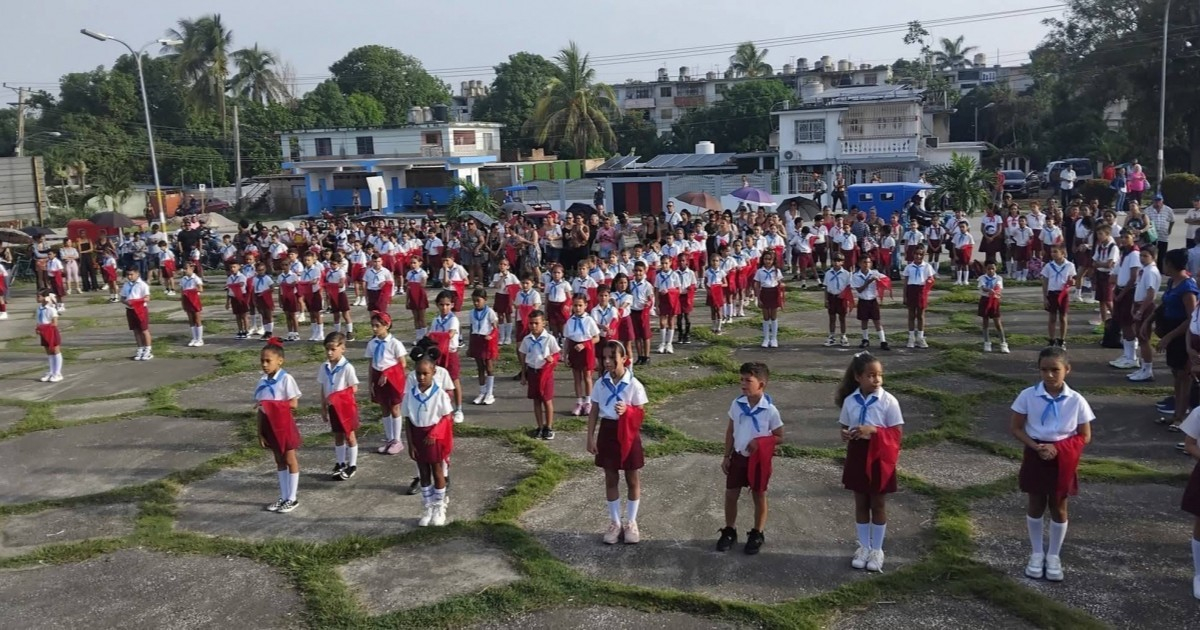
A Cuban mother, identified on social media as Lety Lety, initially expressed her strong resistance to her daughter starting school on September 1, declaring, "My girl isn't going to school; I gave birth to her, and she won't go!"
Despite her initial stance, her four-year-old daughter's eagerness to attend classes ultimately outweighed all the hardships they face, leading the young girl to start school.
In a heartfelt Facebook post, Lety Lety detailed the overwhelming challenges that make it nearly impossible to ensure a dignified school experience for her daughter. She shared that she practically had to "sell a kidney" to afford school supplies, uniforms, and other basic necessities, yet even then, she can't guarantee the essentials.
"How do I tell her that sometimes mom won't have a snack for her, or that she won’t be able to bathe in the morning because there's no water, gas, or even charcoal to heat it?" she lamented.
The Struggle for Basic Needs
Transportation poses another significant challenge. "Mom doesn't want her to walk because there are no buses, the scooter's battery is dead, and there's no money for a new one," Lety Lety explained. She described the unbearable nights of heat, sweat, and mosquitoes due to blackouts, preventing her daughter from resting properly.
"What do I do when she comes home, and there's not even bread to give her, and she has to do homework in the dark, drenched in sweat?" she emphasized.
A Countrywide Crisis
This mother's plight reflects the struggles of thousands across Cuba. The school year began amid power outages impacting up to 70% of the country, with only 960 MW of electricity available against a demand of 2,910 MW, leaving a shortfall of 2,280 MW, according to the Electric Union.
Naima Ariatne Trujillo Barreto, the Minister of Education, acknowledged the "very difficult" conditions and "tremendous difficulties" at the start of the school year, contradicting her earlier statements of it being "a big celebration."
The educational system began with a teacher coverage of just 73%, a shortfall of at least 24,000 teachers. Only 20% of students received new uniforms, as production reached only 2.2 to 2.3 million items out of the 3.6 million needed.
Economic Hardships Impacting Families
The economic crisis in Cuba is devastating for families with school-aged children. Outfitting a student in the informal market can cost between 15,000 and 20,000 pesos, with uniforms alone exceeding 5,000 pesos each, compared to under 100 pesos for a complete set when available through state channels.
Providing breakfast and snacks can add over 10,000 pesos per month, in a country where the minimum wage ranges from 2,100 to 3,210 pesos.
The World Food Program reported that 48.5% of Cuban students aged six to eleven don't receive any meals or snacks at school, highlighting the severity of the situation faced by mothers like Lety Lety.
Understanding the Educational Challenges in Cuba
What are the main obstacles Cuban parents face when sending their children to school?
Cuban parents face a myriad of challenges, including inadequate school supplies, lack of transportation, and frequent power outages. Economic constraints further exacerbate these issues, making it difficult to provide basic necessities for their children's education.
How does the economic crisis in Cuba affect school children?
The economic crisis severely impacts Cuban school children by limiting access to essential educational materials and meals. Many families struggle to afford uniforms, supplies, and daily meals, which are crucial for their children's schooling and well-being.
What is the current state of Cuba's educational infrastructure?
Cuba's educational infrastructure is strained, with a significant teacher shortage and insufficient resources to meet student needs. Only a fraction of students have access to new uniforms, and the system struggles with inadequate electricity supply and other logistical issues.