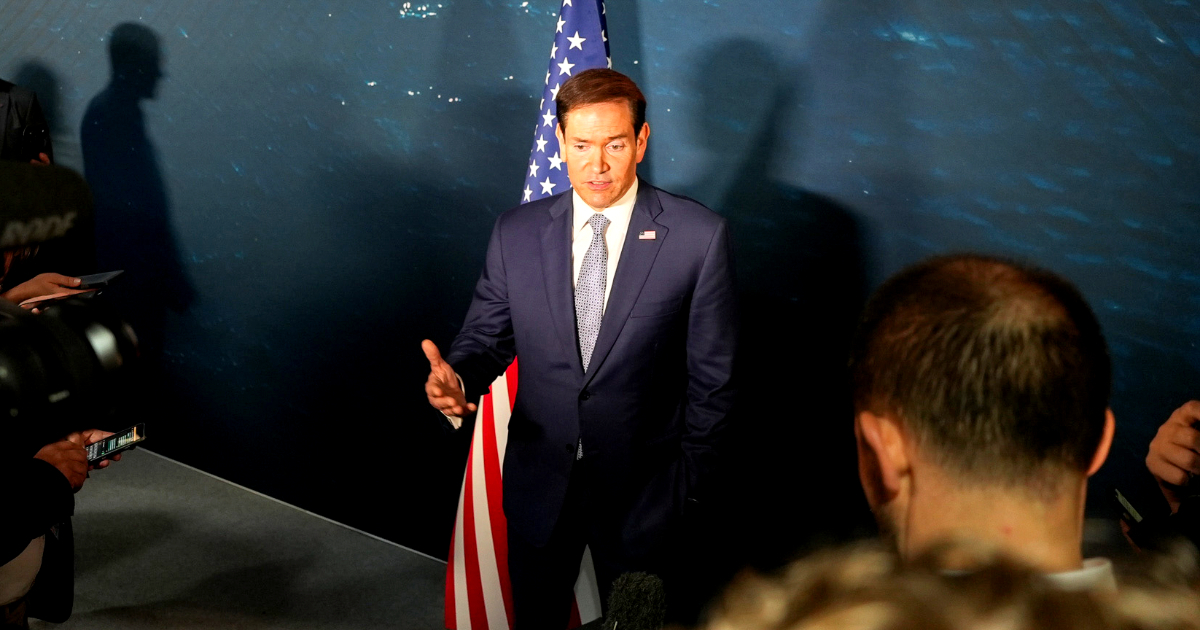
U.S. Secretary of State Marco Rubio has outlined the prerequisites Washington sees as essential for completing a democratic transition in Venezuela. This includes the need for free elections, the safe return of exiled leaders, and political participation for the millions of Venezuelans living abroad.
In an interview with journalist Sergio Novelli, Rubio emphasized that the interim government led by Delcy Rodríguez is viewed by Washington as a temporary measure, not the ultimate goal of the process initiated after the capture of Nicolás Maduro.
“Our desire and goal here is not to create a permanent system, for the current structure to become the permanent one,” Rubio asserted during the interview.
He added, “Ultimately, there will come a time when Venezuela must be governed by a democratically elected government.”
Economic Revival as a Step Towards Democratic Transition
This conversation gains significance following a new oil deal announced by the Trump administration, which deepens economic ties between the United States and Venezuela. Rubio describes this as a crucial step towards achieving a democratic stage.
Washington’s strategy after the fall of Maduro was introduced by Rubio at the beginning of the year, comprising three major phases: stabilization, economic recovery, and political transition.
The rationale behind this sequence is to ensure that a future democratically elected government does not inherit a completely collapsed state. “We don’t want them to inherit an economic disaster, a national disaster,” Rubio explained in the interview.
Oil is a central component of this strategy. The recent agreement with North American Blue Energy Partners (NABEP) involves exploiting 17 Venezuelan oil fields and making significant investments to boost their productive capacity.
According to Rubio, the recovery of the oil sector should generate revenue for the state and create economic conditions that will later support a stable democratic system.
Ensuring Transparency and Accountability
Rubio also elaborated that in the short term, the U.S. can monitor the funds generated under the new scheme through KPMG audits. However, in the long run, these resources should be managed by a legitimate government elected by the people.
The plan connects economic recovery directly to Washington's political objective: attracting investment, rebuilding state capacity, and eventually transferring control to democratically elected authorities.
Yet, the oil deal introduces new tensions. The U.S. is forging a long-term economic relationship with interim authorities while still aiming for the ultimate goal of democratic elections.
Washington maintains that stabilization and recovery are necessary to reach this point. The challenge will be ensuring that these economic advancements do not entrench a government initially conceived as temporary.
Urgency for Elections Balanced with Preparation
Rubio insisted that elections should be held “as soon as possible,” although he refrained from providing a specific date.
“Everyone understands that this must happen, because at the end of the day, Venezuela cannot reach where it needs to be without a legitimate government,” he stated.
However, he warned that holding elections immediately under the structures inherited from chavismo would not ensure a democratic process.
“If elections were held in Venezuela tomorrow, they would use the existing machinery. Clearly, this machinery won’t provide a system. There are many things to clean up,” he stated.
Rubio emphasized the necessity for opposition parties to have time, space, and resources to organize and campaign; for a free press where all candidates can express themselves; for a recognized legitimate National Electoral Council; a reliable voting system; and international observation.
He also demanded security guarantees for those participating in the political process.
Learning from Nicaragua's Past
Rubio referenced Nicaragua to illustrate why Washington does not consider it sufficient to quickly organize elections and declare the transition completed.
He recalled that the Nicaraguan opposition defeated Sandinismo electorally in 1990, but Daniel Ortega later returned to power and rebuilt an authoritarian system.
“A few years later Sandinismo returned and took over the country and they lost their freedom. We don’t want that here,” he stated. The goal, he explained, is to build “a permanent democracy and republic for Venezuela’s future.”
Therefore, the priority is not just setting an election date but altering the institutional conditions that allowed chavismo to control public powers for decades.
This process has already begun. In August, a negotiation table was formally established between interim government representatives and the 2015 National Assembly, recognized for years by Washington as Venezuela’s legitimate representation.
The first negotiation cycle resulted in an agreement to completely renew the Supreme Court of Justice, a step aimed at rebuilding institutions before future elections.
Rubio revealed in the interview that representatives from the 2015 National Assembly will meet again next month. “Those negotiations are up to the Venezuelans. But we will do everything possible to continue facilitating and insisting,” he stated.
Exiled Leaders and the Right to Return
An essential component for a legitimate transition, according to Rubio, is the return of political leaders forced to leave Venezuela.
When asked specifically about María Corina Machado and her intention to return, he asserted that she does not need Washington's authorization.
“María Corina Machado is a Venezuelan citizen who has every right to enter her country whenever she wants to return,” he responded.
Rubio expressed concern for her safety and emphasized the need to guarantee it. “She has every right to return. She is a citizen of Venezuela,” he insisted.
He expressed admiration for Machado but extended his remarks to other opposition leaders who remain abroad.
“It’s important that all those elements, if they want, can return and participate in Venezuela’s political life in a way that poses no danger to them and that they are given the necessary space to participate,” he noted.
The issue is particularly significant because Machado and Edmundo González Urrutia are not part of the core negotiations currently taking place between the interim government and the 2015 National Assembly's opposition sector.
Both have conditioned their support for the process on achieving concrete results, including the release of political prisoners, the restoration of democratic institutions, and outlining a path to presidential elections.
Including the Venezuelan Diaspora
Rubio extended political guarantees to the millions of Venezuelans who left the country in recent decades.
He specifically mentioned those residing in the United States, Spain, and Panama, advocating for their right to participate in Venezuela’s political future, regardless of whether they choose to return permanently.
“Some will return, others will not. But they want to participate, they want, for example, to vote from abroad,” he asserted.
According to Rubio, the more than seven or eight million Venezuelans who left due to economic or political circumstances, or both, must play “a key role” in the country’s future.
The roadmap outlined by Washington seeks to connect two processes occurring simultaneously: rebuilding a devastated economy and dismantling the institutional structures that enabled chavismo to remain in power.
The new oil agreement could significantly accelerate the first process. The real challenge for the Trump administration will be ensuring this economic stability serves to reach the second goal rather than delaying it.
Rubio made clear in the interview what he sees as the endpoint: a stabilized country, with institutions capable of sustaining themselves beyond who governs and with a government legitimized through free elections.
According to Washington, the transition does not conclude when Venezuela resumes producing wealth, but when Venezuelans can democratically choose who manages that wealth and under which institutions.
FAQs on Venezuela's Democratic Transition
What are the key components of the U.S. strategy for Venezuela's transition?
The U.S. strategy involves three main phases: stabilization, economic recovery, and political transition, with an emphasis on free elections, safe return of exiled leaders, and political involvement of the Venezuelan diaspora.
How does the new oil deal fit into Venezuela's democratic transition?
The oil deal with North American Blue Energy Partners is seen as a crucial step to generate state revenue, boost economic recovery, and create conditions for a stable democratic system.
What role does the Venezuelan diaspora play in this transition?
The diaspora, particularly those in the U.S., Spain, and Panama, are encouraged to participate in Venezuela's political future and may vote from abroad, playing a key role in shaping the country's future.
What guarantees are being sought for a legitimate election process in Venezuela?
The U.S. seeks conditions including time and resources for opposition parties, a free press, a legitimate National Electoral Council, a reliable voting system, international observation, and security for participants.