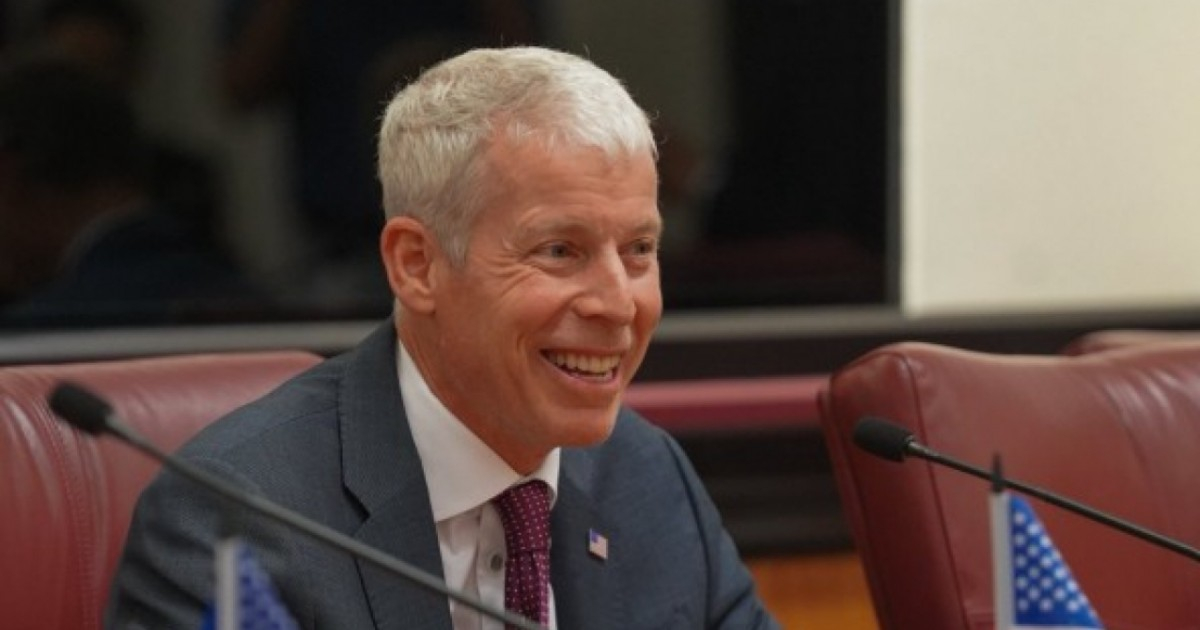
Chris Wright, the United States Secretary of Energy, touched down at Maiquetía International Airport near Caracas on Tuesday to attend the signing of a new Chevron contract in the Orinoco Oil Belt. This comes just four days after Washington and Caracas announced what former President Trump labeled as the most significant oil deal in history.
The American delegation was welcomed shortly after 8:30 pm local time by Venezuela's Minister of Hydrocarbons, Paula Henao, and the U.S. Chargé d'Affaires in Venezuela, John Barrett.
Addressing the gathered press in Maiquetía, Wright was forthright about the purpose of his trip: "We want to see substantial U.S. investment in Venezuela to enhance opportunities and prosperity for Venezuelans, Americans, and energy consumers." He emphasized the goal of increasing "the influx of private capital from numerous American companies."
On his social media account, Wright celebrated that "President Trump's energy diplomacy is yielding results: fostering new energy agreements, opening doors for U.S. companies, and strengthening energy security across the hemisphere."
An American official, speaking to journalists on condition of anonymity, confirmed that Chevron is set to announce an "expansion of its current operations in the country, which will also enhance Venezuela's production capacity."
According to a report by América Económica, the oil company is negotiating rights over two substantial heavy crude fields in the Carabobo region, within the Orinoco Belt, near assets already operated through PetroIndependencia alongside PDVSA.
This Chevron expansion is independent of the mega-deal announced last Friday, yet aligns with the same strategy of oil sector revitalization that Washington has pursued since the capture of Nicolás Maduro in January.
The historic agreement between the U.S. and Venezuela grants 100-year concessions over 17 fields with proven reserves of approximately 65 billion barrels—around 21% of Venezuela's total—to the private firm North American Blue Energy Partners (NABEP), founded by Venezuelan entrepreneur Alejandro Betancourt López.
The White House confirmed that the U.S. Department of War's Strategic Capital Office secured a 35% equity stake in NABEP's parent company at no cost to taxpayers, while the State Department has the right to purchase 20% of the oil produced at cost.
Interim President Delcy Rodríguez described the pact as a "historic milestone" with a 25-year validity and a production target exceeding 1.5 million barrels daily, while insisting that Venezuela retains constitutional sovereignty over its hydrocarbons.
On the day of Wright's arrival, the Venezuelan parliament—dominated by the ruling party—and the Armed Forces endorsed the agreement. Defense Minister General Gustavo González López stated on VTV, "We support, approve, and agree with all terms of the recent strategic agreement with the United States."
The Venezuelan Socialist Party also backed the agreement, marking a historical shift in the Chavista discourse on oil sovereignty.
Nonetheless, the pact has sparked protests in Caracas and criticism from Venezuelan opposition figures and U.S. Democratic lawmakers, who have described it as "corruption on an epic scale."
This marks Wright's second trip to Venezuela; his first was in February when he toured Chevron facilities in the Orinoco Belt and projected that Venezuelan oil would generate $10 billion for the U.S.
Diplomatic relations between the two nations, severed since 2019, were restored last March, two months after Maduro's capture.
The American delegation's substantive meetings are scheduled for Wednesday, coinciding with Chevron's planned expansion announcement.
Key Questions About U.S.-Venezuela Oil Deal
What is the significance of Chevron's new contract in Venezuela?
The new contract represents a major step in increasing U.S. investments in Venezuela's oil sector, aiming to expand production capacity and enhance economic opportunities for both nations.
How does the recent U.S.-Venezuela oil deal benefit the United States?
The deal allows the U.S. to secure a significant share of Venezuela's oil resources, strengthening energy security and opening markets for American companies, while offering the State Department rights to purchase oil at cost.