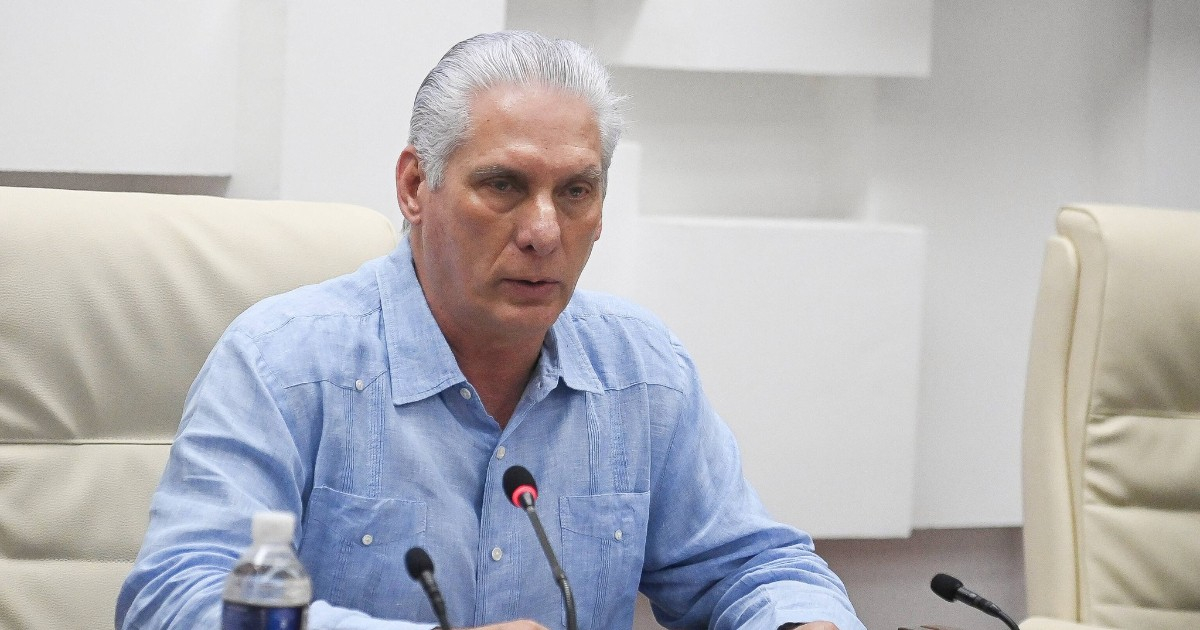
On Tuesday, Miguel Díaz-Canel hailed the commencement of the 2026-2027 school year as a "victory of the Revolution" and a triumph for the Cuban people. However, his post on Facebook ignited a wave of criticism, sarcasm, and anger from citizens who painted a picture starkly different from the one presented by the leader.
In his social media message, Díaz-Canel claimed that "social protection means maintaining, amidst the energy blockade, the achievements of the Cuban Revolution." He also stated that "over one and a half million students" were beginning a new academic year that "the empire sought to thwart through its suffocating plan."
Earlier, during a National Central Act held at Paseo del Prado in Old Havana, he declared, "As long as there are classrooms with students and schools with teachers in Cuba, there is a nation, there is a Homeland, there is Revolution, and there is Socialism."
The Stark Reality Behind Government Claims
The public reaction in the comments section was overwhelmingly critical. While a minority echoed the official rhetoric with hashtags, the majority pointed out the country's harsh realities.
"What achievements?" one user questioned. Another remarked, "Social protection is what you have, not suffering a single hour of blackout."
One of the more detailed comments described the school year's start as "bittersweet," listing the challenges faced by families: children attending classes after sleepless nights due to power cuts, spending eight hours in school without cold water or snacks, and parents leaving and returning to homes without electricity.
"More than 24 hours in the dark for just two with light," another user criticized. "Mr. President, sometimes it's not the blockade; it's the lack of scruples among those who profit from something as critical as electricity."
Another commenter challenged Díaz-Canel's concept directly: "Social protection means ensuring those thousands of young people have access to quality education and healthcare, new notebooks, knowledgeable teachers, and electricity inside and outside their homes. In one word: Prosperity. Neither you nor the Single Party you serve understand the meaning of that word, and worse, you don't care."
Other responses were brief but equally damning: "No lunch at my child's school," "teachers asking for 1,000 pesos to buy paint and fans," "most children in my town didn't go to secondary or pre-university due to lack of fuel," and "the government's cynicism is at its peak."
Data Reveals a Deepening Crisis
The 2026-2027 school year began with a shortage of 24,000 teachers, representing 12.5% of the needed positions, and a national teacher coverage of 73%. In Camagüey alone, there was a shortfall of about 3,000 teachers for over 95,000 students across 690 schools.
According to the World Food Program, 48.5% of Cuban children aged six to 11 do not receive meals or snacks at school. Uniform production only covered 20% of the required enrollment, with 2.2 million garments produced out of the 3.6 million needed.
Even the Minister of Education, Naima Ariatne Trujillo Barreto, admitted that the school year was starting under "very difficult" conditions.
One commenter summed up the skepticism: "In a month or less, they'll likely suspend it, like the power plants they fix today and break tomorrow."
Meanwhile, Díaz-Canel stated from Paseo del Prado that "each classroom will become a workshop of solutions" and that although the school year would be challenging, it "would be a worthy one."
Common Questions About Cuba's Education Crisis
What are the main challenges facing the Cuban education system in 2026-2027?
The Cuban education system is grappling with a significant teacher shortage, inadequate meal provisions for students, insufficient uniform production, and challenging conditions highlighted by power outages and lack of resources.
How did the public react to Díaz-Canel's statements about the school year?
The public response was largely critical, with many citizens expressing anger and disbelief at the government's claims of educational success, pointing out the ongoing hardships and deficiencies within the system.