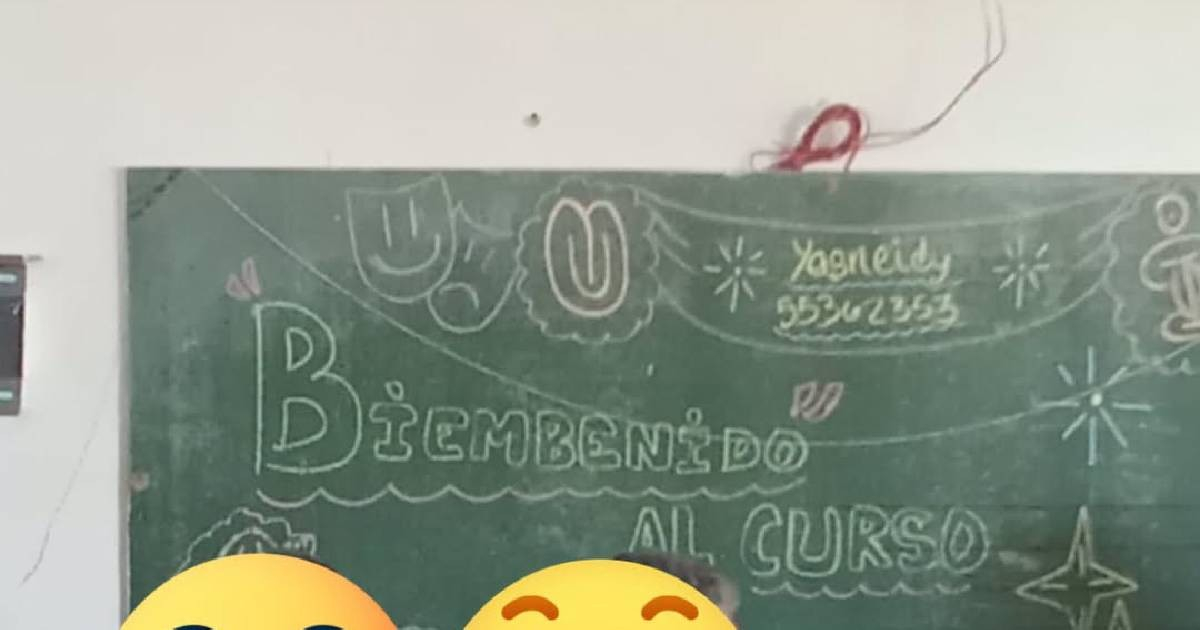
An image captured this Tuesday at Salvador Allende Primary School in Alamar, East Havana, encapsulates the state of Cuban education: a preschool classroom chalkboard adorned with stars and flowers features a welcome message from the teacher, who will be responsible for teaching those children to read and write, yet it reads "BIEMBENIDO AL CURSO."
Posted on Facebook by Yuley Boza on the first day of the 2026-2027 school year, the photo quickly spread among Cubans and the diaspora. The reaction was a mix of disbelief and irony, as the spelling mistake—"biembenido" instead of "bienvenido"—was made by the very educator tasked with laying the foundation of written language for her students.
"The future looks bleak if the fundamentals of primary education are so poorly established," Boza remarked alongside the image.
Responses to the post ranged from bewilderment to dark humor. "I'm speechless and out of ideas," commented one user. Another clung to forced optimism, saying, "I hope it's a meme." A third comment found the sole redeeming quality in the board's writing: "At least the rule of 'm' before 'b' and 'p' was applied correctly." The harshest verdict was also the briefest: "Enthusiasm 10 / Spelling 0."
Ongoing Educational Struggles
This incident is not an isolated case. In 2021, a professor from the Central University "Marta Abreu" of Las Villas publicly pointed out spelling errors in televised educational classes, and that same year, the word "DESICIÓN" appeared in the subtitles of the Evening News.
The Alamar scene unfolds amidst an educational crisis that the Minister of Education, Naima Ariatne Trujillo Barreto, described as "very challenging" even before the school bells rang for the new year.
Systemic Issues and Their Impact
The academic year began with just 73% of teaching positions filled, as reported by Infobae. Merely 12% of primary school students had new uniforms, and power outages affected up to 70% of the country during peak demand hours, according to data from the Electric Union shared by EFE.
The shortage of teachers is the core issue. For the 2024-2025 school year, Cuban schools had 24,000 vacant positions, equating to 12.5% of the total required. To fill these gaps, the system relies on university students, reactivated retirees, and teachers instructing subjects outside their expertise, a stopgap measure that directly and visibly impacts the quality of education.
Over 1.5 million children and teenagers returned to classrooms across Cuba this Tuesday. For many, the first written message they saw upon entering was marred by a spelling error.
Common Questions About Cuba's Educational Challenges
What is the main issue facing Cuba's education system?
The primary challenge is a significant shortage of qualified teachers, with 24,000 teaching positions unfilled for the 2024-2025 school year, leading to a reliance on unqualified personnel.
How does the teacher shortage affect students?
The lack of qualified teachers results in a decline in educational quality, as schools resort to using university students and retirees to fill gaps, affecting the learning experience and foundational skills of students.