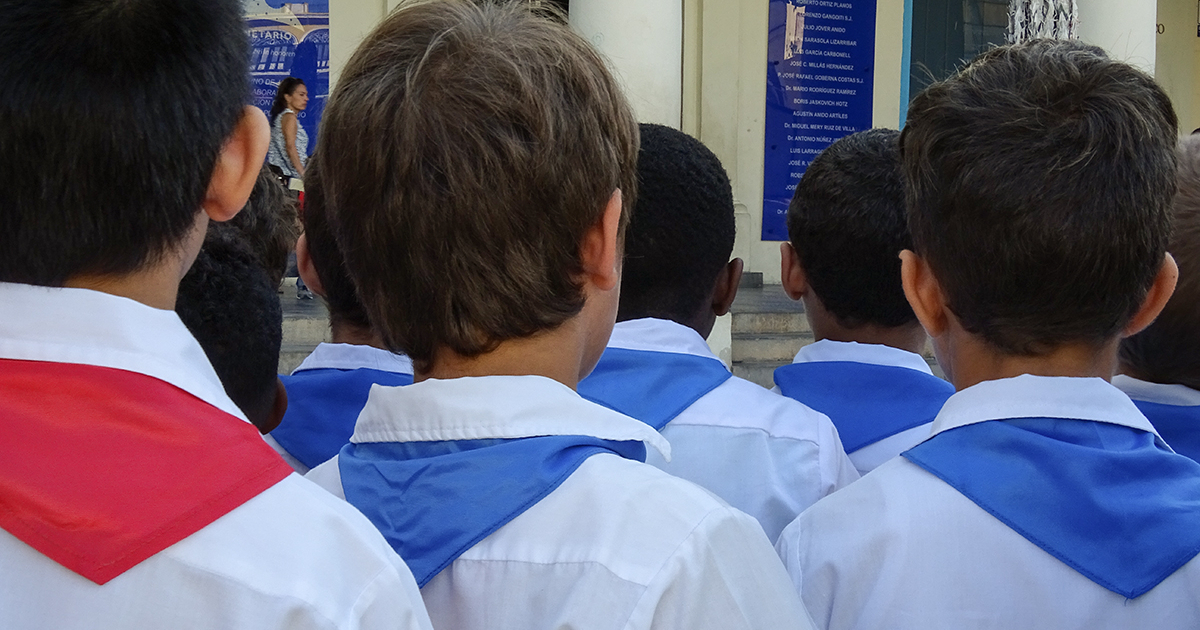
The Cuban Communist Party (PCC) has touted the return of "nearly 1.5 million students" to classrooms this Tuesday as an achievement, even though the new school year began amidst power outages, a shortage of teachers, scarce uniforms and materials, and challenges in providing adequate food for students.
The PCC attributed many of these difficulties to the United States, insisting that education remains a priority despite the challenges.
"Obstacles have not been absent, exacerbated by the hostile policies of the empire, but the determination to overcome them and the right to education for our youth is—and will continue to be—a priority in Cuba," the statement declared, accompanied by the hashtag #CubaEstáFirme.
The PCC's remarks also drew critical responses from users who questioned why the start of the school year was framed as a victory when fundamental problems persist.
Voices of Dissent Amidst Claims of Success
"Without breakfast, without sleep, the biggest obstacle is the PCC," one netizen wrote.
Another user highlighted a very specific issue from the first day: "Today was the first day of the school year, and by 11 a.m., students were already out on the streets because there were no teachers, let alone snacks or lunch to sustain them throughout the day."
From Havana, another commenter reported a lack of supplies at a specific school: "At Fructuoso Rodríguez Primary School in La Lisa, first-graders have no workbooks and just one textbook per desk. What solution is there?"
Another comment summed up the conditions many children face: "No sleep due to heat and mosquitoes from power cuts, stomachs empty from lack of breakfast, yet 'Proudly' preparing for the future."
Reality Check by the Ministry of Education
The triumphant rhetoric contrasts sharply with the conditions acknowledged just hours earlier by Education Minister Naima Ariatne Trujillo Barreto, who admitted that the 2026-2027 school year would begin under "very difficult" circumstances.
The minister pointed out issues such as the shortage of uniforms, limited availability of notebooks and other supplies, difficulties in filling teaching positions, and significant challenges in sustaining school meals.
She acknowledged that not all students would receive uniforms and that notebooks would be distributed under a "basic adjusted standard."
To tackle the teacher shortage, the Ministry plans to use university students, pedagogical trainees, former sector employees, and professionals from other fields.
The Education Minister had previously noted the impact of nights without electricity on both students and teachers: "After a night without power, going to school for a child [...] is a challenge."
Electricity Crisis Deepens as School Resumes
The return to school also coincided with one of the country's most severe electrical situations. The Electric Union forecasted an impact of up to 2,310 MW during peak hours on Tuesday, following a 2,323 MW deficit on Monday, with blackouts continuing around the clock.
FAQs on Cuba's Educational Crisis Amid Power Outages
What challenges are Cuban schools facing as the new academic year begins?
Cuban schools are grappling with power outages, a shortage of teachers, scarce uniforms, limited educational materials, and food supply issues for students.
How is the Cuban government addressing the shortage of teachers?
The government plans to address the teacher shortage by employing university students, pedagogical trainees, former education sector workers, and professionals from other areas.
What impact do power outages have on students and teachers in Cuba?
Power outages result in challenging conditions for students and teachers, as they lead to sleepless nights due to heat and mosquitoes, impacting their ability to attend and perform well in school.