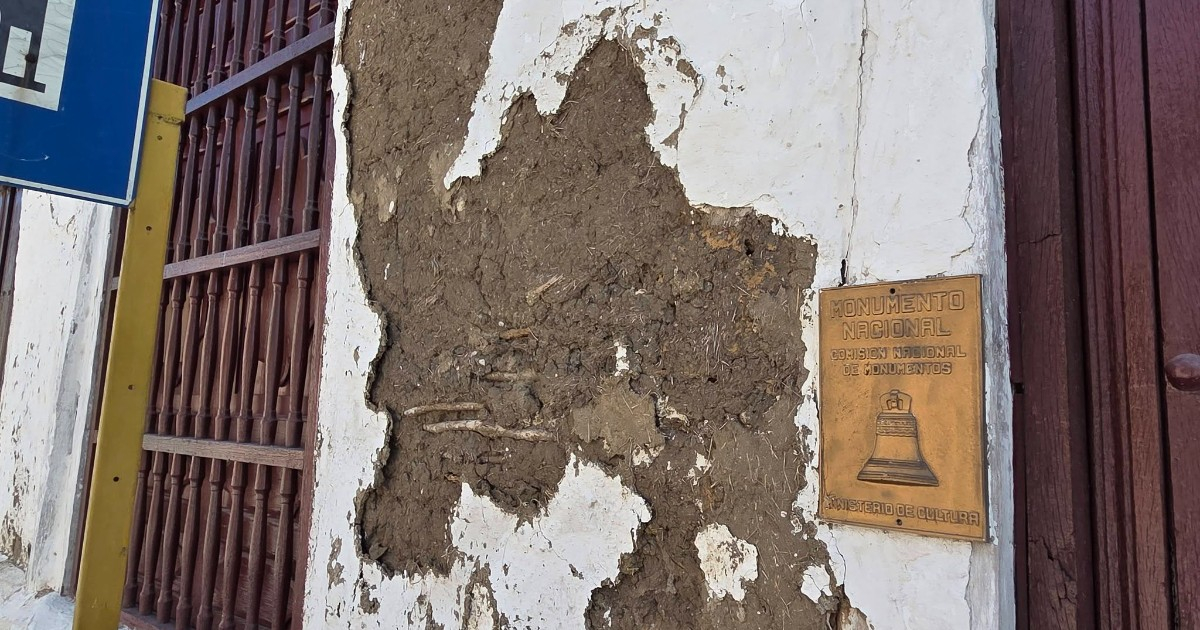
The Lieutenant Governor's House Museum in Holguín, affectionately known as the "Casa de Fango" and recognized as a National Monument, is already displaying troubling signs of decay merely four months post-renovation.
Photos shared on the "Holguín en fotos" Facebook page highlighted the issue, stating, "It's concerning that a recently restored structure is showing such deterioration in such a short time. It raises questions about whether the restoration work met the necessary standards for durability."
The images reveal peeling paint, cracks, deep holes, and expose the underlying material — a mix of mud and plant fibers — to the elements.
The Historical Significance of the Lieutenant Governor's House
This structure, the oldest surviving in the city, dates back to the first half of the 18th century and was home to Holguín's first Lieutenant Governor from 1752. The National Monuments Commission declared it a National Monument with Resolution 195 on January 12, 2004.
The publication, which sparked concern, concluded, "Ultimately, we're talking about one of the city's most historically valuable buildings, and it deserves preservation."
Challenges of Restoring a Centuries-Old Technique
The building's nickname directly references its construction method: "embarrado," a technique involving a framework of sticks and wooden rods filled and coated with a mixture of mud, straw, dry grass, and clayey soil, finished with a lime wash.
Proper restoration of these walls requires specialized knowledge of this construction technique. A commentator noted, "This technique demands constant maintenance," emphasizing that the mixture must pass consistency tests before application.
Fernando Bacallao Siré, an independent architect on Facebook, explained: "The maintenance for this construction method is ongoing. If rain causes material to fall, it must be replaced and covered with lime mixed with sand immediately."
He further added, "The 'embarrado' technique with sticks, straw, and earth (with the right amount of clay for plasticity) is ancient, and the craftsmen are disappearing. The mixed earth needs several tests like the 'tobacco' test, where a piece of earth is shaped like a cigar and placed on a table's edge. If a third breaks off immediately, the mix is unsuitable. It's not just any soil, as clays vary significantly, making these experiments and others on-site essential for ensuring quality before it's mixed with dry straw and layered between the sticks."
The urgency for further restoration has increased due to impending rains in Holguín, which could hasten the collapse of the exposed mud. "If the mud dissolves with rain, this historic building could be lost," warned a concerned resident.
Questions Raised Over Restoration Quality and Execution
The post sparked numerous reactions questioning both the Heritage Department's oversight and the quality of materials used.
A nearby resident disclosed that "it was patched up after the hurricane by prisoners brought in from the provincial jail," furthering doubts about the quality of the intervention.
Many comments suggest the work was rushed to meet a deadline, lacking the rigor a National Monument deserves. "Such heritage buildings should be restored seriously, not just to meet a date," one user stated. Another remarked, "The issue is that everything here is done to commemorate a date."
This year, Holguín witnessed the partial roof collapse of the Ismaelillo Theater in May and the fall of the "Woman with Umbrella" sculpture on the city's boulevard.
Nationally, the pattern persists. In Matanzas, the historic center has nearly 100 highly deteriorated buildings, and Havana reports around 185,000 buildings in poor condition, with approximately 1,000 collapses annually.
Understanding the Challenges of Heritage Preservation in Cuba
Why is the Casa de Fango important?
The Casa de Fango is significant as it is the oldest preserved building in Holguín, dating back to the 18th century and serving as the residence of the first Lieutenant Governor of the city.
What challenges does the restoration of the Casa de Fango face?
Restoring the Casa de Fango is challenging due to its construction using the traditional "embarrado" technique, which requires specialized knowledge and constant maintenance to withstand environmental conditions.
What concerns have been raised about the restoration work?
Concerns include the quality of the materials used, the execution of the work, and whether the restoration met the necessary standards for durability, with suggestions that the work was rushed to meet deadlines.