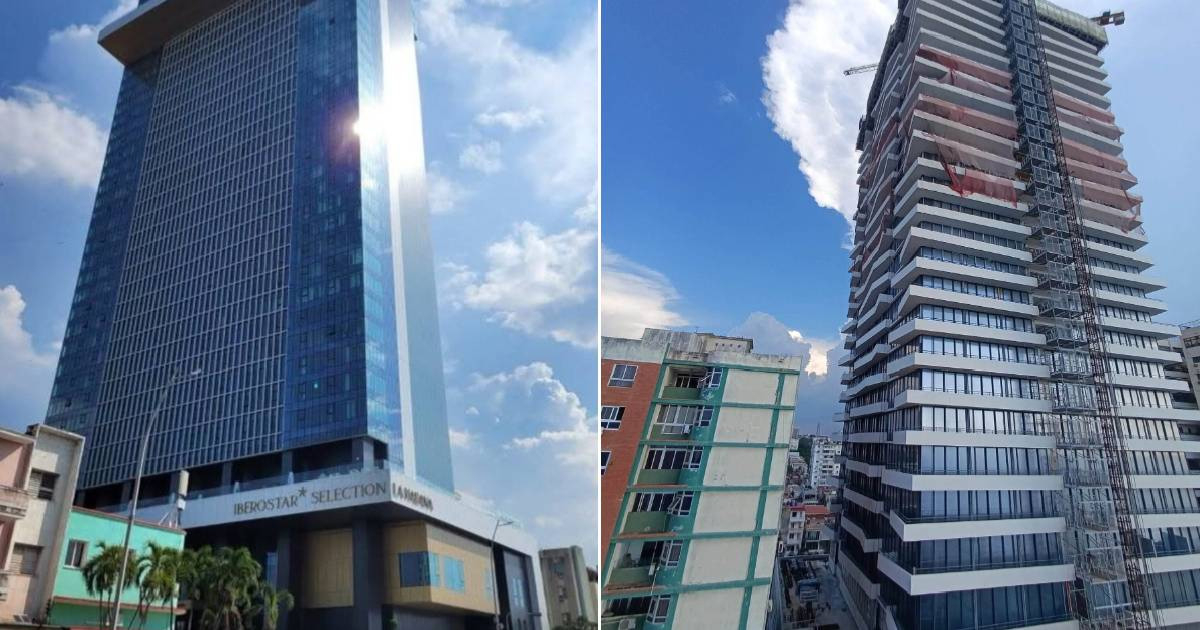
The Cuban government's focus on building luxury hotels starkly contrasts with the fate of the Iberostar Selection La Habana. Located on Vedado's 23rd Avenue, this skyscraper now stands shuttered as the country grapples with an electrical system incapable of providing reliable service.
This contradiction was highlighted on Saturday by Facebook user Yau ASalcedo, who labeled the structure, popularly known as the K-23 Tower, a "monument to failure." The building, which reportedly required an investment of over $200 million, stands as a testament to misplaced priorities.
Before its closure, the hotel, funded entirely by Almest, a real estate arm of the military conglomerate GAESA, had an occupancy rate of merely 20%, according to the same source. Despite being closed, the building incurs costs for security, maintenance, electricity, climate control, elevators, and fire protection systems.
The K-23 situation has fueled criticism regarding the allocation of government investments in tourism, especially given the existence of other hotel facilities that are underutilized or non-operational.
The Misguided Investment in Tourism
On Sunday, Facebook user Santiago Díaz questioned why the funds weren't used to enhance the national electrical generation capacity. He pointed out that tourist facilities in areas like Cayo Coco and Guardalavaca are also experiencing operational issues and contrasted these investments with the pressing need for new thermal power plants.
The case of the K-23 encapsulates the core criticism from social media commentators: hundreds of millions of dollars tied up in a closed facility, while other infrastructure needs remain unmet.
Analysts have calculated that the money spent on the K-23 Tower could have financed the construction of a thermal power plant with a capacity of about 300 MW—similar to the Antonio Guiteras plant in Matanzas, estimated to cost between $210 million and $450 million—or stabilized the National Electric System (SEN) for approximately $250 million.
Cubans on social media quickly highlighted the contradiction. "It's like buying pots without buying the stove to cook," one user remarked. Another added, "I think it was a bad decision like many others... if that money had been invested in the SEN, public health, education, food, or medicine, the country would have improved significantly, but their well-being comes first, and the people suffer."
The Broader Picture of Misallocation
The irony even extends to the closed building itself. An observer passing by described the hotel's power generator as sounding like a "dragon guzzling fuel."
This investment pattern is not an isolated incident. Between 2021 and 2023, the Cuban government allocated 36% of all state investment to hotel construction, while health received a mere 1.9% and education just 1.3%. In 2024, tourism accounted for nearly 37.4% of national investment.
The outcome is a comprehensive failure. In late July, Prime Minister Manuel Marrero Cruz admitted to the National Assembly that 73% of the country's hotel facilities were closed, leaving around 25,000 workers in limbo.
The tourism sector's downfall is widespread. Cuba welcomed only 387,591 international visitors in the first half of this year, a 60.7% drop compared to the same period in 2025. In May, hotel occupancy plummeted to 12.9%. Chains like Blue Diamond Resorts shuttered 62 hotels, and Meliá announced the closure of its 34 establishments on the island, ending 36 years of operations.
This year, the SEN has experienced numerous partial and total outages, with generation deficits exceeding 2,200 MW, leaving many areas in complete darkness for 20 continuous hours or more.
Weeks ago, the U.S. Department of State used the K-23 Tower as a symbol of the chasm between the regime and the Cuban populace, commenting that the building is "a permanent reminder to the Cuban people that the illegitimate regime only cares about enriching itself, not improving their living conditions."
Understanding the Impact of Mismanaged Investments in Cuba
Why was the K-23 Tower project considered a failure?
The K-23 Tower project is seen as a failure because it required over $200 million in investment, yet it remains closed and underutilized while Cuba faces severe infrastructure issues, particularly in its electrical system.
How has the Cuban government prioritized its investments in recent years?
Between 2021 and 2023, the Cuban government allocated 36% of its state investment to hotel construction, significantly more than what was allotted to health and education. This trend continued into 2024, with tourism receiving nearly 37.4% of national investment.
What could have been done with the funds used for the K-23 Tower?
Analysts suggest that the funds could have been used to build a thermal power plant or stabilize the National Electric System, addressing some of the critical infrastructure needs of the country.