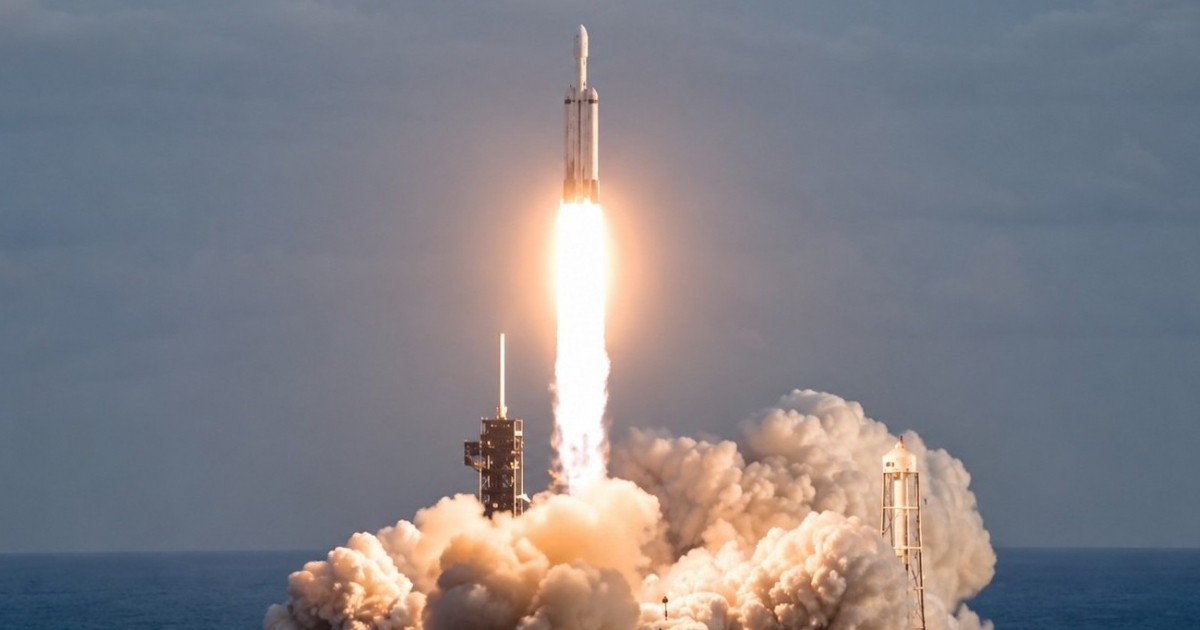
The NASA's Nancy Grace Roman Space Telescope took off from Kennedy Space Center in Florida at 7:26 a.m. Eastern Time on Sunday, aboard a SpaceX Falcon Heavy rocket. This marks the beginning of its three-month journey to a final orbit located a million miles from Earth.
"At 7:26 a.m. ET (1126 UTC) on August 30, NASARoman soared into the sky, heading to its new home a million miles from Earth. It is expected to reach its final destination in a month," NASA announced on its X account.
This groundbreaking observatory is en route to the Sun-Earth Lagrange Point L2, the same operational location as the James Webb Telescope since 2022, situated approximately 1.6 million kilometers from our planet.
Unveiling the Mysteries of the Universe
Roman is designed to be the next major observatory of NASA, with a mission focused on uncovering the secrets of the dark universe: dark energy, dark matter, and the large-scale structure of the cosmos.
NASA Administrator Jared Isaacman described the telescope as a tool that will provide humanity with "a new atlas of the universe," shedding light on "dark matter, dark energy, and the structure of the universe itself."
"Roman is on its way. Years of dedication, extraordinary engineering, and an incredible launch. Congratulations to the entire NASA team and our partners who made this mission possible. The Nancy Grace Roman Space Telescope is about to open an entirely new window to our universe," he expressed on X.
Advanced Technology and Ambitious Goals
Nicky Fox, Associate Director of the Science Mission Directorate, highlighted that Roman was specifically constructed to address the accelerating expansion of the universe, one of the most profound questions in contemporary astrophysics.
"It's going to revolutionize how we observe the cosmos," she emphasized.
The telescope's primary tool, the Wide Field Instrument, is a 300-megapixel infrared camera with a field of view 100 times larger than that of the Hubble, yet with comparable clarity. Its primary mirror measures 2.4 meters in diameter, akin to the legendary orbital observatory.
Among its scientific objectives is the detection of exoplanets. Roman is anticipated to identify over 100,000 new worlds, including more than 1,000 using gravitational microlensing techniques in the galactic bulge.
The telescope also features a coronagraph capable of suppressing starlight up to a billion times to directly study planets.
A Milestone in Space Exploration
The total lifecycle cost of the mission is estimated at around $4.3 billion, while the launch contract with SpaceX was approximately $255 million. The mission was completed eight months ahead of schedule, moving up its original launch date set for 2027.
Once settled in its final orbit, Roman will have a nominal lifespan of five years, with a potential extension to a decade, during which it will map the universe with an unparalleled breadth and speed in the history of space astronomy.
The telescope is named after Nancy Grace Roman (1925-2018), NASA's first Chief of Astronomy and the first woman to hold an executive position at the agency. Roman joined NASA in 1959, just six months after its founding, and was instrumental in planning the Hubble Telescope, earning her the nickname "the mother of Hubble" from her colleagues.
The Roman launch comes months after another historic milestone for NASA: the Artemis II mission, completed in April 2026, which took four astronauts around the Moon for the first time in over 50 years.
Frequently Asked Questions about the Roman Space Telescope
What is the primary mission of the Roman Space Telescope?
The Roman Space Telescope aims to unravel the mysteries of dark energy, dark matter, and the large-scale structure of the cosmos.
How does the Roman Space Telescope differ from the Hubble Telescope?
While the Roman Telescope has a comparable clarity to the Hubble, its Wide Field Instrument offers a field of view 100 times larger, enabling it to capture a broader section of the sky.
What is the expected lifespan of the Roman Space Telescope?
The Roman Telescope has a nominal lifespan of five years, with a potential extension to a decade for continued scientific exploration.