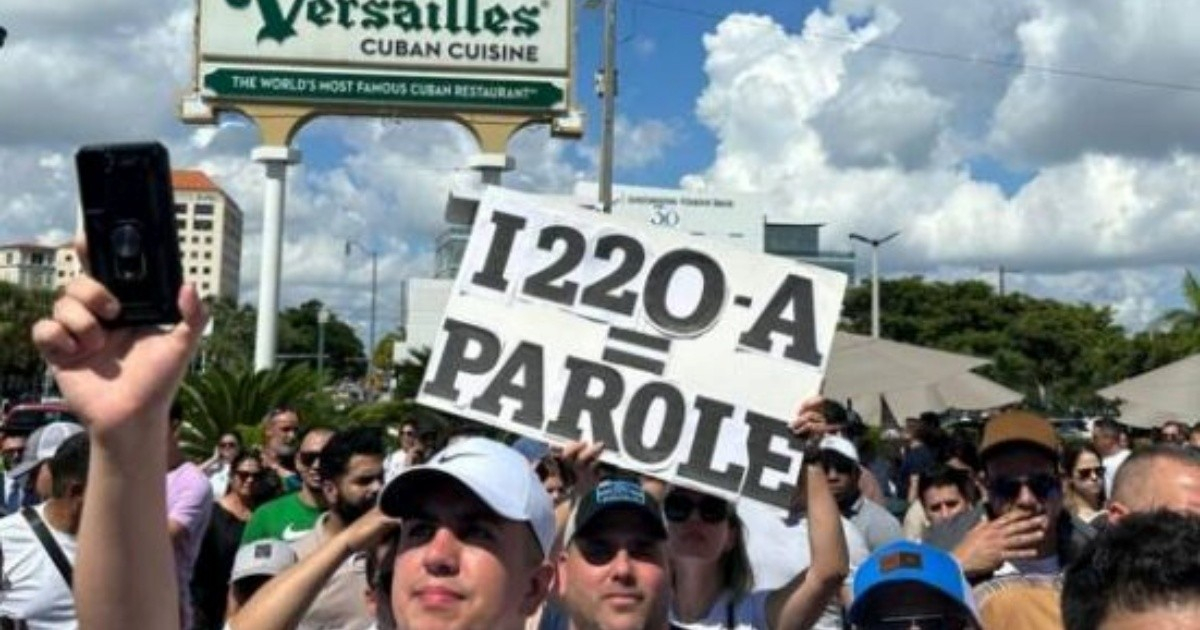
A federal court in Miami has once again postponed a pivotal hearing in the case of Bello-Rubio v. Noem. This lawsuit involves 992 Cuban nationals who hold the I-220A form and are seeking legal recognition of their release status as parole.
On Thursday, August 27, an order rescheduled the hearing to September 10 at 8:30 a.m., to be held at the Wilkie D. Ferguson Jr. courthouse in downtown Miami.
Cautious Anticipation Surrounds Upcoming Hearing
Attorneys involved in the case are urging caution regarding the proceedings on September 10. The judge is expected to hear arguments from both parties, but a written decision may follow at a later date without any immediate ruling.
Attorney Willy Allen emphasized to CiberCuba, "This hearing won't mark the beginning or the end of anything; it's simply part of the ongoing process."
He further stated, "I don't foresee final outcomes, but I do expect a constructive step toward clarifying the path to legal status for all Cubans with I-220A."
A negative outcome wouldn't result in automatic consequences: it wouldn't lead to the immediate deportation of those holding the document nor cancel asylum applications or other individual immigration proceedings.
Repeated Postponements Amid Legal Proceedings
The hearing was initially slated for August 26 before Judge Jacqueline Becerra at the Federal District Court for the Southern District of Florida.
The first rescheduling moved it to September 2, and shortly thereafter, a second change set the date for September 10. Lead attorney for the plaintiffs, Mark Prada, downplayed the delays, explaining to Café Fuerte, "The judge needed more time, possibly due to an extended previous case, which is not uncommon at this judicial level."
Prada also clarified the hearing's purpose: "The judge aims to address motions from the government seeking to dismiss the case, arguing a lack of court jurisdiction to grant the legal remedies we're pursuing."
Legal Debate Over I-220A's Status
Central to the dispute—filed under case number 1:25-cv-23665 in the Southern District of Florida—is whether the I-220A, an Order of Release on Recognizance issued by Immigration and Customs Enforcement (ICE), can be legally equivalent to a parole.
This distinction matters because the Cuban Adjustment Act of 1966 allows those "inspected and admitted or paroled" to apply for permanent residency after one year and a day in the U.S.
The I-220A hasn't been universally recognized as parole, leaving its holders in a state of immigration uncertainty.
The plaintiffs are also seeking class-action status for the lawsuit, which would extend any favorable ruling to all Cubans in similar circumstances.
Background and Growing Urgency in Immigration Case
In January 2026, Prada presented arguments in the Second Circuit Court of Appeals in New York for the I-220A to be recognized as a record of admission, a decision yet to be made.
In February, the Eleventh Circuit in Atlanta overturned Immigration Appeals Board decisions concerning two Cuban women with I-220A, remanding the cases for further review without declaring the document equivalent to parole.
Urgency increased in July when Cubans with I-220A began receiving deportation orders after ICE appointments.
According to TRAC data, U.S. courts issued 1,642 deportation orders against Cubans in June alone.
It is estimated that approximately half a million Cubans are in a similar situation as the 992 plaintiffs.
This case involving Cubans with I-220A is one of the most closely monitored in immigration law. Stay informed of this and other legal processes affecting the Cuban community in the U.S.
Key Questions About I-220A and Legal Status
What is the significance of the I-220A form?
The I-220A form is an Order of Release on Recognizance issued by ICE, and its legal recognition as equivalent to parole is pivotal for Cubans seeking to adjust their immigration status under the Cuban Adjustment Act.
Why has the hearing been postponed multiple times?
The hearing has faced delays possibly due to scheduling conflicts or the judge needing more time, which is a common occurrence in high-level judicial proceedings.