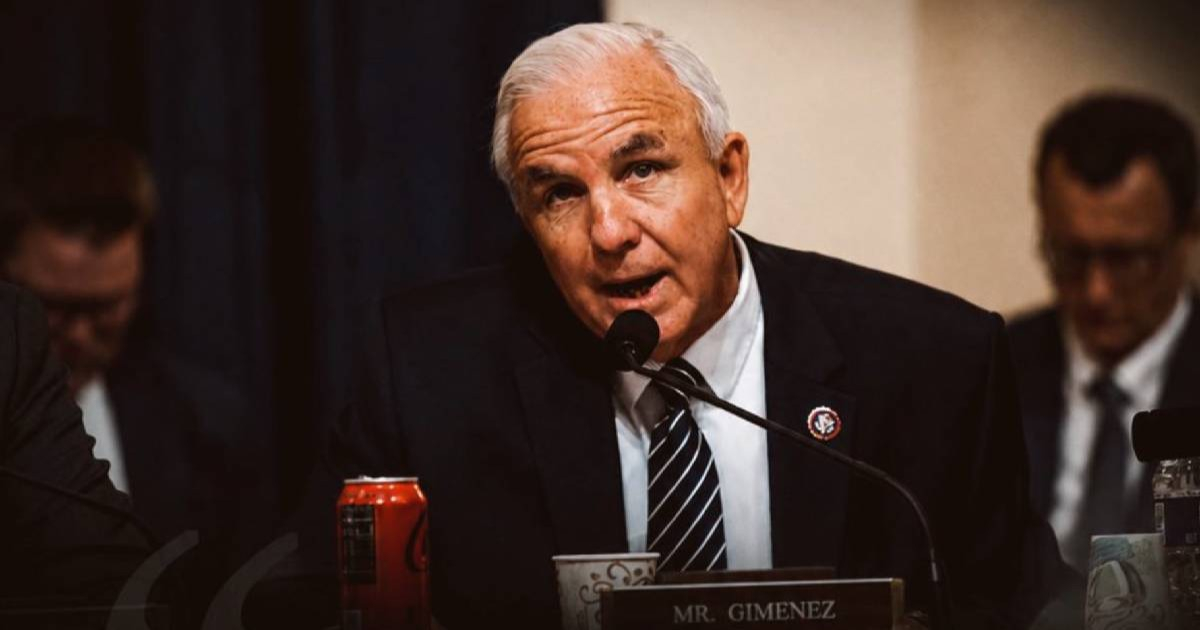
Republican congressman and Cuban-American Carlos Giménez issued a stern warning on Saturday regarding the Venezuelan regime in two back-to-back posts on X. He referred to acting president Delcy Rodríguez as an "interim dictator" and demanded that ongoing negotiations should not serve to legitimize a government he deems unacceptable.
"Let no one be deceived about who we are dealing with in Venezuela," Giménez stated in his initial post, highlighting that alongside Rodríguez is Diosdado Cabello, who remains wanted by U.S. authorities for drug trafficking.
Representing Florida, Giménez set forth non-negotiable conditions for any agreement: "Our goal must be clear: to advance towards a free and democratic Venezuela, with a new Supreme Court of Justice, a new National Electoral Council, independent institutions, and free, transparent, and verifiable elections. Anything less will be unacceptable."
Giménez also emphasized the role of the major opposition in any political resolution: "Millions of Venezuelans supported Edmundo González Urrutia and María Corina Machado, and they must be a fundamental part of Venezuela's democratic future."
The congressman expressed hope that negotiations between the regime and the representatives of the National Assembly elected in 2015 would continue in September and "yield concrete progress towards a genuine democratic transition."
Shortly thereafter, in a much more aggressive follow-up post, Giménez warned that Rodríguez "knows that if she does not cooperate with Trump's orders, she will end up worse than Nicolás Maduro," and described it as a "grotesque mockery" that the acting president is leading the government in Miraflores.
Political Tensions Surrounding Venezuelan Negotiations
These statements come amid heightened political tension surrounding Venezuela. The negotiation process between Rodríguez's government and a sector of the opposition—represented by Dinorah Figuera, with Machado excluded—officially began on August 7 in La Carlota, Caracas, with support from Washington.
The first round concluded on August 12, with agreements on the renewal of the Supreme Court of Justice and addressing the victims of the June 24 earthquakes, according to reports from both the chavista regime and the opposition.
Giménez's messages also coincide with controversy sparked this Saturday by an oil agreement announced by President Trump, which would open access for American private companies to Venezuelan reserves.
Fellow Cuban-American and Republican congresswoman María Elvira Salazar initially criticized the deal, stating that "any oil agreement with the interim regime has an expiration date: the day President Trump leaves the White House," before moderating her stance, as reported by the New York Post.
Giménez, who had already publicly demanded in April that Rodríguez hand over Cabello to U.S. authorities, did not directly address the oil agreement. However, his general warning points to the same debate: how far should Washington's understanding with the chavista regime go.
Cabello has faced formal charges since March 2020 in the Southern District of New York for conspiracy to commit narcoterrorism and cocaine importation, and the U.S. maintains a $25 million reward for his capture.
"Venezuela will be free, and as we said from the start: this fight is to the end," Giménez concluded in his initial post.
Understanding the U.S. Stance on Venezuela
What are the key demands of Congressman Giménez for Venezuela?
Congressman Giménez demands a clear path towards a free and democratic Venezuela, including the establishment of new judicial and electoral institutions, and free, transparent, and verifiable elections.
Who is Diosdado Cabello and why is he significant in this context?
Diosdado Cabello is a key figure in the Venezuelan regime, wanted by U.S. authorities for drug trafficking. His presence alongside Delcy Rodríguez underscores the regime's resistance to democratic change.
What was the outcome of the first negotiation round in Caracas?
The first negotiation round concluded with agreements to renew the Supreme Court of Justice and address the needs of earthquake victims from June 24.