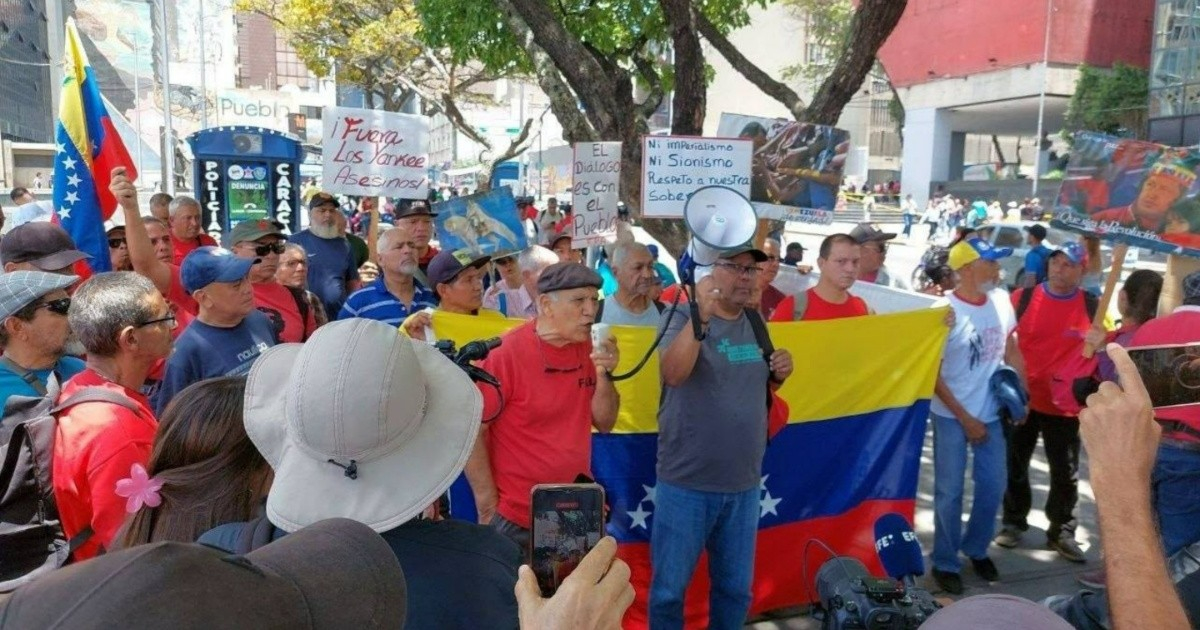
On Saturday, committed followers of the hardcore Chavista movement took to the streets in downtown Caracas, voicing their opposition to the presence of the United States in Venezuela and demanding the release of Nicolás Maduro and his wife, Cilia Flores, who were detained by U.S. forces on January 3.
The protest, organized by the Anti-Imperialist Popular Front, occurred just a day after Washington and Caracas announced what President Donald Trump hailed as the largest oil agreement in history. This faction of Chavismo views the deal as an unacceptable surrender of national sovereignty.
Protesters gathered near the National Assembly building, distributing a manifesto to passersby and labeling Trump as a "murderer."
Chavista Movement's Stance
Humberto Vargas, spokesperson for the Anti-Imperialist Popular Front, spoke to EFE, summarizing the movement's paradoxical stance: "To us, the government is a victim of what's happening."
Vargas was referring to the interim government led by Delcy Rodríguez, whom the group supports despite criticizing the agreement she signed with Washington.
Dialogue and Accusations
Vargas also condemned the ongoing dialogue process between Chavismo and a segment of the opposition, led by former deputy Dinorah Figuera, as a "trap orchestrated" by the U.S. to impose Trump's "planned agenda" following the January 3 military operation in Caracas.
"We have identified our true enemy as Yankee imperialism and Zionism, along with their followers in Venezuela," Vargas declared to EFE during the demonstration.
Oil Agreement Details
The group announced that they would soon discuss the implications of the oil agreement unveiled on Friday, highlighting that Washington would gain control over more than 20% of Venezuela's oil reserves.
The agreement, confirmed by Rodríguez, involves the development of 17 strategic fields with a proven potential of 65 billion barrels of oil, an investment exceeding $100 billion, and more than $209 billion in taxes for the Venezuelan state.
The interim president expressed her "profound appreciation" to Trump and Secretary of State Marco Rubio "for their commitment to the development" of what she called "a historical milestone in bilateral relations."
Background and Current Situation
This agreement marks the culmination of a progressive energy cooperation that began after Maduro's capture, when Venezuela and the United States resumed diplomatic relations that had been severed for seven years.
The Anti-Imperialist Popular Front, officially established in April 2026, has been active in several protests in Caracas this year, including demonstrations on August 1 against the opposition-Chavismo dialogue and on August 16 in El Junquito.
Meanwhile, Maduro is set to face trial in New York for charges of conspiracy to commit narcoterrorism and cocaine importation, with the trial starting on June 1, 2027. Cilia Flores faces charges related to drug importation and weapon possession.
Key Questions About the Venezuela-U.S. Oil Agreement
What triggered the protests in Caracas?
The protests were triggered by the announcement of a major oil agreement between the United States and Venezuela, which many Chavista supporters see as a surrender of their country's sovereignty.
What are the details of the oil agreement?
The agreement involves the development of 17 strategic oil fields, with a potential of 65 billion barrels, and requires an investment of over $100 billion, with $209 billion in taxes for Venezuela.
Who is leading the protests against the U.S. presence in Venezuela?
The Anti-Imperialist Popular Front, a Chavista movement, is leading the protests against U.S. involvement in Venezuela.