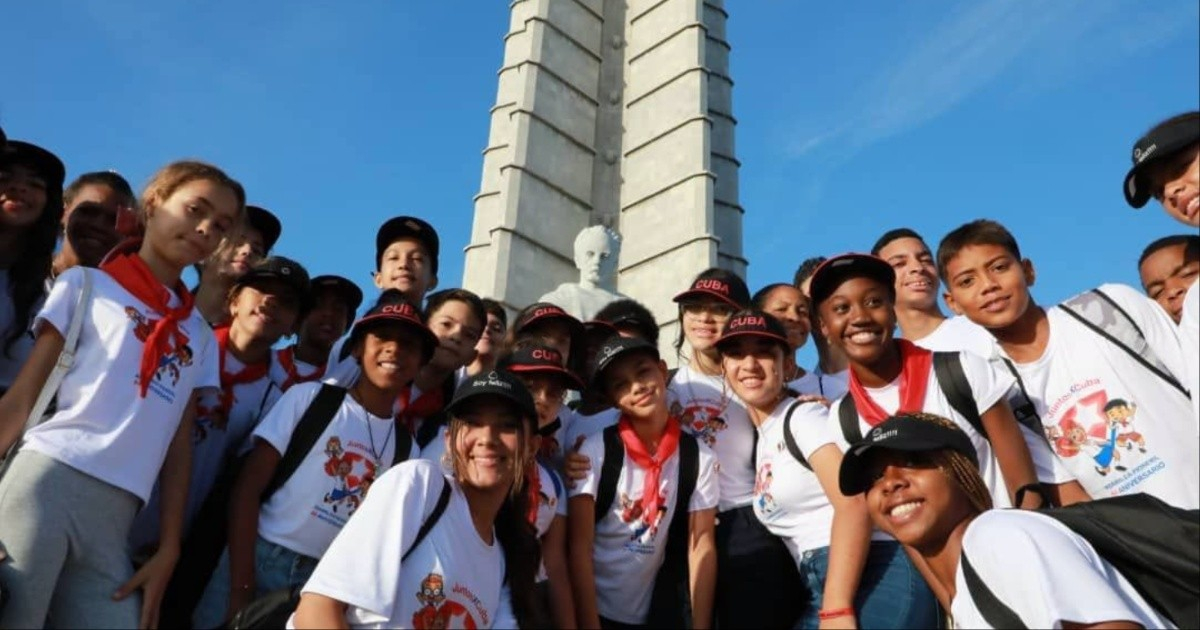
The Communist Party of Cuba recently proclaimed on their official Facebook page that the commencement of the 2026-2027 school year is yet another "heroic act and a steadfast determination not to surrender," tagging their post with #CubaStandsFirm and #CubaWillWin.
This statement was met with a torrent of criticism from numerous Cubans who painted a starkly different picture of the reality imposed by the regime.
School Year Begins Amidst Deep Crisis
Set to start on September 1st, according to the Ministry of Education's Resolution 43/2025, the new school year arrives amidst a severe energy and educational crisis unseen in Cuba for decades.
The post featured an image of young students wearing the red scarves of the Pioneers in front of the José Martí Memorial at the Plaza de la Revolución. Rather than sparking enthusiasm, the announcement incited outrage from those who described the dire conditions faced by children and teachers attending school.
Andria GianAnt, a user, expressed, "Truly heroic are those who attend classes after enduring long hours without power and in unbearable heat. Many go without breakfast or snacks to bring, others with patched shoes and no uniforms, attending schools in deplorable conditions."
Widespread Discontent and Criticism
Another commenter, Floria Juban, bluntly asked, "What hope and future are they talking about? Unless it's young people leaving through Guyana and then to Brazil."
The backdrop is indeed grim. The energy crisis left 65% of the island without power on Thursday, escalating to 72% on Friday, with outages lasting up to 40 hours in some provinces. So far in 2026, Cuba has suffered at least seven total collapses of the National Electric System.
Activist Thais Mailén Franco Benítez questioned the capacity of teachers and students to perform after over 30 hours without electricity: "There's no power, no water, no food, no health."
Educational System Under Pressure
Adding to this is a structural deficit of nearly 3,000 teaching vacancies in Camagüey, required for over 95,000 students across 690 schools, along with over 2,000 missing teachers in Holguín for the school year. Nationally, the deficit exceeds 24,000 teachers, representing 12.5% of required positions.
Given these challenges, the Ministry of Education acknowledged "exceptional" conditions and announced emergency measures such as reducing class hours and allowing one teacher to serve multiple institutions. The production of uniforms is also falling short, covering only 20% of students: 2.3 million garments out of the 3.6 million needed.
Cuban mothers voiced their concerns as well. "When there's no power: I won't send him. When there's no water: I won't send him. When I have nothing for his breakfast: I won't send him," shared Verónica C. Barrios. Yunia Avila, a mother of a secondary student, added, "He's been sleeping on the floor for over a month with barely any water, and he goes because he wants to, because as far as I'm concerned, he wouldn't."
Historical Context of "Heroic" Rhetoric
This rhetoric of "heroism" is not new. Recently, the first secretary of the PCC in Camagüey, Walter Simón Noris, described the start of classes as a "blow to imperialism," a statement that also drew widespread ridicule and criticism on social media.
The immediate past adds to the bleak situation: last May, the government was compelled to end the 2025-2026 school year early due to fuel shortages and to cancel university entrance exams. Reynier Curbelo Sanchez captured the sentiment of many in the comments on the PCC's post: "You only care about your slogans and cheap politics, not the suffering of people and children."
Understanding Cuba's Educational and Energy Crisis
What challenges are Cuban schools facing in the 2026-2027 school year?
Cuban schools are facing severe energy shortages, a significant deficit in teaching staff, and inadequate resources like uniforms and educational materials.
How are Cuban parents responding to the current educational crisis?
Many Cuban parents are expressing their frustration and concerns online, citing lack of basic necessities like electricity, water, and food as reasons for not sending their children to school.
What measures is the Cuban Ministry of Education taking in response to these challenges?
The Ministry has acknowledged the "exceptional" conditions and announced emergency measures, such as reducing class hours and having one teacher cover multiple institutions, to cope with the shortages.