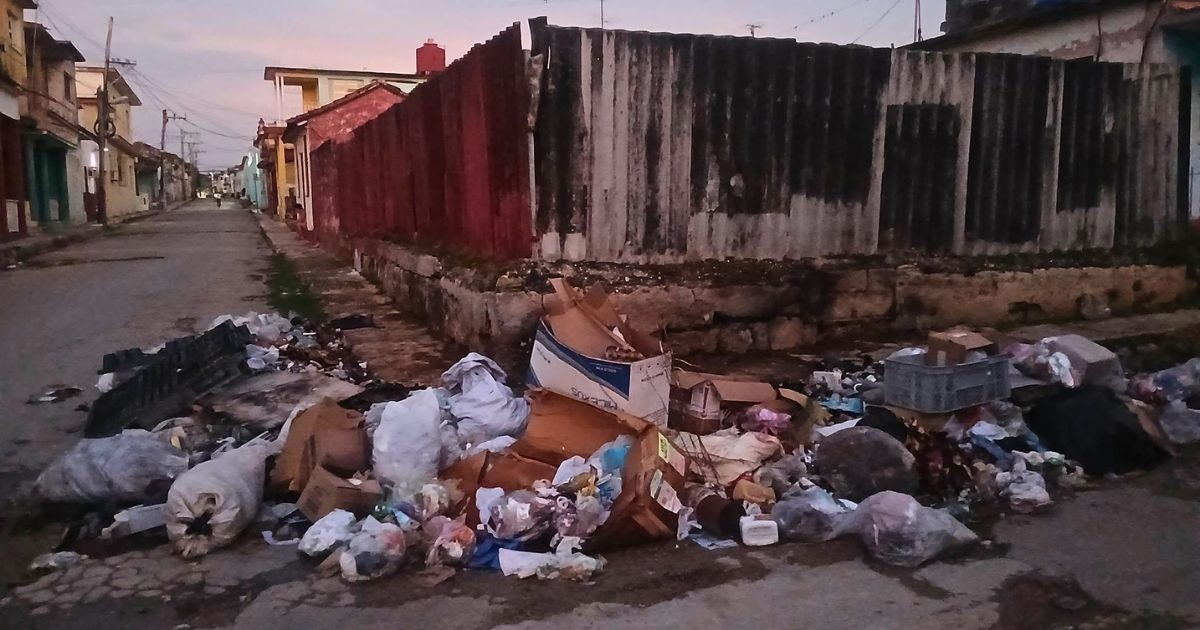
On Wednesday, Cuban poet and repentista Juan Carlos García Guridi shared a poignant décima espinela on his Facebook profile. Accompanied by three striking photographs, the post highlights the severe waste accumulation at the corner of 15 and 8 in Bejucal, Mayabeque. The poem starkly concludes with a grim observation: "we have become a land of garbage."
The poem, dated August 26, depicts this particular corner—situated "a block from the Party"—as a "corner almost like a latrine / of proven excess" that "contaminates us all, whether we like it or not."
Accompanying the verses, the images reveal heaps of black bags, cardboard, plastics, decomposed organic waste, and rubble scattered across crumbling pavements, amidst houses with peeling facades and overhead electrical wires.
The publication sparked a wave of reactions from Cubans acknowledging the nationwide issue. One commenter, having recently visited Bejucal, remarked: "No words. Last Saturday, I passed through Bejucal and noticed that every corner had its own mini-dump. It's truly disheartening."
From Havana, another voice noted the ubiquity of the problem: "Entire blocks in Havana / Vedado, Playa, Miramar / No one is spared." A resident from Batabanó described a garbage dump behind their house "that even a goat couldn't leap over, and a stench that keeps you from sleeping." Another commenter summed up the scale of the issue with a stark statement: "Cuba is a garbage dump from Cabo de San Antonio to Punta de Maisí and back."
Several commentators dismissed the official narrative blaming the U.S. embargo for the country's shortages. "What does the embargo have to do with this filth? With carts, wagons, and willing people, along with municipal government support, couldn't neighborhoods, towns, and cities be cleaned up? [...] This is total neglect, of unbelievable proportions," one wrote.
García Guridi's latest work joins a series of socially critical poems he has released throughout 2026. In July, his piece "PREGUNTO" questioned the erosion of dignity and freedom with lines like "What have they done to us? I ask / as we lose day by day / our dignity, our joy […]." On August 21, he shared "Catarsis," declaring: "Enduring in silence / is no badge of honor."
The waste collection crisis depicted in the poem is supported by hard data. As of February 2026, only 44 of Havana's 106 garbage trucks were operational, leaving over 20,000 cubic meters of waste uncollected daily in the capital, as reported by international media.
The accumulated waste also poses serious public health risks: In June 2026, the Ministry of Public Health warned of a potential dengue epidemic linked, among other factors, to mosquito breeding grounds in garbage dumps, with multiple virus serotypes circulating at once.
One online user encapsulated the collective sentiment with a historically loaded comparison: "If Cuba was once an eternal Baraguá, today it's an Eternal Garbage Dump."
Cuba's Waste Crisis: Key Questions and Answers
What is the main issue highlighted by Juan Carlos García Guridi's poem?
The poem underscores the severe waste accumulation and neglect in Cuba, particularly in Bejucal, Mayabeque, portraying the nation as a "land of garbage."
How has the public reacted to the waste crisis in Cuba?
The public has responded with frustration and recognition of the issue as nationwide, with many rejecting the government's narrative that attributes the problem to the U.S. embargo.
What are the health implications of Cuba's waste problem?
The waste buildup has serious health implications, including a heightened risk of dengue fever due to mosquito breeding grounds in the dumps.