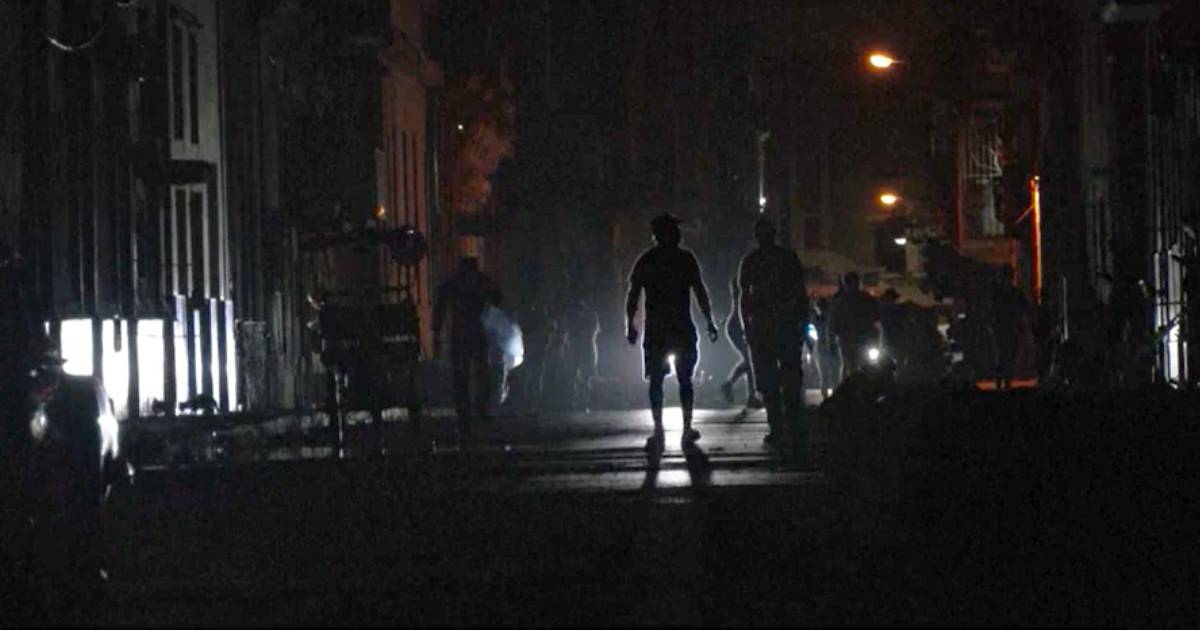
María Antonia Borroto Trujillo, a prominent writer and journalist from Camagüey, took to Facebook to voice her frustration this Friday about her neighborhood enduring two full days without electricity. When she attempted to file a formal complaint with the electric authorities, she was shuffled from call to call until she was finally advised to return on Monday.
Borroto Trujillo, who holds a doctorate in Communication Sciences and is a member of the Union of Writers and Artists of Cuba (UNEAC), recounted that after the 48-hour mark without service, she contacted the Union Eléctrica’s official helpline, 18888. "A very polite young woman attended to me and mentioned that our report is still pending—I say 'our' because several neighbors have called—and she had no clue when the issue would be resolved," she shared.
When she inquired whether such a prolonged outage warranted any priority, the operator redirected her to the Office of Basic Electricity (OBE) municipal division responsible for handling formal complaints.
What ensued was a frustrating sequence of three fruitless calls.
During the first call, a staff member asked her to call back in three minutes to speak with the person in charge of complaints. On the second attempt, that person immediately dismissed her: “Call back in forty minutes. I'm currently with someone else and can't leave them hanging to attend to you.”
By the third call, after the allotted time had passed, the response was final: the person in charge had left for the day, and no further assistance would be available until Monday.
"—But... I mean, I've been without power for over forty-eight hours and I can't even file a complaint...," Borroto Trujillo wrote, detailing the conversation. "I don't know if anything was said after that, because I hung up. The whole situation felt like a mockery, and in the worst possible taste."
The post sparked a wave of reactions. One commenter summed up the sentiment with a question: "Who cares about us?" Another described the situation as "indifference upon indifference," while a third sardonically noted the prolonged wait: "Hey, in forty minutes anyone's arm and ear would go numb!"
This incident is just the latest in a series that the writer has documented over recent weeks. On July 31, she sarcastically shared a "Basic Manual for Communicating with the Electric Company." Her post on August 6 and 7 tallied "7 days, 172 hours, 10,320 minutes, 619,200 seconds without power," coining a widely circulated phrase: "The Revolution has ended up being just that: carrying everything that needs to be carried." Three days later, her neighborhood exceeded 10 days without electricity due to a faulty transformer that failed each time reconnection was attempted.
The situation underscores a broader crisis affecting both Camagüey and the entire nation. In July, the Minister of Energy and Mines, Vicente de la O Levy, acknowledged before the National Assembly that some communities had been without service for up to 105 days due to damage to special transformers, and that the theft of dielectric oil was reaching levels comparable to national production. The question Borroto Trujillo posed weeks ago remains unanswered: "Are we going to be left in the dark forever? Is that the plan? [...] Does anyone really care about us?"
Understanding Cuba's Power Crisis
What prompted María Antonia Borroto Trujillo to speak out?
She spoke out after her neighborhood in Camagüey experienced over 48 hours without electricity and she faced difficulties in filing a formal complaint with the electric authorities.
How did the electric company respond to the outage?
The electric company was unable to provide a specific timeline for resolving the issue, and attempts to escalate the complaint were met with delays and unavailability of responsible personnel.
What broader issues does this incident highlight?
The incident highlights a broader crisis in Cuba's power infrastructure, including long outages, damaged transformers, and theft of essential materials, which are affecting communities nationwide.