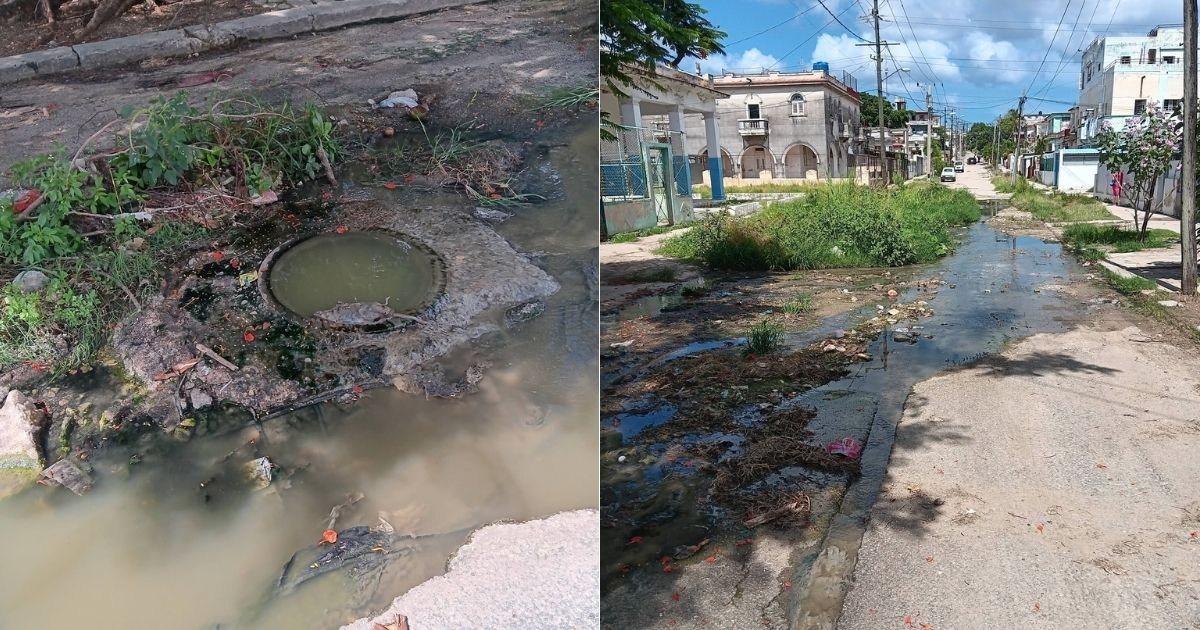
On Friday, Cuban writer, linguist, and translator Rodolfo Alpízar Castillo took to Facebook to share a satirical commentary on the sewage overflow at the intersection of Figueroa and Luis Estévez in the Santos Suárez neighborhood, located in the Diez de Octubre municipality of Havana.
The opening words of his concise post convey the message clearly: "Beautiful tourist vistas." Employing his characteristic irony, Alpízar highlighted how the sewage water "merges nonchalantly with the potable one as a sign of inclusivity," and noted that "the street no longer exists" in that area of the neighborhood.
Images that accompanied the post leave little room for doubt: murky, greenish-gray water covers the pavement, a manhole appears without its metallic cover and is completely submerged, the street surface shows severe cracks and depressions, and weeds grow amidst the debris.
The conclusion was as predictable as it was devastating: "Oh, I almost forgot: It's the blockade's fault." With this remark, Alpízar mocked the regime's habitual excuse for every calamity, from power outages to transportation breakdowns.
The Broader Context of Havana's Infrastructure Crisis
The social media users responded in a similar vein. One sarcastically questioned, "With such beautiful resources, I wonder why tourists don't come?" Another was more blunt: "Even the blockade has erased the intelligence of many officials."
What Alpízar depicts is not an isolated incident but a symptom of a larger structural collapse. Havana's sewer system, constructed between 1908 and 1914 for a city of around 600,000 people, now struggles to serve approximately two million residents, with 1,755 kilometers of pipes in a state of disrepair.
Historical and Ongoing Challenges in Diez de Octubre
The Diez de Octubre municipality has faced repeated challenges. On August 20, a rupture in a 78-inch pipe from Cuenca Sur left six capital municipalities, including Diez de Octubre, without water.
Moreover, over 80% of Cuba's water supply system relies on electric pumping, making every power outage an automatic water cut. In July, more than 500,000 Havana residents experienced water supply issues.
Alpízar's Persistent Critique
Alpízar's voice is particularly unsettling for the regime, as he cannot be easily dismissed as an "imperialist mercenary." He is a respected intellectual, previously serving as vice president of the UNEAC's Literary Translators Section, and a recipient of the 2011 Aurora Borealis Prize from the International Federation of Translators and the 2013 Distinction for National Culture.
Throughout 2026, the writer has maintained a consistent, ironic chronicle of Cuba's decline. In June, he issued five political demands to Díaz-Canel, including amnesty, enforcement of the Constitution's Article 56, abolition of the death penalty, transparency, and a plebiscite. Earlier in August, he declined to participate in the 34th International Book Fair, stating, "Every cent of the budget spent on the fair is, to me, a cent stolen from the people's welfare. I won't support it with my presence, though my gesture changes nothing."
His post on the sewage situation in Santos Suárez is the latest installment in this sharp and ongoing critique.
Understanding Havana's Infrastructure Woes
What prompted Rodolfo Alpízar Castillo to write about Havana's sewage overflow?
Rodolfo Alpízar Castillo shared a satirical Facebook post in response to the sewage overflow at a specific intersection in Havana, using irony to critique the infrastructure issues and the government's excuses.
How does the sewage system in Havana struggle to meet the city's needs?
Havana's sewage system, built for a population of 600,000, now serves around two million people. The outdated infrastructure, with over 1,700 kilometers of deteriorating pipes, is unable to cope with the current demands.
Why is Alpízar's critique significant?
Alpízar's critique is significant because he is a respected intellectual with a history of achievements. His criticisms cannot be easily dismissed, making them particularly challenging for the regime.